Facts
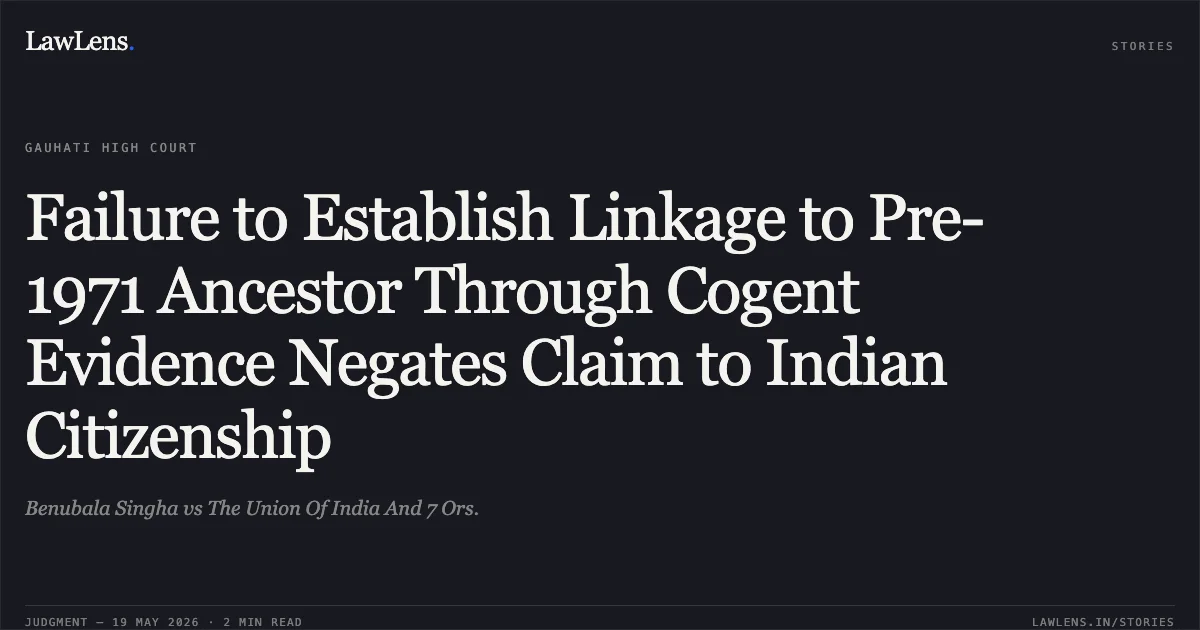
The petitioner challenged an opinion dated 29.06.2019 passed by the Foreigners’ Tribunal-II, Lakhimpur, which declared her a foreigner of the post-25.03.1971 stream
Source reference: p. 2The petitioner claimed citizenship by paternal descent, asserting her grandfather (Adhir Chandra Sinha) and grandmother (Malati Sinha) appeared in the 1966 and 1970 voters' lists for Dhakuakhana LAC
Source reference: p. 3She relied on revenue receipts from 1966 to 2014, a school transfer certificate of her father (Abhiram Sinha) dated 1971, a Gaon Panchayat certificate, and her own inclusion in the 2009 and 2019 voters' lists
Source reference: p. 4-7The Tribunal rejected her claim citing significant discrepancies in names, ages, and a failure to establish a continuous link between the generations
Source reference: p. 9-10Issues
1. Whether the petitioner discharged the burden of proof to establish her citizenship and linkage to her projected ancestors under Section 9 of the Foreigners Act, 1946
Source reference: p. 15 / para. 152. Whether the documents produced (voters' lists, revenue receipts, and certificates) were sufficient and legally proved to establish the petitioner's identity and descent
Source reference: p. 13-14 / para. 12-14Law Applied
Under Section 9 of the Foreigners Act, 1946, the burden of proving that a person is not a foreigner lies upon that person
Source reference: p. 15The court applied the principle that documents like PAN cards, Aadhar cards, or Voter IDs are for identification/services and do not autonomously confer citizenship, as held in Md. Babul Islam v. Union of India
Source reference: p. 14certificates issued by private or local authorities (e.g., School or Panchayat certificates) must be proved by examining the author to verify the contents
Source reference: p. 14the court noted that certiorari jurisdiction under Article 226 is supervisory, not appellate
Source reference: p. 16Reasoning
The court found the petitioner failed to bridge the linkage gap between her projected father and grandfather. While she appeared with her father in the 2009 voters’ list, her grandfather appeared in a separate list with a different house number (166 vs. 131), and no evidence explained this separation
Source reference: p. 12There was a 43-year evidentiary gap (1966 to 2009) where the grandparents did not appear as voters
Source reference: p. 9Revenue receipts failed to establish linkage because the land descriptions differed between the generations, and there were significant gaps in payment records
Source reference: p. 13The father’s school certificate and the Panchayat certificate were deemed inadmissible because their authors were not examined to prove the contents
Source reference: p. 14Additionally, the father only first appeared as a voter at age 48 in 2005, which weakened the claim of continuous residency
Source reference: p. 13Holding
The court Answered the issues in the negative, holding that the petitioner failed to discharge the burden of proof under Section 9 of the Foreigners Act.
The writ petition was dismissed, the petitioner was affirmed as a foreigner of the post-1971 stream, and the records were returned for further legal action
Source reference: p. 16Acts & Sections Cited
2 provisions across 2 statutes referred to in this judgment. Linked provisions open on LawLens.
Foreigners Act, 19461
Foreigners (Tribunals) Order, 19641
Original Court PDF
Benubala SinghavsThe Union Of India And 7 Ors.
Click to open original judgment
Original judgment, available to read, download and summarize on LawLens.in