Facts
The petitioner, Insan Ali, was referred to the Foreigners’ Tribunal No. 5th, Morigaon, by the Superintendent of Police (B), Morigaon, on suspicion of having entered India (Assam) after the cutoff date of March 25, 1971
Source reference: p. 3The petitioner claimed Indian citizenship by birth, asserting that his father, Nurul Islam (@ Nurul), was enlisted in the voters’ lists of 1965 and 1970 in the Lahorighat Constituency
Source reference: p. 3The petitioner relied on the 1989 voters' list, a Gaonburah certificate, and a Panchayat certificate to establish his linkage to his father
Source reference: p. 4-5By an opinion dated July 26, 2016, the Tribunal declared the petitioner a foreigner of the post-1971 stream due to discrepancies in names, lack of corroborating evidence for his residency, and failure to prove linkage
Source reference: p. 5-6The petitioner challenged this opinion via the present writ petition
Source reference: p. 3Issues
1. Whether the PETITIONER proved his citizenship and his linkage to his projected father, who was listed in the pre-1971 voters’ lists, in accordance with the requirements of the Foreigners Act, 1946
Source reference: p. 5/92. Whether the findings of the Foreigners’ Tribunal were perverse or characterized by errors of law warranting interference under Article 226
Source reference: p. 9/10Law Applied
The court applied Section 9 of the Foreigners Act, 1946, which places the burden of proving citizenship upon the person so claiming
Source reference: p. 10It relied on the precedent in Rashminara Begum v. Union of India (2017) regarding the necessity of comprehensive pleadings in the written statement
Source reference: p. 6, 7For the admissibility of certificates, the court applied the principles from Romila Khatun v. Union of India (2018) and Alekjan Begum v. Union of India (2019), which establish that certificates (from Gaonburah or Panchayat) must be proved in two stages: authenticity of the document and proof of its contents through the examination of the author
Source reference: p. 8, 9Finally, the court applied the standard of Certiorari jurisdiction, emphasizing that writ courts exercise supervisory rather than appellate jurisdiction over Tribunal findings of fact
Source reference: p. 10Reasoning
The Court found that the petitioner failed to discharge his burden of proof due to multiple irreconcilable discrepancies. First, the petitioner's own testimony contradicted his witness (DW-2) regarding the existence of siblings and the ownership of landed property
Source reference: p. 9Second, there was a significant gap in the electoral record; although the petitioner claimed his father voted in 1965/1970, the petitioner did not appear in any voters’ list until 1989, despite reaching majority around 1979
Source reference: p. 7Third, the Court rejected the Gaonburah and Panchayat certificates (Exhibits Gha and Unga) as the petitioner failed to examine the authors of these documents, rendering the contents unproven and the certificates inadmissible for establishing linkage
Source reference: p. 8-9Lastly, discrepancies in the spelling of the father's name across different voters' lists (Nural Islam vs. Nurul Islam vs. Nurislam) remained unexplained in the pleadings
Source reference: p. 7Holding
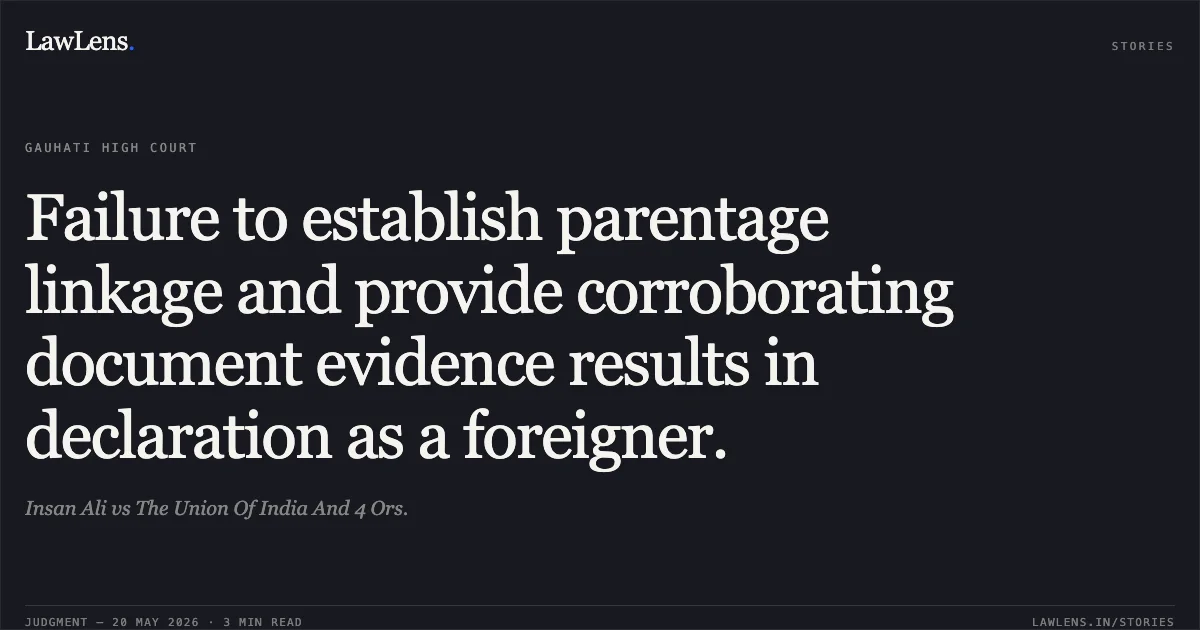
The Court answered the issues against the petitioner, holding that he failed to establish a reliable linkage to his projected father or prove his Indian citizenship.
The Court held that the Tribunal’s findings were based on a proper appreciation of evidence and did not suffer from legal infirmity. Consequently, the writ petition was dismissed, and the Tribunal's opinion declaring the petitioner a foreigner of the post-March 25, 1971 stream was upheld.
Source reference: p. 10The Court directed the records to be returned to the Tribunal for consequential action in accordance with law
Source reference: p. 11Acts & Sections Cited
1 provisions across 1 statute referred to in this judgment. Linked provisions open on LawLens.
Foreigners Act, 19461
Original Court PDF
Insan AlivsThe Union Of India And 4 Ors.
Click to open original judgment
Original judgment, available to read, download and summarize on LawLens.in