Facts
The deceased, Chandulal Rawal, committed suicide by hanging between 10.10.2006 and 11.10.2006
Source reference: p. 1-2An Accidental Death (A.D.) entry was registered on 11.10.2006 upon information by Manishbhai Rawal
Source reference: p. 6Eight days later, the complainant (another nephew) filed an FIR alleging that the respondent-accused had lent money to the deceased and was harassing/threatening him for repayment, driving him to suicide
Source reference: p. 2, 7During the inquest, a handwritten chit was allegedly found in the deceased’s pocket naming the accused
Source reference: p. 6The Trial Court acquitted the accused on 29.05.2009, citing lack of evidence and investigative lapses
Source reference: p. 2Issues
1. Whether the prosecution proved a direct and proximate nexus between the accused’s conduct and the deceased's suicide to satisfy the requirements of Section 306 IPC?
Source reference: p. 5, 132. Whether the delay in filing the FIR and the non-examination of material witnesses (wife/daughter) proved fatal to the prosecution's case?
Source reference: p. 8-93. Whether the Trial Court’s acquittal was perverse or contrary to the evidence on record?
Source reference: p. 5, 12Law Applied
Section 306 of the IPC regarding abetment of suicide
Source reference: p. 14Section 107 of the IPC, which defines abetment as instigating, engaging in conspiracy, or intentionally aiding an act
Source reference: p. 15Chandrappa v. State of Karnataka and Rajesh Prasad v. State of Bihar to establish that in appeals against acquittal, there is a "double presumption" of innocence, and the Appellate Court should not interfere unless the Trial Court’s view is perverse or manifest error exists
Source reference: p. 16-18Ramesh Kumar v. State of Chhattisgarh regarding the necessity of a proximate nexus for instigation
Source reference: p. 15Reasoning
The Court observed that despite the police allegedly finding a suicide note on 11.10.2006, they failed to register a cognizable offense for eight days without a valid explanation
Source reference: p. 7, 10The Investigating Officer admitted that the alleged suicide note was never sent to a handwriting expert or FSL for verification against the deceased's admitted handwriting
Source reference: p. 9-10Critically, the prosecution failed to examine the wife and daughter of the deceased, who were the most natural witnesses to the alleged harassment
Source reference: p. 9The Court reasoned that a mere demand for repayment of a loan does not, by itself, constitute "instigation" under Section 107 IPC
Source reference: p. 13-14There was no evidence of any immediate or proximate act of intimidation that left the deceased with no alternative but suicide
Source reference: p. 13Holding
The High Court dismissed the appeal and confirmed the Trial Court's judgment of acquittal
The Court held that the prosecution miserably failed to prove the ingredients of Section 306 IPC beyond a reasonable doubt
Source reference: p. 20It concluded that the Trial Court’s findings were based on a proper appreciation of evidence, specifically noting that investigative "tendencies" to suppress independent evidence and the failure to verify the suicide note created significant doubt
Source reference: p. 11, 20The bail bond was ordered cancelled
Source reference: p. 20Acts & Sections Cited
5 provisions across 2 statutes referred to in this judgment. Each provision opens on LawLens.
Code of Criminal Procedure, 19731
Indian Penal Code, 18604
Original Court PDF
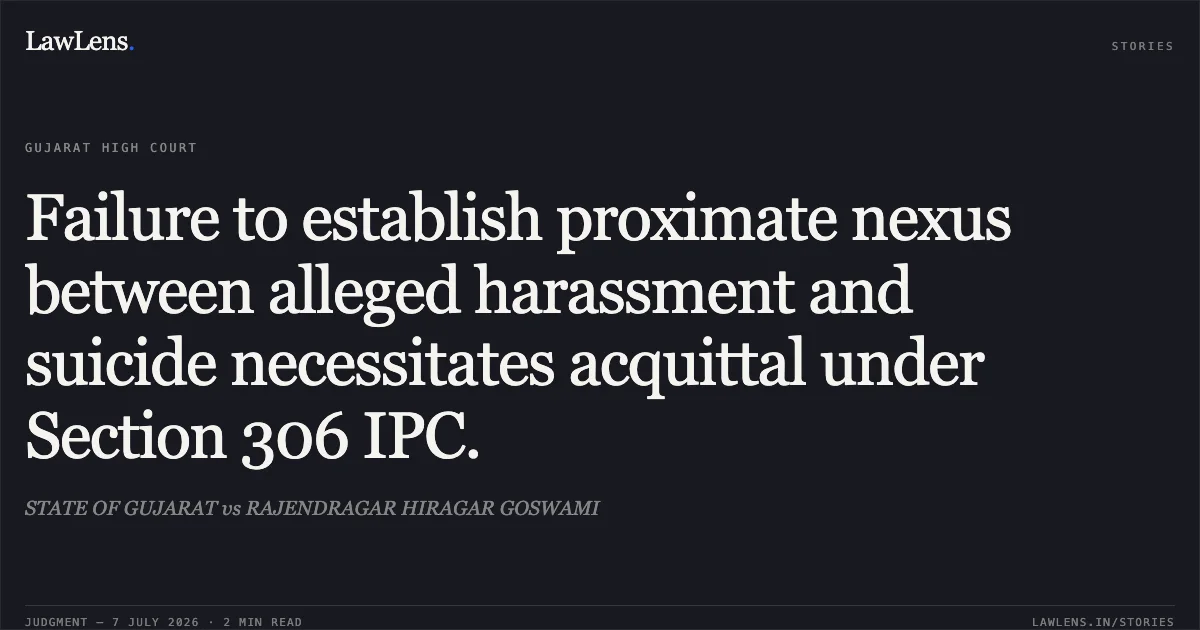
STATE OF GUJARATvsRAJENDRAGAR HIRAGAR GOSWAMI
Click to open original judgment
Original judgment, available to read, download and summarize on LawLens.in