Facts
On 7 December 2017, acting on secret information that the appellant was storing and selling liquor illegally, a raiding party searched his house and allegedly recovered 90 pouches of country-made liquor, each containing 200 ml., totalling 18 litres.
Source reference: para. 3The appellant was arrested and Nawada Town P.S. Case No. 842 of 2017 was registered.
Source reference: para. 3The prosecution examined six witnesses. The informant and another raiding-party member supported the recovery, but the latter admitted that he remained outside the room from which the liquor was allegedly recovered.
Source reference: para. 4The seizure-list witnesses admitted that they had not witnessed the actual recovery.
Source reference: para. 4The Investigating Officer admitted that the seized liquor was sealed only in Court and not at the place of seizure or at the police station.
Source reference: para. 4The defence examined two neighbouring witnesses who denied that any raid had taken place at the appellant’s house.
Source reference: para. 5The trial court convicted the appellant under Section 30(a) of the Bihar Prohibition and Excise Act and sentenced him to ten years’ rigorous imprisonment, a fine of ₹1,00,000, and three months’ simple imprisonment in default of payment of fine.
Source reference: para. 2Issues
Whether the prosecution proved beyond reasonable doubt that the alleged liquor was recovered from the conscious possession of the appellant?
Source reference: paras. 7, 9, 11, 14Whether the absence of independent local witnesses and the doubtful presence of the seizure-list witnesses rendered the alleged search and seizure unreliable?
Source reference: paras. 9, 12, 15Whether the prosecution established the identity, integrity, and complete chain of custody of the seized liquor when it was not sealed at the spot or at the police station and was sealed only before the Court?
Source reference: paras. 10, 14, 16Whether the seizure list’s reference to the date of institution of the FIR created doubt regarding the sequence of the search, seizure, and registration of the case?
Source reference: para. 13Law Applied
The Court applied Section 30(a) of the Bihar Prohibition and Excise Act, under which the prosecution was required to prove the unlawful possession or recovery of liquor beyond reasonable doubt.
Source reference: para. 2It applied the settled criminal-law principle that the burden remains on the prosecution and that the accused is entitled to the benefit of every reasonable doubt.
Source reference: paras. 14, 16The Court further held that in cases based on recovery of contraband or liquor, the prosecution must establish not only the fact of seizure but also the identity, safe custody, and integrity of the seized articles, thereby excluding the possibility of tampering or substitution.
Source reference: para. 10Relying on State of Rajasthan v. Daulat Ram, (1980) 3 SCC 303, the Court reiterated that the prosecution must prove the complete chain of custody and the integrity of the seals from seizure until examination or production before the Court.
Source reference: para. 10Although official witnesses cannot be disbelieved merely because of their official status, their evidence must still be scrutinised where material gaps exist in the proof of recovery and custody.
Source reference: para. 15Reasoning
The Court found that the prosecution evidence did not reliably establish the alleged recovery from the appellant’s conscious possession.
Source reference: para. 9No independent local witness was examined, while the seizure-list witnesses were not local residents and admitted that they had not witnessed the recovery.
Source reference: para. 9The evidence of the second raiding-party member was also limited because he remained outside the room and did not personally see the recovery.
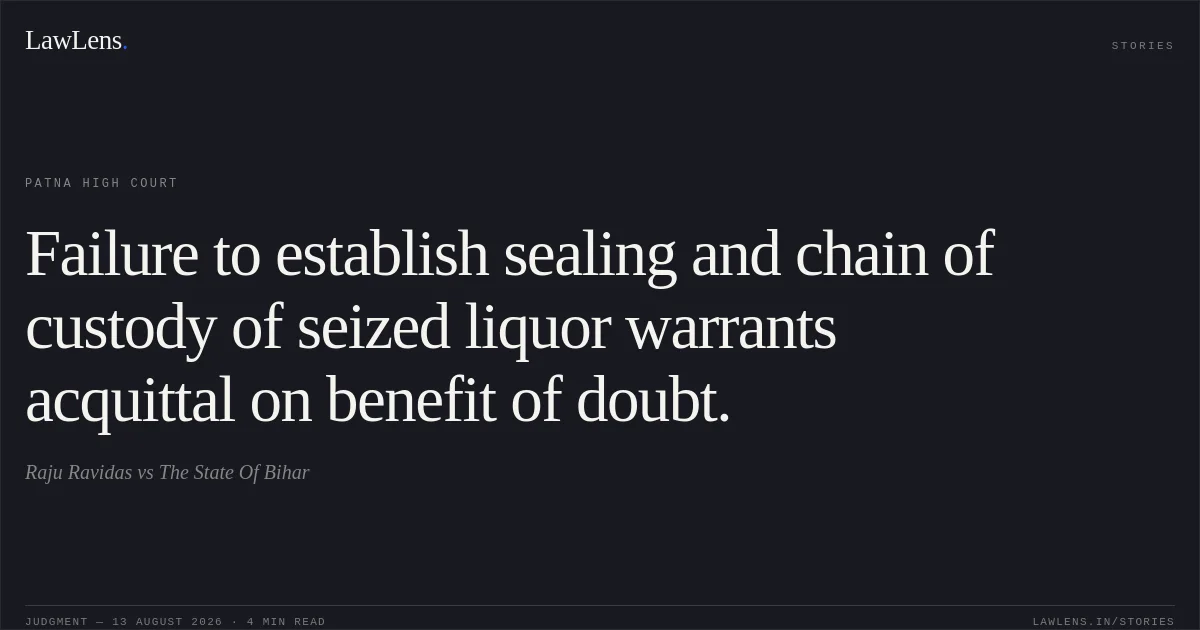
Source reference: para. 11Most significantly, the liquor was not sealed either at the place of seizure or at the police station and was sealed only before the Court.
Source reference: paras. 10, 14, 16The prosecution therefore failed to explain how the seized articles were preserved and kept secure, leaving an unexplained break in the chain of custody and a possibility of tampering or substitution.
Source reference: paras. 10, 14, 16The seizure list’s reference to the date of institution of the FIR further created doubt regarding the sequence of events, particularly when considered with the other deficiencies.
Source reference: para. 13The defence evidence denying the raid assumed significance because the prosecution had failed to produce reliable independent corroboration.
Source reference: para. 12Cumulatively, these infirmities went to the root of the prosecution case and were not merely technical defects.
Source reference: para. 15Holding
The Court answered the issues in favour of the appellant, holding that the prosecution failed to prove the alleged recovery, conscious possession, and integrity of the seized liquor beyond reasonable doubt.
The judgment of conviction and order of sentence dated 21 December 2017 were set aside.
Source reference: para. 17The appellant was acquitted of the charges and discharged from the liabilities of his bail bond.
Source reference: para. 18The appeal was allowed, and any interlocutory applications were disposed of.
Source reference: paras. 19–20Acts & Sections Cited
1 provisions across 1 statute referred to in this judgment. Each provision opens on LawLens.
BIHAR PROHIBITION AND EXCISE ACT, 20161
Original Court PDF
Raju RavidasvsThe State Of Bihar
Click to open original judgment
Original judgment, available to read, download and summarize on LawLens.in