Facts
On 28 October 1991, a Food Inspector inspected the respondent’s spice shop, “Anil Trading,” and allegedly found approximately 25 kilograms of whole turmeric stored in a jute bag.
Source reference: para. 3After serving notice, he purchased 450 grams of turmeric as a sample, divided it into three portions, sealed them in glass phials, and forwarded one portion to the Public Analyst.
Source reference: para. 3The Public Analyst reported that the sample exceeded the permissible limit of insect-damaged matter and was adulterated.
Source reference: para. 3The respondent was prosecuted under Sections 7 and 16(1)(a)(i) of the Prevention of Food Adulteration Act, 1954, but the Trial Court acquitted him on 5 May 1998 in Case No. 40D of 1991.
Source reference: paras. 1–2The Calcutta Municipal Corporation challenged the acquittal in the present appeal.
Source reference: para. 1The prosecution examined four witnesses, while the defence examined one witness.
Source reference: para. 4Issues
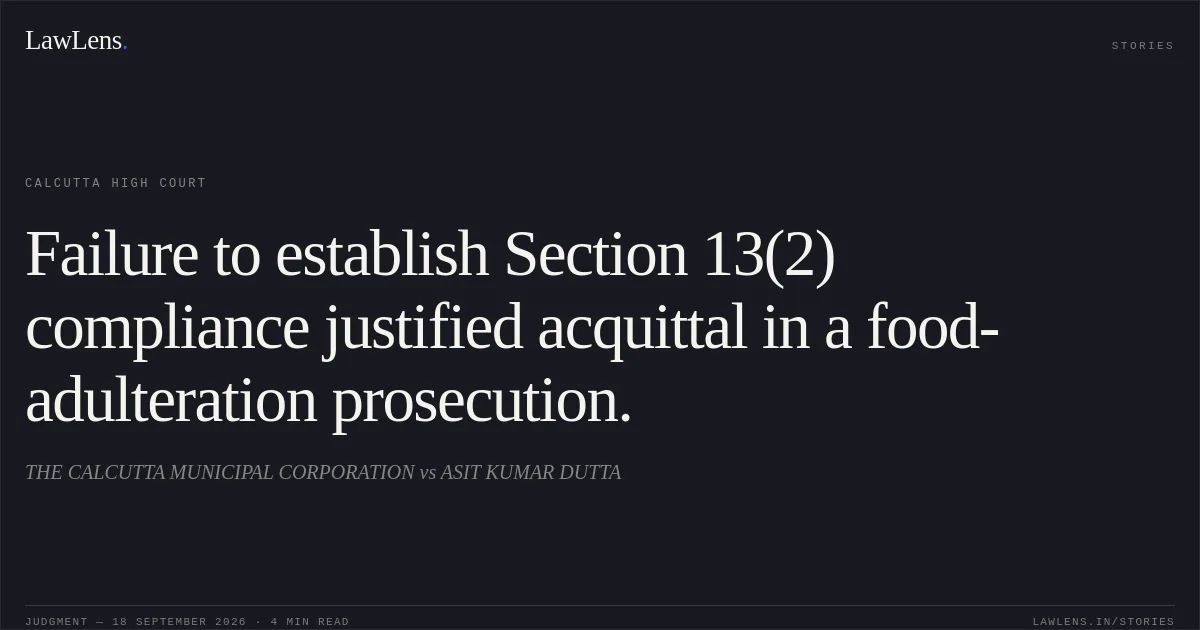
Whether the prosecution established compliance with the statutory requirement under Section 13(2) of the Prevention of Food Adulteration Act, read with Rule 9-A of the Rules, by duly communicating the Public Analyst’s report and the accused’s right to seek examination by the Central Food Laboratory?
Source reference: paras. 24–29Whether the prosecution established proper sealing and dispatch of the sample, including transmission of the memorandum and specimen impression of the seal, as required under Rule 18 of the Prevention of Food Adulteration Rules?
Source reference: para. 30Whether the prosecution proved that the particular turmeric stock from which the sample was taken was stored or exposed for sale for human consumption?
Source reference: paras. 24, 31–33Whether the Trial Court’s order of acquittal was so perverse, illegal, or materially irregular as to warrant interference in an appeal against acquittal?
Source reference: paras. 36–37Law Applied
The Court applied Sections 7 and 16(1)(a)(i) of the Prevention of Food Adulteration Act, 1954, which prohibit the sale of adulterated food and prescribe punishment for such contravention.
Source reference: paras. 1–2Section 13(2), read with Rule 9-A of the Prevention of Food Adulteration Rules, requires the prosecution authorities to communicate the Public Analyst’s report to the accused and inform him of the statutory right to have the counterpart sample examined by the Central Food Laboratory; this safeguard is substantive because it enables the accused to challenge the analyst’s opinion.
Source reference: paras. 25–29Rule 18 requires proper sealing and transmission of the memorandum and specimen impression of the seal so as to preserve the identity and integrity of the sample and prevent tampering or substitution.
Source reference: para. 30The prosecution must also establish that the sampled article was stored or exposed for sale for human consumption, and in an appeal against acquittal, appellate interference is justified only where the Trial Court’s view is perverse, illegal, or otherwise unsustainable; a reasonably possible view favouring acquittal should not be disturbed.
Source reference: paras. 31, 36–37Reasoning
The Court held that the prosecution failed to prove actual communication of the Public Analyst’s report to the respondent.
Source reference: paras. 27–29No acknowledgement card or other reliable proof of service was produced, and PW2 admitted that he did not know whether the report had actually been served or whether any inquiry had been made with the postal authorities regarding non-receipt of the acknowledgement.
Source reference: paras. 27–29The Court also found an unexplained deficiency in Exhibit-6, the peon book entry, which did not satisfactorily establish that the memorandum and specimen seal impression had been sent to the Public Analyst in the prescribed sealed manner, thereby affecting the integrity of the sample.
Source reference: para. 30Further, PW4 stated that the bag from which the sample was taken was not kept at the sale counter, while PW2 acknowledged that whole turmeric was an agricultural product and that several bags were present in the shop.
Source reference: paras. 31–33These circumstances created reasonable doubt whether the particular stock had been exposed or intended for sale for human consumption.
Source reference: paras. 31–33Although Exhibit-10 reported adulteration, the Public Analyst’s report could not cure the foundational defects relating to statutory safeguards, sample integrity, and proof of sale exposure.
Source reference: para. 34Since the Trial Court’s view was reasonably possible on the evidence, the appellate court declined to substitute its own view merely because another view could be taken.
Source reference: paras. 35–37Holding
The Court answered the issues against the prosecution.
It held that compliance with Section 13(2), read with Rule 9-A, and Rule 18 had not been satisfactorily established, and that reasonable doubt also existed regarding whether the sampled turmeric was exposed or intended for sale for human consumption.
Source reference: paras. 35–37The Trial Court’s acquittal was therefore neither perverse nor legally unsustainable.
Source reference: paras. 35–37The appeal was dismissed, and the judgment and order of acquittal dated 5 May 1998 in Case No. 40D of 1991 were affirmed.
Source reference: paras. 38–40A copy of the judgment was directed to be transmitted to the Trial Court along with the Trial Court Records.
Source reference: para. 41Acts & Sections Cited
3 provisions across 1 statute referred to in this judgment. Linked provisions open on LawLens.
Prevention Of Food Adulteration Act, 19543
Original Court PDF
THE CALCUTTA MUNICIPAL CORPORATIONvsASIT KUMAR DUTTA
Click to open original judgment
Original judgment, available to read, download and summarize on LawLens.in