01Facts
The Appellant was convicted by the Trial Court on November 16, 2017, for the rape and murder of a 14-year-old girl under Sections 302, 376, and 201 of the IPC.
¶ 1On October 30, 2011, the deceased went to collect fodder and did not return; her body was later recovered from a pond.
¶ 2-3The prosecution’s case rested on the "last seen" testimony of PW2, the recovery of the Appellant’s driving license and mobile phone at the scene, and DNA profiling connecting the Appellant to the biological material on the deceased.
¶ 3, 4, 9The Appellant challenged the conviction, citing a broken chain of circumstantial evidence, hostile witnesses, and procedural lapses in DNA handling.
¶ 20-2402Issues
i.1. Whether the prosecution successfully established the "last seen" circumstance through the testimony of PW2.
¶ 35-36ii.2. Whether the recoveries of the driving license, mobile phone, and clothes were proved in accordance with law to serve as incriminating evidence.
¶ 42iii.3. Whether the DNA and medical evidence conclusively connected the Appellant to the crime, given the absence of a documented chain of custody.
¶ 54iv.4. Whether the cumulative circumstances formed an unbroken chain excluding any hypothesis of innocence.
¶ 35, 6403Law Applied
The Court applied the foundational principles of circumstantial evidence, requiring an unbroken chain of events as established in Subhash Chand v. State of Rajasthan.
¶ 49It applied Sections 302 (Murder), 376 (Rape), and 201 (Causing disappearance of evidence) of the IPC.
¶ 1Regarding scientific evidence, the Court relied on the mandatory DNA handling guidelines from Attavellai @ Devakar v. State of Tamil Nadu (2025 INSC 845) and Rahul v. State of Delhi, asserting that DNA reports are not ipso facto evidence without proving technical reliability and custody.
¶ 24, 58The Court also referenced State of U.P. v. Kishanpal regarding the scrutiny of "interested witnesses".
¶ 36Provisions in the judgment · 8 · Linked ones open on LawLens
Indian Penal Code, 1860 Section 302Section 376Section 201
Code of Criminal Procedure, 1973 Section 374Section 161Section 293Section 313Section 437
04Reasoning
The Court found the "last seen" theory unsubstantiated because the only supporting witness (PW2) was a relative whose testimony contained material contradictions, while the other witness (PW3) turned hostile.
¶ 38-41The alleged recoveries were deemed unreliable: independent witnesses were either withheld or turned hostile (PW5), and the police failed to link the recovered mobile phone to the Appellant through call records or SIM ownership (PW6).
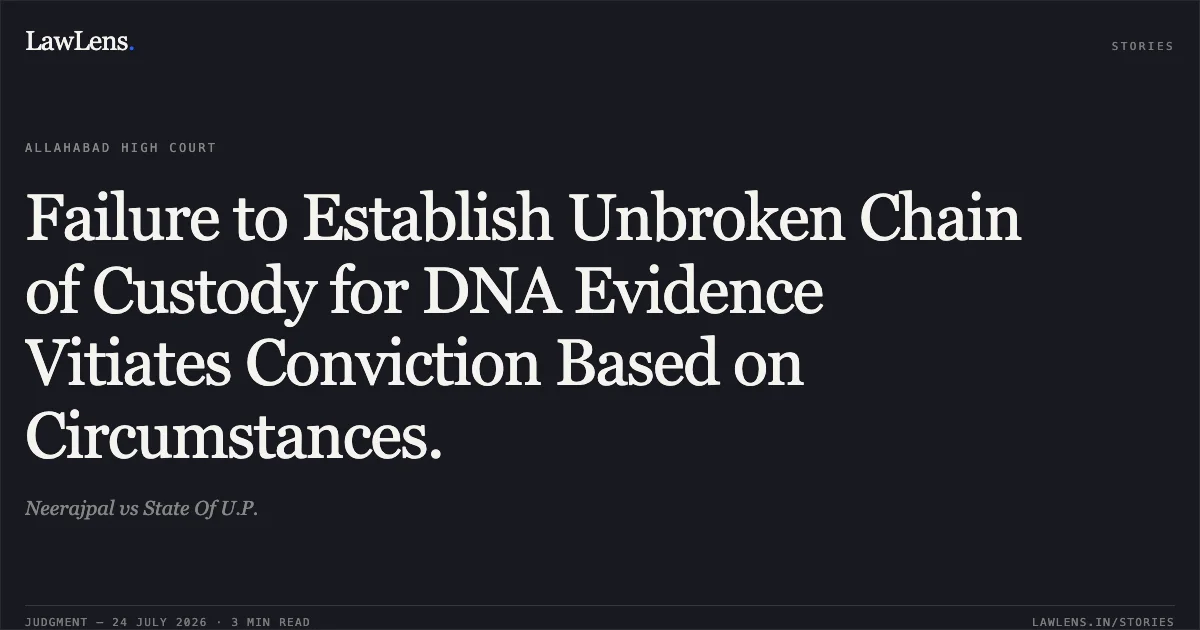
¶ 44-47The Court highlighted a "laconic trial procedure" regarding the DNA evidence: the sample drawer was not examined, the chain of custody from the police Maalkhana to the FSL was not established, and the DNA expert was never called to testify to explain the technical findings.
¶ 57-60The Court noted that a supplementary DNA report produced during the appeal could not be accepted without remanding the case, which would cause undue prejudice to the Appellant who had already served 14 years.
¶ 60-6105Holding
The Court held that the prosecution failed to establish a complete and unbroken chain of circumstantial evidence as the "last seen" circumstance remained unproved, the recoveries were doubtful, and the scientific evidence was vitiated by procedural lapses.
¶ 67-72The Court allowed the appeal, set aside the judgment dated November 16, 2017, acquitted Neerajpal of all charges by extending the benefit of doubt, ordered his immediate release, and directed the State’s DGP and Director of Prosecution to ensure future compliance with DNA evidence protocols.
¶ 74, 75, 78-79Original Court PDF
NeerajpalvsState Of U.P.
Click to open original judgment
Original judgment, available to read, download and summarize on LawLens.in