Facts
The prosecution alleged that on 28 April 1982, the appellant and other accused persons, armed with weapons, entered a bamboo clump and began cutting bamboo. When the informant’s brother, Harendra Dubey, protested, the appellant allegedly inflicted a bhala injury on his stomach, while the other accused assaulted him with lathis.
Source reference: para. 3; p. 2On the basis of the informant’s fardbeyan, Pakri Dayal P.S. Case No. 66 of 1982 was instituted under Sections 147, 148, 149, 447, 323, 324, 326 and 307 of the Indian Penal Code (“IPC”).
Source reference: para. 4; p. 2At trial, seven prosecution witnesses were examined; two witnesses turned hostile, one was tendered for cross-examination, and one was a formal witness.
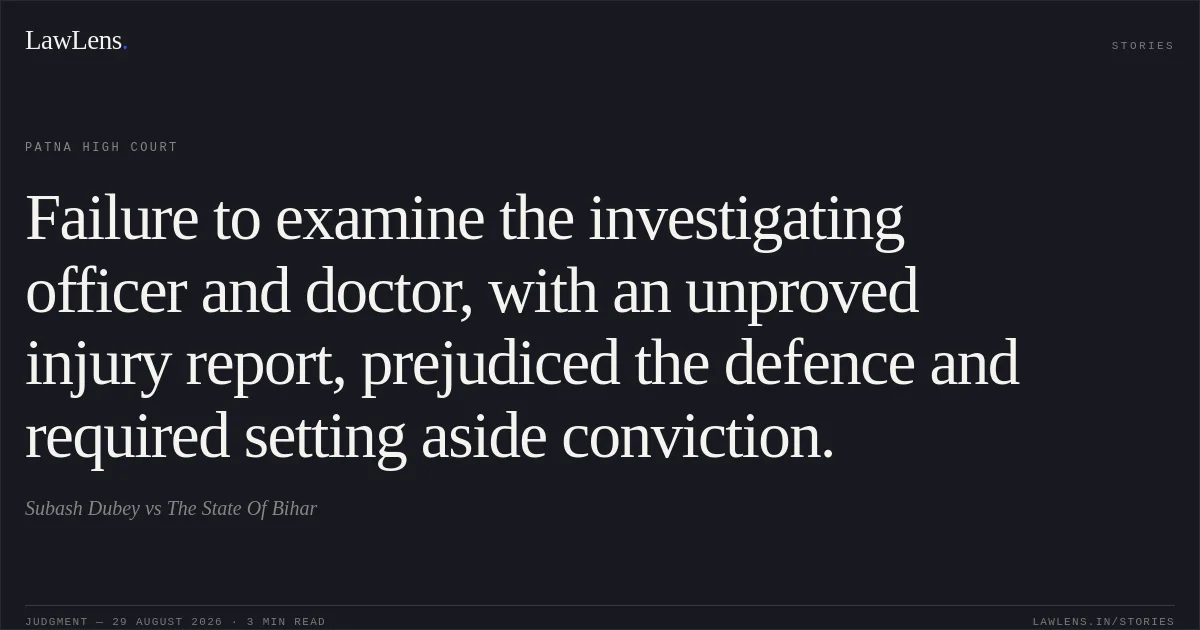
Source reference: para. 5; p. 3The investigating officer and the doctor were not examined, and the alleged injury report was not exhibited.
Source reference: para. 6; p. 3The trial court convicted the appellant under Sections 324 and 148 IPC and sentenced him to rigorous imprisonment for two years and one year, respectively, with the sentences arising from the judgment dated 14 September 2018.
Source reference: para. 2; p. 1The appellant challenged the conviction on the grounds of evidentiary deficiencies, non-examination of material witnesses, and alleged partisan testimony arising from a land dispute between the parties.
Source reference: para. 6; p. 3Issues
Whether the appellant’s conviction under Sections 324 and 148 IPC could be sustained when the investigating officer and doctor were not examined and the injury report was not exhibited.
Source reference: paras. 6, 8; pp. 3–4Whether the evidence of the informant, the injured witness, and the alleged eyewitness was sufficient to prove the prosecution case beyond reasonable doubt despite hostile or non-supporting witnesses and contradictions regarding the alleged eyewitness’s presence.
Source reference: paras. 5–6, 8; pp. 3–4Whether the trial court erred in convicting the appellant on the available evidence, thereby warranting interference in appeal.
Source reference: para. 8; p. 4Law Applied
The court applied Sections 324 and 148 IPC, concerning voluntarily causing hurt by a dangerous weapon and rioting while armed with a deadly weapon, respectively.
Source reference: para. 2; p. 1The court further applied the general criminal-law principle that the prosecution must establish the ingredients of the charged offences through reliable and legally admissible evidence, and that material omissions or failures in proof which cause prejudice to the defence may undermine a conviction.
Source reference: no citationProof of the alleged bodily injury and its nature was material to the charge under Section 324 IPC, while the prosecution was required to establish the appellant’s participation in the armed unlawful assembly for Section 148 IPC.
Source reference: paras. 3, 8; pp. 2, 4–5No judicial precedent was cited in the judgment.
Source reference: no citationReasoning
The High Court held that the prosecution case substantially rested on the testimony of the informant, the injured witness, and P.W.5, while other witnesses either turned hostile, were merely tendered, or were formal witnesses.
Source reference: paras. 5–6; pp. 3–4The investigating officer’s non-examination deprived the defence of an opportunity to test material aspects of the investigation, and the doctor’s non-examination, coupled with the absence of an exhibited injury report, left the alleged bhala injury insufficiently corroborated.
Source reference: para. 8; pp. 4–5The court also noted the parties’ admitted land dispute and the fact that P.W.5’s cross-examination cast doubt on whether he had actually witnessed the assault, since he stated that he saw a person lying on the ground when he reached the bamboo clump.
Source reference: para. 6; p. 3In these circumstances, the High Court concluded that the trial court had erred in sustaining the conviction solely on the testimony of interested or inadequately corroborated witnesses, and that the defence had been seriously prejudiced by the prosecution’s failure to examine material witnesses and prove the injury report.
Source reference: para. 8; pp. 4–5Holding
The High Court answered the issues in favour of the appellant and held that the conviction and sentences under Sections 324 and 148 IPC could not be sustained.
The judgment of conviction and sentence dated 14 September 2018 was set aside, the appeal was allowed, and the appellant was discharged from the liability of his bail bond in the present case.
Source reference: paras. 9–10; p. 5Acts & Sections Cited
8 provisions across 1 statute referred to in this judgment. Each provision opens on LawLens.
Indian Penal Code, 18608
Original Court PDF
Subash DubeyvsThe State Of Bihar
Click to open original judgment
Original judgment, available to read, download and summarize on LawLens.in