Facts
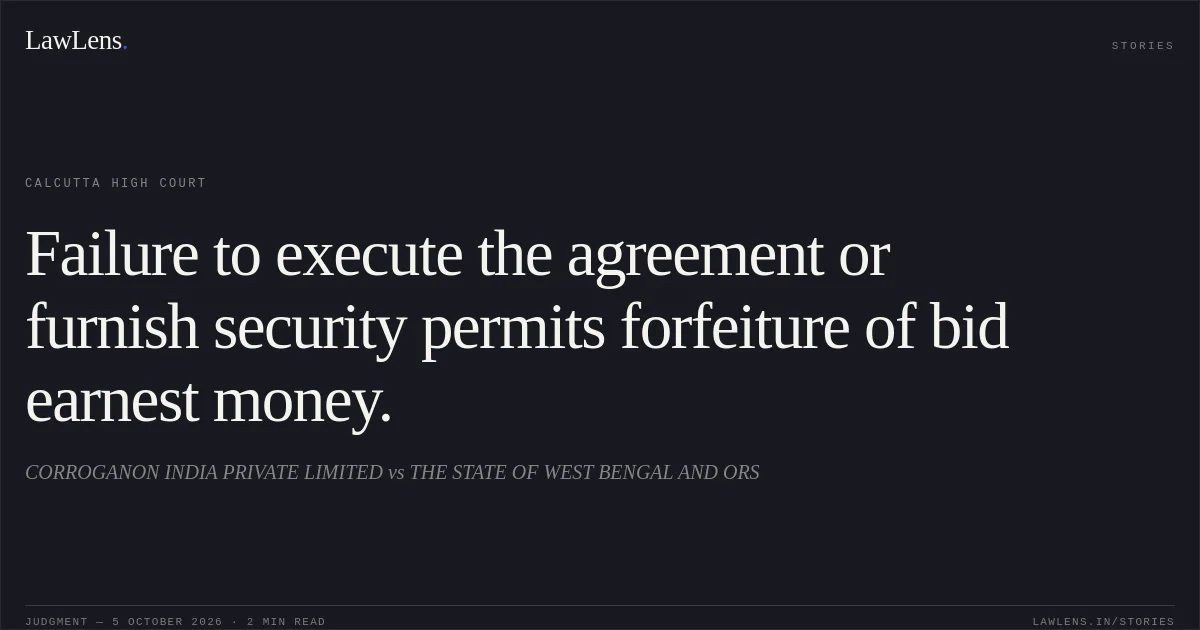
The Hooghly River Bridge Commissioners invited e-tenders for construction of two flyovers, and the petitioner submitted an EMD of ₹73,97,650.
Source reference: pp. 2–5, paras. 2(i)–(v)After the petitioner was declared the successful bidder, the Commissioners issued a letter of acceptance-cum-work order on 18 November 2016.
Source reference: pp. 2–5, paras. 2(i)–(v)The petitioner then sought to withdraw from the tender on 5 December 2016, having neither furnished performance security nor executed the agreement.
Source reference: pp. 2–5, paras. 2(i)–(v)The Commissioners terminated the award on 7 December 2016, invoking the tender conditions.
Source reference: pp. 2–5, paras. 2(i)–(v)Following unsuccessful requests for refund, the petitioner challenged the Commissioners’ memo dated 2 December 2021 forfeiting the EMD.
Source reference: pp. 2–5, paras. 15–17Issues
1. Whether the Commissioners were entitled under the Instructions to Bidders to forfeit the petitioner’s EMD after it failed to execute the agreement and furnish performance security.
Source reference: pp. 11–12, paras. 17–182. Whether Section 74 of the Indian Contract Act, 1872 governed the forfeiture and required the Commissioners to establish loss or damages.
Source reference: p. 12, para. 18Law Applied
Clause 15.6 of the Instructions to Bidders permitted forfeiture of bid security where a successful bidder failed to sign the agreement or furnish performance security; Clauses 31–33 required execution of the agreement and performance security and treated non-compliance as grounds for annulment and forfeiture.
Source reference: p. 8, para. 14The Court relied on National Highways Authority of India v. Ganga Enterprises, (2003) 7 SCC 410; State of Haryana v. Malik Traders, (2011) 13 SCC 200; and National Thermal Power Corporation Ltd. v. Ashok Kumar Singh, (2015) 4 SCC 252, for the principle that a bidder who agrees to forfeiture of bid security upon specified non-performance cannot claim its return merely because the bidder could withdraw or failed to proceed with the contract.
Source reference: pp. 12–16, paras. 19–22, 25The Court held that Section 74 did not apply to the bid-security forfeiture in the circumstances of this case.
Source reference: pp. 12–16, paras. 19–22, 25Reasoning
The letter of acceptance was both acceptance of the petitioner’s bid and a formal work order, subject to the requirements of furnishing performance security and signing the agreement.
Source reference: pp. 10–11, paras. 15–17The petitioner did neither and instead sought to step down from the tender; the Commissioners then terminated the award under the tender conditions.
Source reference: pp. 10–11, paras. 15–17The Court concluded that the forfeiture fell within the express terms of Clauses 15.6 and 33 and was consistent with the Supreme Court authorities on bid security.
Source reference: pp. 10–11, paras. 15–17; pp. 16–18, paras. 22–25It distinguished the petitioner’s cited decisions, including Kailash Nath Associates v. DDA, because those cases did not govern the specific contractual forfeiture of bid security at issue here.
Source reference: pp. 16–18, paras. 22–25Holding
The Court answered the forfeiture issue in the Commissioners’ favour and held that Section 74 did not entitle the petitioner to recover the EMD.
Finding no merit in the writ petition, it dismissed the petition, vacated any interim order, dismissed pending interlocutory applications, and made no order as to costs.
Source reference: pp. 18–19, paras. 25–30Acts & Sections Cited
3 provisions across 2 statutes referred to in this judgment. Each provision opens on LawLens.
Indian Contract Act, 18722
Limitation Act, 19631
Original Court PDF
CORROGANON INDIA PRIVATE LIMITEDvsTHE STATE OF WEST BENGAL AND ORS
Click to open original judgment
Original judgment, available to read, download and summarize on LawLens.in