Facts
Respondent No. 2, an employee of the State Bank of India posted as Special Assistant/Cash Officer at Pirpainti Branch, was alleged to have fraudulently withdrawn amounts from several bank accounts, causing an alleged loss of ₹5,69,000 to the Bank.
Source reference: pp. 3–6The Bank initiated disciplinary proceedings, conducted an ex parte enquiry, and removed him from service on 28 July 2012 after the Enquiry Officer found the principal charges proved.
Source reference: pp. 3–6The workman challenged the removal under Section 2A of the Industrial Disputes Act, 1947, before the Central Government Industrial Tribunal No. 1, Dhanbad.
Source reference: pp. 6–8The Tribunal first held the domestic enquiry improper by order dated 27 January 2016 and thereafter, upon recording fresh evidence, passed an Award dated 12 January 2018 holding the workman not guilty, setting aside the punishment, and directing reinstatement with continuity of service but without back wages.
Source reference: pp. 6–8The Bank filed the present writ petition seeking quashing of both orders and a stay of the Award.
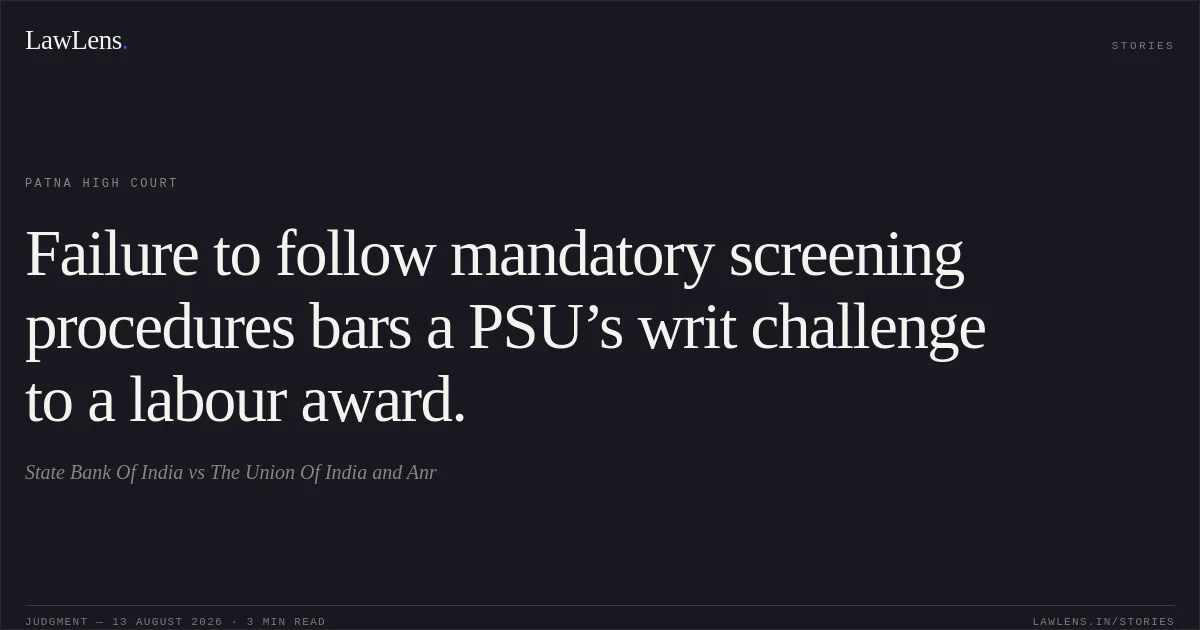
Source reference: pp. 2–3The workman objected that the Bank had not obtained the prior governmental approval required under the applicable screening procedure for public-sector undertakings challenging industrial awards.
Source reference: pp. 8–14Issues
1. Whether the writ petition challenging the CGIT’s Award was maintainable when the Bank had not obtained prior approval under the Government of India’s screening procedure applicable to public-sector undertakings and banks
Source reference: paras. 8–11, 13–172. Whether the Bank’s failure to comply with its own Manual and its omission to disclose material facts disentitled it to relief under Article 226 of the Constitution
Source reference: paras. 12–163. Whether the Tribunal’s findings that the domestic enquiry was improper and that the workman was not guilty were legally sustainable; however, this issue was not examined on merits because the writ petition was dismissed on the preliminary objection.
Source reference: paras. 3–7Law Applied
The Court applied the Government of India’s screening procedure embodied in Memorandum No. 3/25/64-I&E (1-5) dated 8 August 1964, O.M. No. H-52027/8/99-IR (Imp-I) dated 19 March 1999, and Letter No. Z-13025/08/2019-IR (Imp-I) dated 8 November 2019, under which a public-sector undertaking seeking to challenge a labour award was required to refer the matter to its administrative Ministry, followed by consultation with the Law and Labour Ministries, and to obtain governmental approval before instituting proceedings.
Source reference: pp. 14–22The Court also applied the Bank’s own Manual, which required approval from the Government of India and prescribed supporting documents for such a request.
Source reference: pp. 22–23Further, relying on Ramjas Foundation v. Union of India, (2010) 14 SCC 38, the Court held that a litigant who does not approach the Court with complete candour, or suppresses material facts, is not entitled to discretionary relief under Article 226.
Source reference: pp. 23–24Although the 2021 Office Memorandum discontinued the earlier Government screening procedure and required public-sector undertakings to establish their own screening committees, the Court held that the 2018 filing was governed by the instructions operative at that time.
Source reference: pp. 24–25Reasoning
The Bank filed the writ petition in 2018 without demonstrating that prior governmental approval had been obtained. Its subsequent letter dated 20 June 2018 merely showed that approval had been sought after the writ petition was filed; no approval order or follow-up material was produced.
Source reference: para. 13The Bank also failed to forward the nine documents required under its own Manual, having sent only four documents with its request.
Source reference: para. 14The Court further found no pleading or material showing compliance with the then-operative Government screening procedure, including consultation with the administrative Ministry.
Source reference: paras. 15–16Since the writ jurisdiction under Article 226 is discretionary, the Bank’s procedural non-compliance and lack of complete disclosure justified refusal to examine its challenges concerning the domestic enquiry and the Tribunal’s appreciation of evidence.
Source reference: paras. 16–17The subsequent discontinuance of the Government procedure in 2021 did not cure the defect, because the writ petition had been instituted in 2018 when the earlier procedure was in force.
Source reference: paras. 16–17Holding
The Court answered the maintainability and discretionary-relief issues against the Bank.
It held that the Bank had failed to comply with the applicable Government instructions and its own Manual before challenging the CGIT Award and had not approached the Court with the requisite candour.
Source reference: paras. 17–18Consequently, the Court declined to exercise its extraordinary writ jurisdiction and dismissed the writ petition; the pending interlocutory applications, if any, were also disposed of.
Source reference: paras. 17–18The Tribunal’s Award directing reinstatement with continuity of service and without back wages therefore remained undisturbed.
Source reference: paras. 17–18Acts & Sections Cited
2 provisions across 1 statute referred to in this judgment. Each provision opens on LawLens.
Indian Penal Code, 18602
Original Court PDF
State Bank Of IndiavsThe Union Of India and Anr
Click to open original judgment
Original judgment, available to read, download and summarize on LawLens.in