Facts
The plaintiff, Dharani Kumar Deb, claimed ownership of the suit land and house under a registered sale deed dated 6 February 2002.
Source reference: pp. 3–5, paras. 5–6He pleaded that his brother, defendant No. 1 Dayamoy Deb, was permitted to reside there with their mother while the plaintiff was posted elsewhere, but later began occupying the property and running a stationery business; defendant No. 2 was also allegedly conducting a salon from the premises.
Source reference: pp. 3–5, paras. 5–6The plaintiff’s objection led the Hailakandi Municipal Board to revoke defendant No. 1’s trade licence on 4 September 2013.
Source reference: pp. 3–5, paras. 5–6After a legal notice dated 17 October 2015 failed to secure vacant possession, the plaintiff instituted Title Suit No. 28/2016 for eviction and recovery of khas possession.
Source reference: pp. 3–5, paras. 5–6The defendants denied the plaintiff’s case and asserted, inter alia, that defendant No. 1 had entered the property by breaking the lock on 5 April 2002 and had acquired title by adverse possession.
Source reference: pp. 5–6, paras. 5–7The Trial Court decreed the suit on 3 December 2018, and the First Appellate Court affirmed the decree on 31 October 2023.
Source reference: pp. 6–7, paras. 5–6The defendant preferred a regular second appeal under Section 100 CPC.
Source reference: pp. 6–7, paras. 5–6Issues
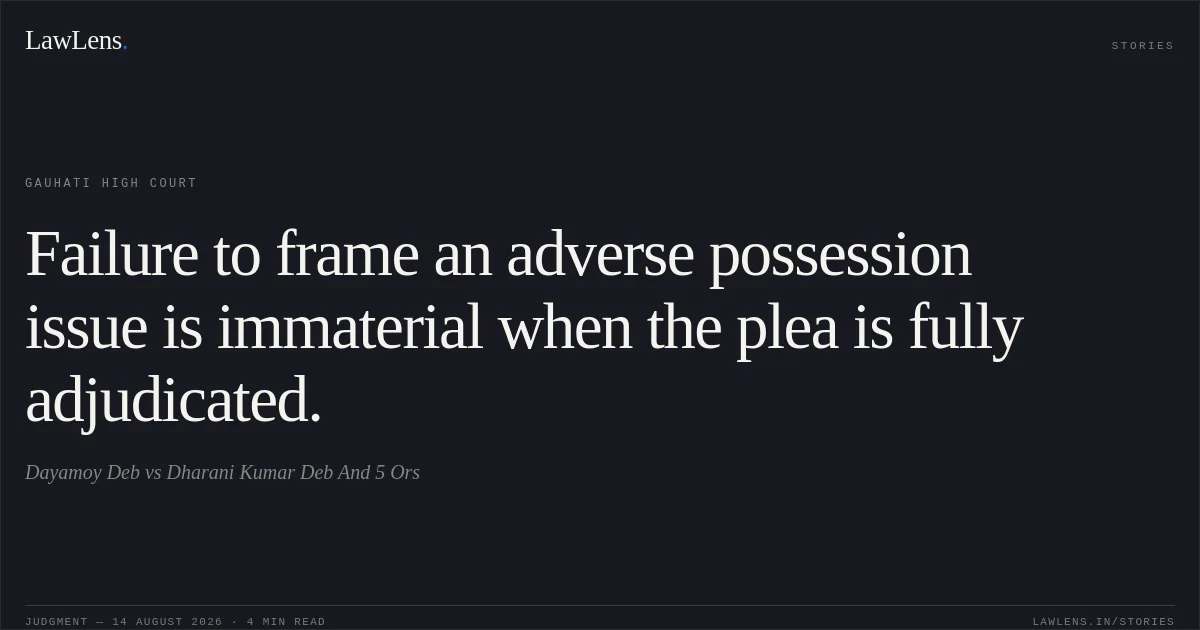
Whether the Trial Court and the First Appellate Court correctly rejected the plea of adverse possession on the basis of the evidence, including Exhibit 4 relating to revocation of the municipal trade licence, despite the Trial Court not framing a separate issue on adverse possession.
Source reference: p. 7, para. 6Whether the failure of the Trial Court to frame a separate issue on adverse possession vitiated the decree when the plea had nevertheless been considered and decided on merits by both courts below.
Source reference: pp. 18–19, paras. 14.1–14.2Law Applied
The Court exercised jurisdiction under Section 100 of the Code of Civil Procedure, under which interference in second appeal is confined to a substantial question of law and concurrent findings of fact are not ordinarily disturbed absent perversity.
Source reference: pp. 20–21, para. 14.6Article 65 of the Limitation Act, 1963 requires continuous, open and hostile possession for twelve years to establish title by adverse possession.
Source reference: p. 18, para. 14.3Relying on Karnataka Board of Wakf v. Government of India, (2004) 10 SCC 779, the Court reiterated the requirements of nec vi, nec clam, nec precario, including continuity, publicity, hostility, exclusive possession and animus possidendi.
Source reference: p. 19, para. 14.3Under T. Anjanappa v. Somalingappa, (2006) 7 SCC 570, mere long possession is insufficient; permissive possession does not become adverse without a clear act of hostility or ouster communicated to, or known by, the true owner.
Source reference: p. 19, para. 14.4The Court also relied on Thiagarajan v. Sri Venugopalaswamy B. Koil, (2004) 5 SCC 762, and allied authorities for the principle that concurrent factual findings based on evidence cannot be re-appreciated in second appeal merely because another view is possible.
Source reference: pp. 20–21, para. 14.6Reasoning
The Court held that although the Trial Court had not framed a distinct issue on adverse possession, it had expressly examined that plea while deciding the issues concerning the plaintiff’s title and the defendant’s unlawful dispossession.
Source reference: pp. 12–18, paras. 10–13.1, 14.1–14.2The First Appellate Court had further framed and decided a specific point on the alleged failure to frame an adverse-possession issue; therefore, no prejudice or denial of justice resulted from the omission.
Source reference: pp. 12–18, paras. 10–13.1, 14.1–14.2On the merits, the plaintiff’s registered sale deed established his title, while municipal records, tax documents and electricity records stood in his name.
Source reference: pp. 15–17, para. 13The courts below found that defendant No. 1’s possession was permissive, arising from the family relationship and his being allowed to look after their mother, rather than hostile from inception.
Source reference: pp. 16–17, para. 13The defendant’s adverse-possession claim was also undermined by inconsistencies in the evidence: although he claimed entry in 2002, DW-2 stated that he entered the house only in 2015–2016; the suit was filed in 2016, making the statutory twelve-year period impossible to satisfy.
Source reference: pp. 13–15, paras. 12.3–12.4; pp. 19–20, para. 14.5The revocation of the trade licence and the plaintiff’s objection before the Municipal Board further demonstrated the plaintiff’s assertion of ownership and negated the defendant’s claim of uninterrupted, hostile possession.
Source reference: pp. 14–15, paras. 12.1–12.3No perversity was shown in the concurrent findings warranting interference under Section 100 CPC.
Source reference: pp. 19–21, paras. 14.5–14.6Holding
The Court answered the substantial question against the appellant.
It held that the absence of a separately framed issue on adverse possession did not invalidate the proceedings because the plea had been considered and rejected on merits by both courts below.
Source reference: p. 21, paras. 15–16The defendant failed to establish the requisite continuous, open, exclusive and hostile possession for twelve years, and the concurrent findings in favour of the plaintiff disclosed no perversity or substantial question of law requiring appellate interference.
Source reference: p. 21, paras. 15–16The regular second appeal was accordingly dismissed, with the parties directed to bear their own costs.
Source reference: p. 21, paras. 15–16Acts & Sections Cited
2 provisions across 2 statutes referred to in this judgment. Each provision opens on LawLens.
Code of Civil Procedure, 19081
Limitation Act, 19631
Original Court PDF
Dayamoy DebvsDharani Kumar Deb And 5 Ors
Click to open original judgment
Original judgment, available to read, download and summarize on LawLens.in