01Facts
The Petitioner, Satinder Singh Bhasin, was the Director of Bhasin Infotech and Infrastructure Private Limited (BIIPL), the developer of the 'Grand Venice' project.
¶ 2-3Facing multiple FIRs across Delhi and Uttar Pradesh alleging non-delivery of units and siphoning of funds, the Petitioner was granted interim bail by the Supreme Court on 06.11.2019.
¶ 2-3The bail was subject to specific conditions: (i) depositing Rs. 50 Crores in the Registry; (ii) making every possible attempt to settle the claims of allottees within 6–8 months; and (iii) not committing similar offences.
¶ 3Subsequently, insolvency proceedings under the IBC were initiated against BIIPL and its sister concern GVCTPL.
¶ 23-24Allottees filed applications seeking cancellation of bail, alleging that the Petitioner failed to complete the project, failed to settle claims, and siphoned off Rs. 74 Crores to related entities during the insolvency moratorium.
¶ 1, 2702Issues
i.1. Whether the Petitioner violated the condition of bail by depositing the mandated Rs. 50 Crores using corporate funds rather than personal funds in contravention of statutory requirements.
¶ 41ii.2. Whether the Petitioner failed to make a bonafide attempt to settle the claims of allottees as per Condition (viii) of the bail order.
¶ 63iii.3. Whether the project was in a habitable condition fit for handing over possession to allottees.
¶ 54iv.4. Whether the Petitioner committed similar offences by siphoning funds during the subsistence of the IBC moratorium, thereby violating Condition (i).
¶ 10703Law Applied
The Court applied the principles governing the cancellation of bail as established in Ashok Dhankad v. State (NCT of Delhi), which allows cancellation based on the accused's conduct subsequent to the grant of bail, including the violation of imposed conditions.
¶ 40It relied on Section 185 of the Companies Act, 2013, which prohibits companies from advancing loans to directors without a special resolution.
¶ 47-48Further, the Court applied Section 14 of the Insolvency and Bankruptcy Code (IBC), 2016, regarding the legal effect of a moratorium on the transfer or disposal of assets.
¶ 111, 119Provisions in the judgment · 12 · Linked ones open on LawLens
Code of Criminal Procedure, 1973 Section 161
Insolvency and Bankruptcy Code, 2016. 9 provisions
Section 5Section 7Section 14Section 43Section 45Section 46Section 49Section 60Section 66Companies Act, 2013 Section 185Section 186
04Reasoning
The Court found that the Petitioner violated the deposit condition by "borrowing" the Rs. 50 Crores from BIIPL without a special resolution, effectively using homebuyers' money to secure his personal liberty.
¶ 46-49On the issue of settlement, the Court reviewed reports from UPSIDA, a Court-appointed Observer, and an independent Committee, all of which confirmed that the project was incomplete, lacked essential services (lifts, fire safety), and was unfit for habitation.
¶ 55-58The Court observed that many "settlements" were merely notional and that the Petitioner had engaged in double-allotments and document fabrication, evidenced by an "assignment deed" dated 2015 that mentions "GST," a tax regime not enacted until 2017.
¶ 82-86, 101-104Regarding the siphoning of funds, the Court noted that Rs. 74 Crores were transferred from GVCTPL to entities controlled by the Petitioner’s relatives during the IBC moratorium, which prima facie established a lack of bonafide conduct and a violation of the condition not to commit similar offences.
¶ 108-111, 119-12105Holding
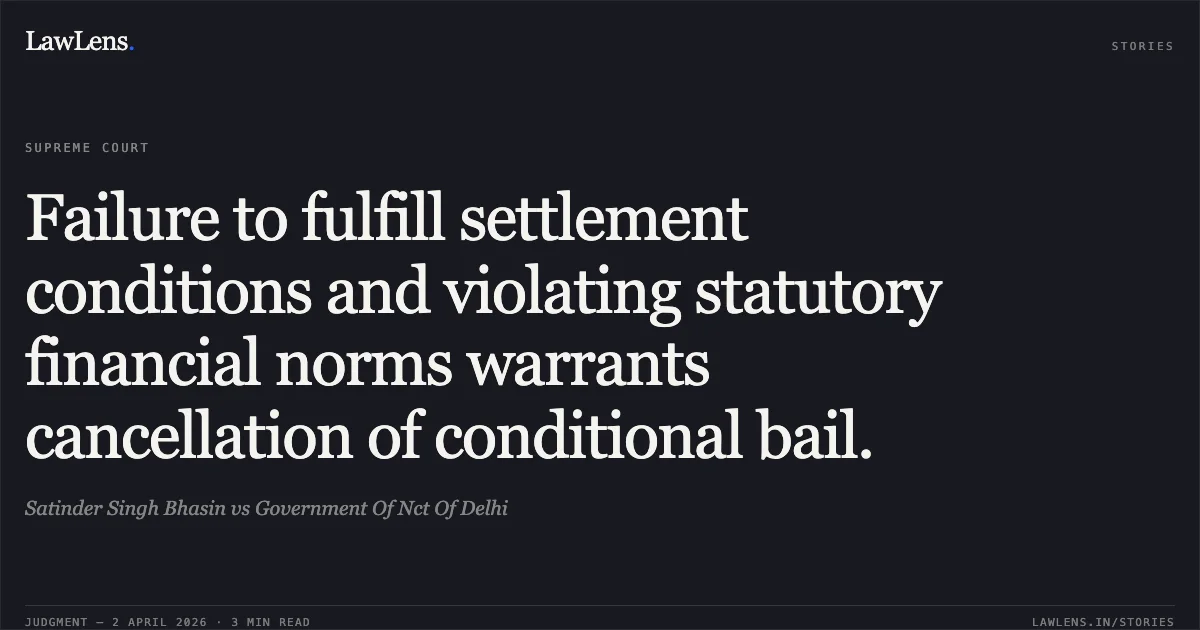
The Court held that the Petitioner had intentionally failed to comply with the bail conditions in both letter and spirit.
¶ 125Consequently, the Court cancelled the Petitioner's bail and directed him to surrender within one week.
¶ 126Under Condition (ix) of the original bail order, the Court ordered the forfeiture of the entire Rs. 50 Crore deposit plus accrued interest; Rs. 5 Crores was directed to be transmitted to NALSA, and the remainder to the IRP for IBC proceedings.
¶ 129The Petitioner was barred from applying for regular bail for twelve months and must first comply with all orders in the insolvency proceedings.
¶ 127Original Court PDF
Satinder Singh BhasinvsGovernment Of Nct Of Delhi
Click to open original judgment
Original judgment, available to read, download and summarize on LawLens.in