Facts
The applicant sought his first bail under Section 483 of the Bharatiya Nagarik Suraksha Sanhita, 2023 (BNSS), in Crime No. 47/2026, registered for offences under Sections 296(b), 109(1), 103(1) and 3(5) of the Bharatiya Nyaya Sanhita, 2023 (BNS), and Section 25 of the Arms Act.
Source reference: para. 1, p. 1He had been in custody since 22 January 2026.
Source reference: para. 1, p. 1The prosecution alleged that on 20 January 2026 the applicant and a co-accused confronted the deceased over a prior dispute; the applicant allegedly restrained the deceased from behind while the co-accused stabbed him in the right armpit.
Source reference: para. 2, p. 1The deceased subsequently died after being taken to hospital, and the complainant also sustained injuries when he intervened.
Source reference: para. 2, p. 1The applicant argued that the fatal blow was specifically attributed to the co-accused, that the eyewitnesses had been examined, and that the written grounds of arrest had not been furnished in violation of Article 22(1) of the Constitution and Section 47 of the BNSS.
Source reference: paras. 3–3.2, pp. 1–3The State opposed bail, relying on the applicant’s alleged active participation, criminal antecedents involving 25 cases, and the absence of demonstrated prejudice arising from the alleged non-supply of written grounds of arrest.
Source reference: paras. 4–4.4, pp. 3–6Issues
Whether the applicant was entitled to bail on merits considering his alleged active participation in an incident resulting in the death of the deceased, the gravity of the offence, and his criminal antecedents.
Source reference: paras. 6–8, pp. 6–8Whether failure to furnish the grounds of arrest in writing violated Article 22(1) of the Constitution and Section 47 of the BNSS, and whether such violation, by itself, entitled the applicant to release on bail.
Source reference: paras. 3.1–3.2, 4.2–4.4 and 7–8, pp. 2–8Law Applied
The Court applied Section 483 of the BNSS governing bail powers of the High Court, together with Section 47 of the BNSS and Article 22(1) of the Constitution, which require that an arrested person be informed, as soon as may be, of the grounds of arrest.
Source reference: paras. 1, 3.1–3.2, pp. 1–3Relying on Prabir Purkayastha v. NCT of Delhi, (2024) 8 SCC 254, Vihaan Kumar v. State of Haryana, (2025) 5 SCC 799, and Mihir Rajesh Shah v. State of Maharashtra, (2026) 1 SCC 500, the Court recognised that written communication of the grounds of arrest is a constitutional safeguard and that, where immediate written communication is not possible, the grounds must at least be communicated orally and in writing within a reasonable time, and ordinarily two hours before production for remand.
Source reference: para. 3.2, pp. 2–3It also considered State of Karnataka v. Sri Darshan, 2025 SCC OnLine SC 1702, and State of Meghalaya v. Sonal Raghuvanshi, SLP (Cr.) No. 11944/2026, for the principle that non-furnishing of written grounds does not automatically result in bail where substantial communication occurred and no actual prejudice is demonstrated.
Source reference: paras. 4.3–4.4, pp. 4–6The Court further applied the bail principle that gravity of the offence, the accused’s prima facie role, medical corroboration, criminal antecedents, and the potential impact on collective societal interests are relevant considerations.
Source reference: paras. 6–8, pp. 6–8Reasoning
On the merits, the Court found that the applicant had an active role in the occurrence: although the fatal knife blow was attributed to the co-accused, the applicant allegedly restrained the deceased during the assault.
Source reference: para. 6, p. 6This allegation was supported by the medical evidence and concerned an offence punishable under Section 103 of the BNS.
Source reference: para. 6, p. 6; para. 7, p. 7Regarding arrest, the Court held that the record showed the applicant was aware of the reasons for his arrest, was legally represented from the outset, and had applied for bail shortly after arrest.
Source reference: para. 7, p. 7Therefore, no actual prejudice or denial of a fair opportunity to defend was established.
Source reference: para. 7, p. 7Nevertheless, the Court expressly found that the grounds of arrest had not been supplied to the applicant in writing, constituting a violation of Article 22(1) as interpreted in Mihir Rajesh Shah.
Source reference: para. 7, p. 7Applying the prejudice-oriented approach in State of Karnataka v. Sri Darshan, however, it concluded that this procedural violation did not, in the particular circumstances, require release on bail.
Source reference: para. 8, pp. 7–8The Court additionally relied on the seriousness of the charge, the applicant’s active participation, his criminal antecedents, his failure to raise the objection earlier, and the fact that the trial had already entered the evidence stage.
Source reference: para. 8, pp. 7–8Holding
The Court answered the merits issue against the applicant, holding that his alleged active participation in a murder, the gravity of the offence, the supporting medical evidence, and his criminal antecedents justified refusal of bail.
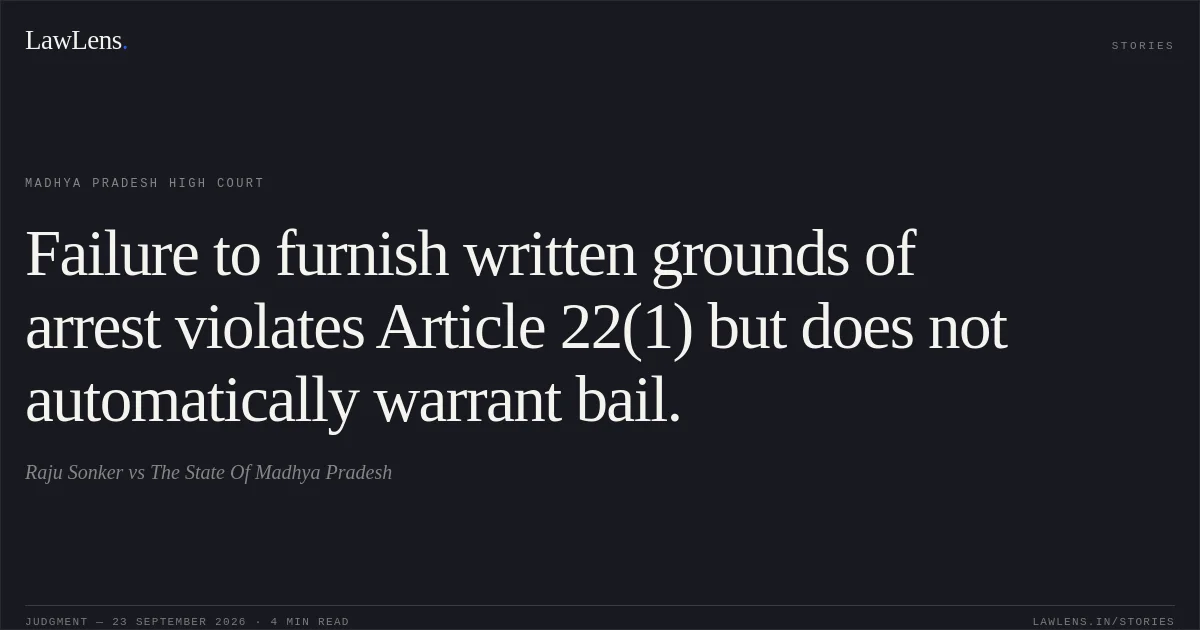
It further held that the non-supply of written grounds of arrest violated Article 22(1) of the Constitution but, absent demonstrated prejudice and in view of the surrounding circumstances, did not independently warrant release on bail.
Source reference: paras. 7–8, pp. 7–8The application under Section 483 of the BNSS was accordingly dismissed.
Source reference: para. 9, p. 8Acts & Sections Cited
9 provisions across 5 statutes referred to in this judgment. Each provision opens on LawLens.
Bharatiya Nagarik Suraksha Sanhita, 20232
Bharatiya Nyaya Sanhita, 20234
Arms Act, 19591
Code of Criminal Procedure, 19731
Indian Penal Code, 18601
Original Court PDF
Raju SonkervsThe State Of Madhya Pradesh
Click to open original judgment
Original judgment, available to read, download and summarize on LawLens.in