Facts
The petitioner’s father, a Work Guard in the Public Works Directorate, died-in-harness on August 4, 2017
Source reference: para. 1The petitioner’s mother applied for compassionate appointment for her son on August 23, 2017, followed by the petitioner’s own application on September 12, 2017
Source reference: para. 1The respondent authorities rejected the application on July 12, 2023, and again upon reconsideration on January 5, 2024, on the grounds that the petitioner failed to submit the application in the "prescribed format" within the two-year stipulated period
Source reference: paras. 1–2The petitioner challenged these rejections via a writ petition, asserting that the authorities failed to comply with their statutory obligation to assist the bereaved family
Source reference: paras. 5, 11Issues
1. Whether the respondent authorities' rejection of the compassionate appointment application on technical grounds was valid in light of the notification dated March 1, 2016
Source reference: para. 112. Whether the failure of the authorities to advise and assist the family members of the deceased employee as per the amended rules vitiates the rejection order
Source reference: para. 14Law Applied
The Court applied the notification dated March 1, 2016, issued by the Labour Department, which amended the parent notification (251-Emp dated December 3, 2013). Specifically, Clause 10(bb) mandates that the concerned department must meet the family members of a deceased government servant immediately after death to advise and assist them in the appointment process, including individual counseling on requirements/formalities and maintaining a record of such meetings
Source reference: para. 3The Court also relied on the precedent set in Bishnu Rajak v. The State of West Bengal & Ors. (WPA 7615 of 2025), which held that these amended provisions are obligatory/mandatory for the authorities
Source reference: paras. 6, 13Reasoning
The Court observed that the 2016 amendment was in force when the employee died in 2017, yet the authorities failed to provide the mandated assistance or counseling to the petitioner's family
Source reference: para. 11There was no record of any meeting as required by Clause 10(bb)
Source reference: para. 12The Court reasoned that the petitioner cannot be blamed for failing to use a "prescribed format" when the authorities, despite having his initial application on record since September 2017, neglected their duty to inform him of the simplified proforma or checklist introduced by the amendment
Source reference: paras. 14–15The Court characterized the scheme as beneficial legislation designed to help families tide over financial crises, noting that the objective is frustrated if authorities treat it as a bureaucratic hurdle rather than a duty of care
Source reference: paras. 16–17Holding
The Court held that the rejection orders dated July 12, 2023, and January 5, 2024, were illegal and contrary to the revised notification dated March 1, 2016
The rejections were set aside. The Court directed the respondents to reconsider the petitioner's prayer for compassionate appointment in accordance with the amended provisions and dispose of the same within eight weeks. The authorities were ordered to communicate any necessary formalities to the petitioner in writing and provide an opportunity for a hearing and submission of documents
Source reference: paras. 19, 20, 21–22Original Court PDF
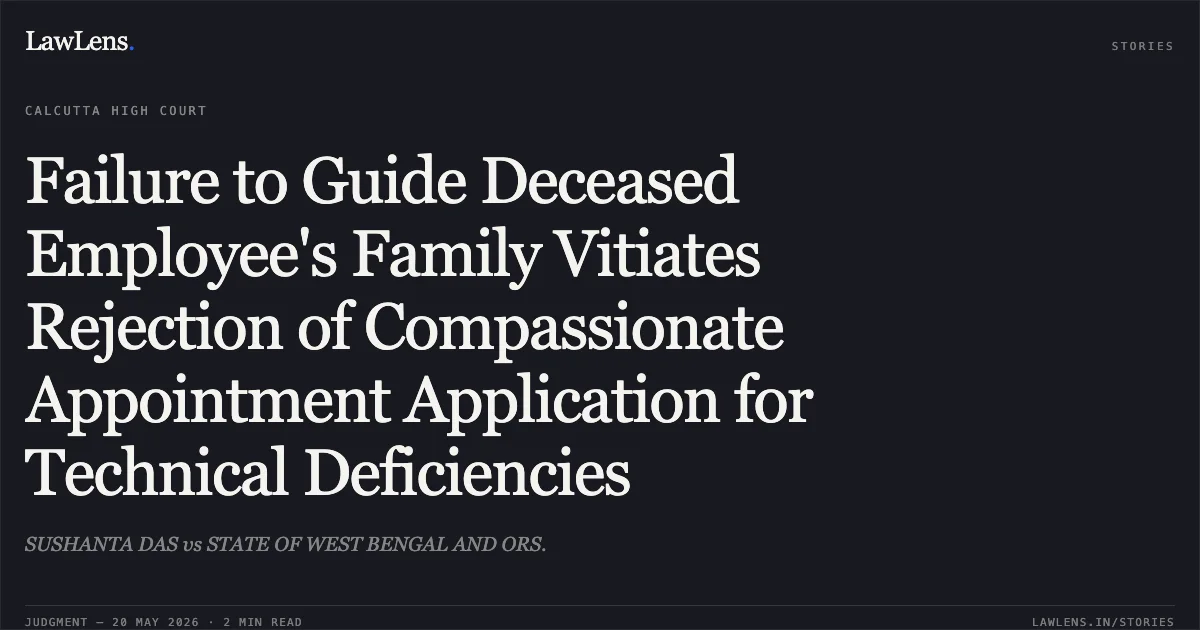
SUSHANTA DASvsSTATE OF WEST BENGAL AND ORS.
Click to open original judgment
Original judgment, available to read, download and summarize on LawLens.in