Facts
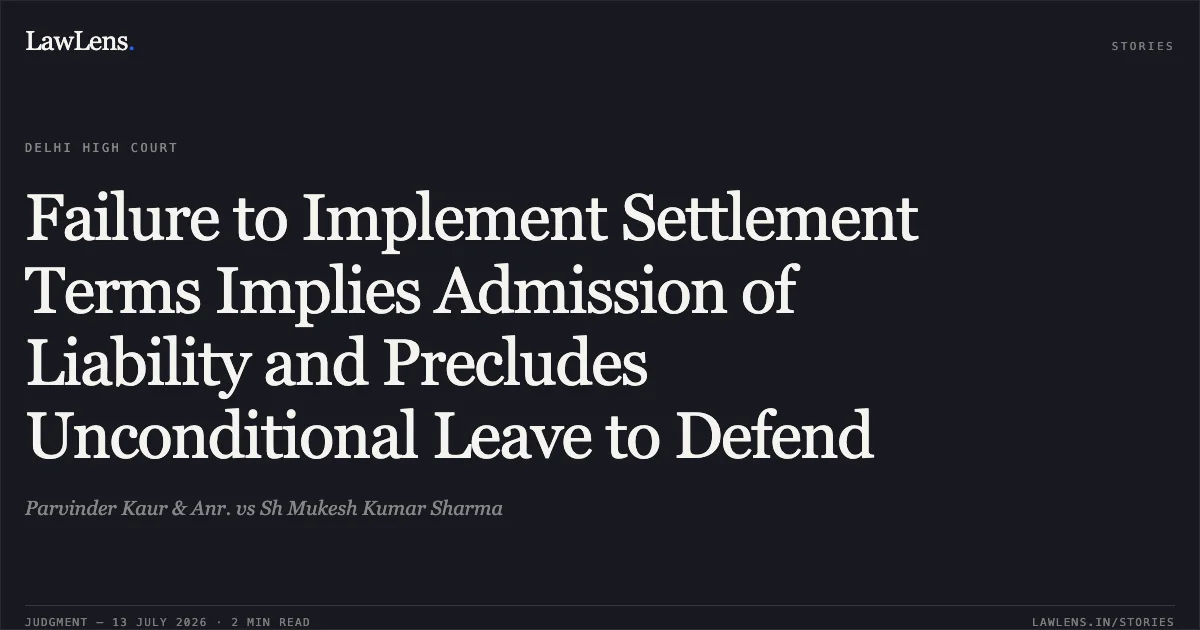
The Appellants (Defendants) allegedly took a friendly loan of ₹6,50,000/- from the Respondent (Plaintiff) between 2018 and 2019.
Source reference: para 3Two cheques issued by Appellant No. 1 were dishonored twice—first for "Stopped Payment" and later for "Funds Insufficient".
Source reference: paras 5-6The Plaintiff filed a summary suit under Order XXXVII of the CPC for recovery.
Source reference: para 8The Appellants filed a 'Leave to Defend' application, claiming the cheques were forged, the suit was improperly verified, and that a subsequent settlement agreement dated 22.12.2020 reduced their liability to ₹4,00,000/-, of which ₹1,20,000/- had already been paid.
Source reference: paras 9-14The Trial Court dismissed the Leave to Defend and decreed the suit for the full amount.
Source reference: para 1Issues
1. Whether the Appellants raised any "triable issues" in their Leave to Defend application that would warrant an unconditional trial.
Source reference: para 182. Whether a settlement agreement entered into after the filing of the suit, which was subsequently breached by the Appellants, creates a valid defense against the original claim.
Source reference: paras 37, 43Law Applied
Order XXXVII Rule 3(5) of the Code of Civil Procedure (CPC), which governs the grant of leave to defend in summary suits based on whether the defendant discloses facts sufficient to support a substantial defense.
Source reference: para 9The principle of implied admission, where a defendant’s reliance on a settlement agreement acknowledging a debt functions as an admission of the underlying liability.
Source reference: para 38The principle that a breach of settlement terms restores the parties to their original legal positions.
Source reference: para 43Reasoning
The High Court observed that the Appellants admitted the signatures on the cheques and failed to explain the basis for their "forgery" plea, rendering it a "non-arguable" defense.
Source reference: paras 18, 33The court found that the Settlement Agreement dated 22.12.2020—though not mentioned in the plaint as it occurred post-filing—actually corroborated the existence of a ₹6,50,000/- loan liability.
Source reference: para 38The court reasoned that since the Appellants failed to pay the settled amount within the stipulated period, they could not claim the benefit of the reduced settlement figure.
Source reference: para 43Oral allegations regarding the manipulation of a second set of cheques were disregarded as they lacked supporting documentation or pleadings in the original application.
Source reference: paras 46-47Holding
The Court upheld the dismissal of the Leave to Defend application, finding no triable issues.
The High Court partially allowed the appeal only to the extent of quantum, reducing the decreed amount from ₹6,50,000/- to ₹5,30,000/- with simple interest at 6% per annum, reflecting the Respondent's admission of receiving ₹1,20,000/- during the pendency of the litigation.
Source reference: paras 42, 49Acts & Sections Cited
4 provisions across 2 statutes referred to in this judgment. Each provision opens on LawLens.
Code of Civil Procedure, 19083
Negotiable Instruments Act, 18811
Original Court PDF
Parvinder Kaur & Anr.vsSh Mukesh Kumar Sharma
Click to open original judgment
Original judgment, available to read, download and summarize on LawLens.in