Facts
The appellant, Razzak, resided with his father, Gulam Husain, in a double-storeyed house in village Bichhia. On September 5, 1981, a quarrel broke out between them, during which the appellant poured acid on his father.
Source reference: p. 1–2The victim sustained 60% acid burn injuries.
Source reference: p. 4–5The appellant was apprehended by bystanders while fleeing.
Source reference: p. 2The victim provided a statement to the police on September 8, 1981, and succumbed to his injuries due to septicaemia and exhaustion approximately three weeks later.
Source reference: p. 5, 8The Trial Court (Sessions Judge, Gorakhpur) charged the appellant under Section 302 IPC but eventually convicted and sentenced him to three years' R.I. under Section 326 IPC.
Source reference: p. 2The appellant challenged the conviction, claiming the death was accidental and requesting probation due to his age.
Source reference: p. 6–7Issues
1. Whether the findings of the Trial Court convicting the appellant under Section 326 IPC instead of Section 302/304 IPC were legally sound based on the medical and ocular evidence.
Source reference: p. 102. Whether the non-imposition of a fine by the Trial Court constituted a legal error in sentencing under Section 326 IPC.
Source reference: p. 10–113. Whether the appellant is entitled to the benefit of probation or a reduction in sentence given the passage of 40 years.
Source reference: p. 7, 13Law Applied
Section 326 of the Indian Penal Code (IPC), which mandates imprisonment and a fine for voluntarily causing grievous hurt by dangerous means.
Source reference: p. 10–11Section 32(1) of the Indian Evidence Act regarding the admissibility of a statement as a dying declaration when made by a person as to the cause of their death.
Source reference: p. 8–9Principles of Section 304 IPC regarding culpable homicide not amounting to murder, specifically the element of 'knowledge' of likely consequences.
Source reference: p. 10Appellate principle that a sentence cannot be enhanced in an appeal filed solely by the accused in the absence of a State appeal for enhancement.
Source reference: p. 13Reasoning
The Court analyzed the disparity between the superficial injuries on the appellant and the extensive 60% burns on the deceased, concluding the appellant was the aggressor.
Source reference: p. 8The deliberate use of acid on vital parts imputed "knowledge" to the appellant that his act was likely to cause death, which should have attracted Section 304 or 302 IPC rather than Section 326.
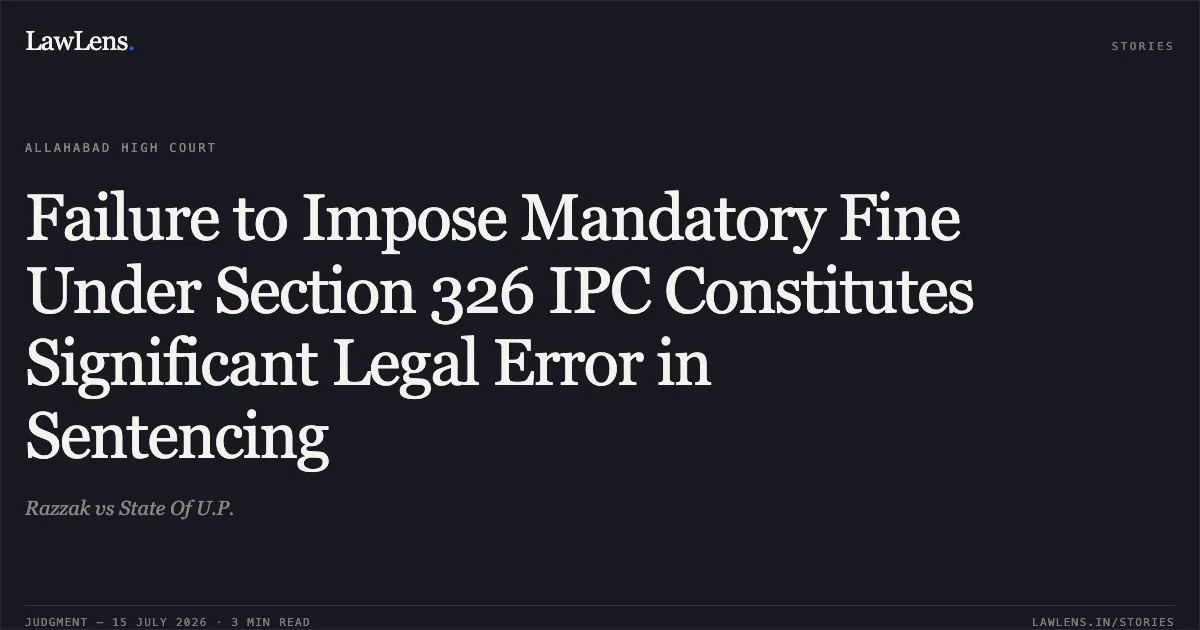
Source reference: p. 9–10The Court found the Trial Judge's reasoning for leniency flawed and noted a "patent non-application of mind" regarding the mandatory imposition of a fine under Section 326.
Source reference: p. 12However, because the State did not file an appeal for enhancement, the Court noted it could not legally increase the three-year sentence or alter the conviction to a more severe section to the prejudice of the appellant.
Source reference: p. 13The Court rejected the plea for probation, citing the gravity of an attack by a son on his father within their home.
Source reference: p. 13–14Holding
The Court dismissed the appeal and upheld the conviction under Section 326 IPC.
The Court held that while the Trial Court committed a legal error by not imposing a fine and by exercising "misplaced leniency," the sentence of three years' R.I. would remain undisturbed as the State had not appealed for enhancement.
Source reference: p. 13–14The Court denied the benefit of probation and ordered the appellant to surrender within two weeks to serve the remainder of his sentence.
Source reference: p. 14The Court further recorded strong disapproval of the Trial Judge’s disregard for mandatory sentencing provisions and misappreciation of the evidence regarding the charge of murder.
Source reference: p. 11–12Acts & Sections Cited
5 provisions across 2 statutes referred to in this judgment. Each provision opens on LawLens.
Indian Penal Code, 18603
Code of Criminal Procedure, 19732
Original Court PDF
RazzakvsState Of U.P.
Click to open original judgment
Original judgment, available to read, download and summarize on LawLens.in