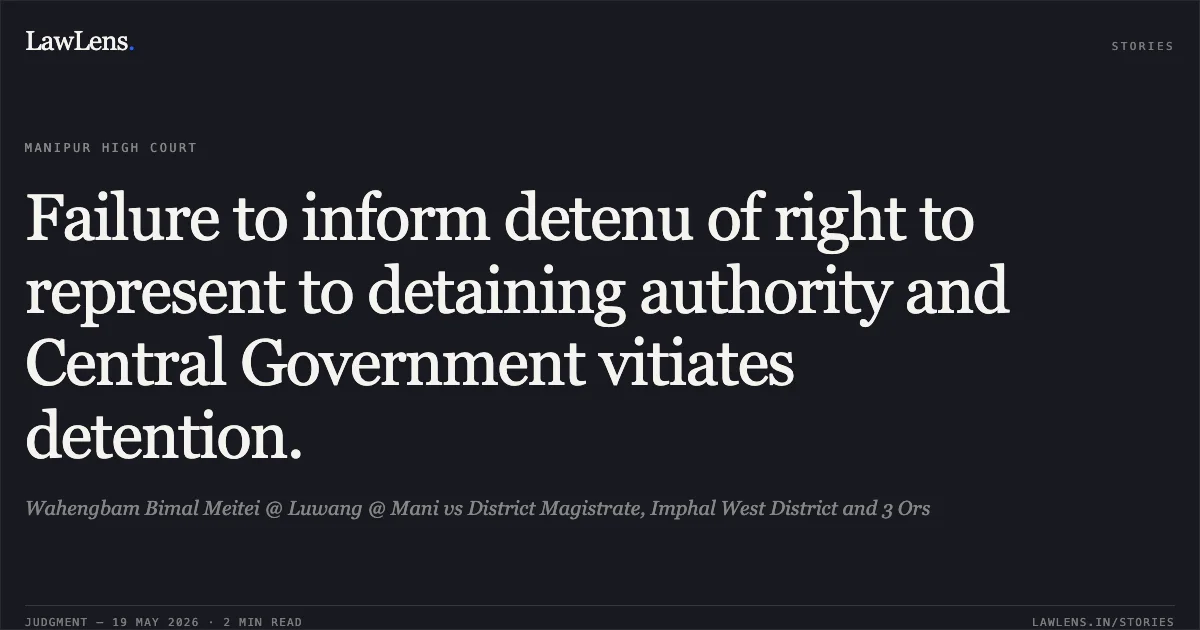
Facts
The Petitioner was involved in three successive FIRs between January 2024 and January 2026 for alleged offences under the UAPA and Arms Act
Source reference: p. 3-4While his bail application for the third FIR was pending, Respondent No. 1 (Detaining Authority) issued a preventive detention order dated 20.02.2026 under Section 3(3) of the National Security Act (NSA), 1980
Source reference: p. 4This order was subsequently approved and confirmed by the State Government
Source reference: p. 2-3The Petitioner challenged the detention via a writ of habeas corpus on the grounds that he was not informed of his right to represent his case to the Detaining Authority and was belatedly informed of his right to represent to the Central Government
Source reference: p. 6-7Issues
1. Whether the failure of the Detaining Authority to inform the detenu of his right to make a representation to the Detaining Authority himself constitutes a violation of Article 22(5) of the Constitution
Source reference: p. 6, para. 6(i)2. Whether the delayed communication (17 days after grounds were served) regarding the detenu's right to make a representation to the Central Government violates the "earliest opportunity" mandate under Article 22(5)
Source reference: p. 6-7, para. 6(ii)Law Applied
The court primarily applied Article 22(5) of the Constitution of India, which guarantees a detenu the right to be informed of the grounds of detention and the "earliest opportunity" to make a representation
Source reference: p. 11It relied on the Constitution Bench decision in Kamleshkumar Ishwardas Patel v. Union of India, which established that the right to representation includes a corresponding obligation on the authority to inform the detenu of such rights to all competent authorities, including the Detaining Authority
Source reference: p. 11-12The court further applied the Full Bench ruling in Konsam Brojen Singh v. State of Manipur, which affirmed that these principles apply specifically to the National Security Act, 1980
Source reference: p. 15-16Reasoning
The court found that although the grounds of detention were served on 24.02.2026, they only mentioned the right to represent to the State Government and the Advisory Board, omitting the right to represent to the Detaining Authority
Source reference: p. 7-8Following Kamleshkumar, the court reasoned that since Section 14 of the NSA allows a Detaining Authority to revoke or modify an order for a period of 12 days (prior to approval), the detenu must be informed of the right to approach said authority during that window
Source reference: p. 11-13Regarding the representation to the Central Government, the court noted that the detenu was only informed on 12.03.2026, after the Ministry of Home Affairs alerted the State
Source reference: p. 18This delay was deemed a failure to provide the "earliest opportunity" for representation required by Article 22(5), thereby vitiating the subjective satisfaction and the procedural legality of the detention
Source reference: p. 19-20Holding
The court answered both issues in the affirmative, holding that the procedural infractions regarding the non-communication and delayed communication of representation rights rendered the detention invalid
The High Court allowed the Writ Petition, set aside the detention order dated 20.02.2026 (including the approval and confirmation orders), and directed that the Petitioner be set at liberty forthwith
Source reference: p. 22Acts & Sections Cited
13 provisions across 5 statutes referred to in this judgment. Each provision opens on LawLens.
National Security Act, 19805
Unlawful Activities (Prevention) Act, 19675
Arms Act, 19591
Conservation of Foreign Exchange and Prevention of Smuggling Activities Act, 19741
Prevention of Illicit Traffic in Narcotic Drugs and Psychotropic Substances Act, 19881
Original Court PDF
Wahengbam Bimal Meitei @ Luwang @ ManivsDistrict Magistrate, Imphal West District and 3 Ors
Click to open original judgment
Original judgment, available to read, download and summarize on LawLens.in


