Facts
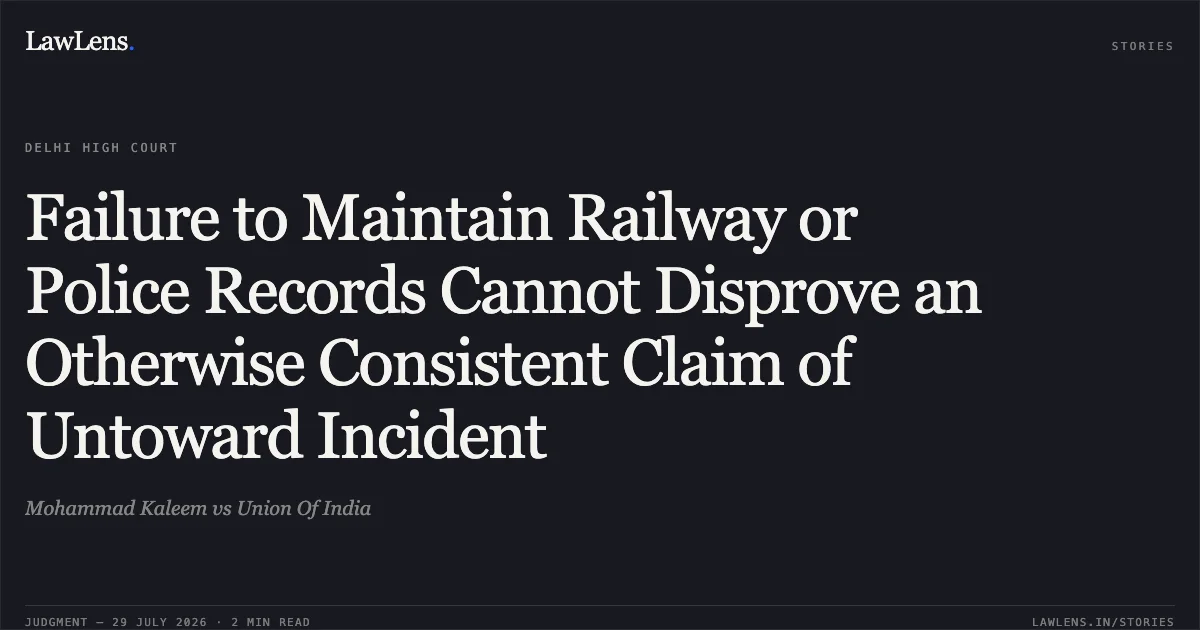
The appellant claimed that on September 20, 2017, he fell from the Bihar Sampark Kranti Express near Lucknow Railway Station due to a sudden push by a crowd while standing near the door.
Source reference: para. 2He sustained severe injuries, including the amputation of his left leg and multiple toes on his right foot.
Source reference: para. 15Nearly one year later, he filed a claim for compensation, which the Railway Claims Tribunal dismissed on March 26, 2021.
Source reference: para. 3, 5The Tribunal's dismissal was based on the lack of official railway or police records of the incident, the absence of eyewitnesses, and a delay in reporting.
Source reference: para. 5The appellant then challenged this dismissal before the Delhi High Court.
Source reference: para. 1Issues
1. Whether the appellant was a bona fide passenger at the time of the incident.
Source reference: para. 92. Whether the injuries sustained by the appellant were the result of an "untoward incident" as defined under the Railways Act.
Source reference: para. 11Law Applied
Section 123(c) and Section 124-A of the Railways Act, 1989, which define and provide for compensation regarding "untoward incidents" involving railway passengers.
Source reference: para. 9, 11The precedent set in Union of India v. Rina Devi establishes that the initial burden of proof is discharged once a passenger produces a valid ticket and testifies to the occurrence.
Source reference: para. 10The Railways Act is "beneficial legislation," meaning claims should be judged on the "preponderance of probabilities" rather than the strict proof required in criminal trials.
Source reference: para. 6, 18Reasoning
The Court found that the appellant successfully discharged the initial burden of proving he was a bona fide passenger by producing his original journey ticket and testifying under oath.
Source reference: para. 10The Court rejected the Tribunal’s reliance on the absence of official railway records, noting that the Divisional Railway Manager’s report did not affirmatively disprove the incident but merely noted a lack of entries.
Source reference: para. 16The Court emphasized the medical evidence from Dr. Ram Manohar Lohia Hospital, which recorded a "fall from train" just two days after the incident and detailed catastrophic injuries consistent with such an event.
Source reference: para. 15The Court held that the delay in filing the claim was adequately explained by the appellant’s long-term hospitalization and repeated surgeries.
Source reference: para. 17Under the "preponderance of probabilities," the Court concluded the appellant’s consistent testimony and medical records outweighed the procedural gaps cited by the respondent.
Source reference: para. 18Holding
The Court set aside the Tribunal’s judgment, holding that the appellant was a bona fide passenger who suffered injuries in an "untoward incident".
The Court allowed the appeal and remanded the matter to the Railway Claims Tribunal to assess and award compensation within two months. The parties were directed to appear before the Tribunal on August 17, 2026.
Source reference: para. 19Acts & Sections Cited
3 provisions across 2 statutes referred to in this judgment. Each provision opens on LawLens.
Railway Claims Tribunal Act, 19872
Railways Act, 19891
Original Court PDF
Mohammad KaleemvsUnion Of India
Click to open original judgment
Original judgment, available to read, download and summarize on LawLens.in