Facts
The petitioners filed an application under Section 482 of the CrPC to quash FIR No. 11210047232115 of 2023.
Source reference: p.1The complainant (Respondent No. 3) alleged that he supplied grey fabrics to the petitioners through a broker.
Source reference: p.2Petitioner No. 1 allegedly owed a balance of Rs. 11,24,837/- from a 2018-2020 transaction, and Petitioner No. 2 allegedly owed Rs. 12,47,201/- from a 2019-2020 transaction.
Source reference: p.2The complainant alleged criminal breach of trust (Section 406 IPC) and cheating (Section 420 IPC) as payments remained outstanding.
Source reference: p.2The petitioners contended the dispute was purely commercial, motivated by "pressure tactics," and noted they had previously filed civil suits in Jaipur, Rajasthan, against the complainant for supplying inferior quality goods.
Source reference: p.2-3Issues
1. Whether the failure to pay the balance of a commercial sale transaction amounts to the criminal offences of cheating or criminal breach of trust.
Source reference: p.6 / para. 8.32. Whether the allegations in the FIR, even if taken at face value, disclose the necessary ingredients of Sections 406, 420, and 506(2) of the IPC.
Source reference: p.6-18 / para. 8.2 & 10.2Law Applied
Section 405 (Criminal Breach of Trust) and Section 420 (Cheating) of the IPC.
Source reference: p.5-6Race Club (1940) Ltd. v. State of Uttar Pradesh [2024 (10) SCC 690], which establishes that a mere transaction of sale does not amount to "entrustment" and that both offences cannot co-exist simultaneously.
Source reference: p.7-16Principles for quashing FIRs as laid down in State of Haryana v. Bhajan Lal [AIR 1992 SC 604], specifically regarding proceedings initiated with malafide intent or where no offence is disclosed.
Source reference: p.19Vikram Johar v. State of U.P. [(2019) 14 SCC 207], requiring a specific intent to cause alarm for criminal intimidation.
Source reference: p.17Reasoning
For Section 420 IPC, a "fraudulent or dishonest inducement" must exist at the inception of the transaction, which was absent here as the petitioners had made substantial part-payments (over Rs. 24 lakhs by Petitioner 1 and Rs. 6 lakhs by Petitioner 2).
Source reference: p.3, 10Regarding Section 406 IPC, the court held that once a sale is completed, ownership transfers and the buyer is not "entrusted" with the seller's property; therefore, a failure to pay the price is a civil wrong, not a criminal one.
Source reference: p.12, 15The court noted that the FIR was lodged shortly after the petitioners filed civil suits for inferior goods, suggesting the criminal process was used as a shortcut for recovery.
Source reference: p.3, 16The court found the allegation of a death threat lacked the required "intent to cause alarm" to satisfy Section 506(2) IPC, being mere words used in a recovery context.
Source reference: p.18-19Holding
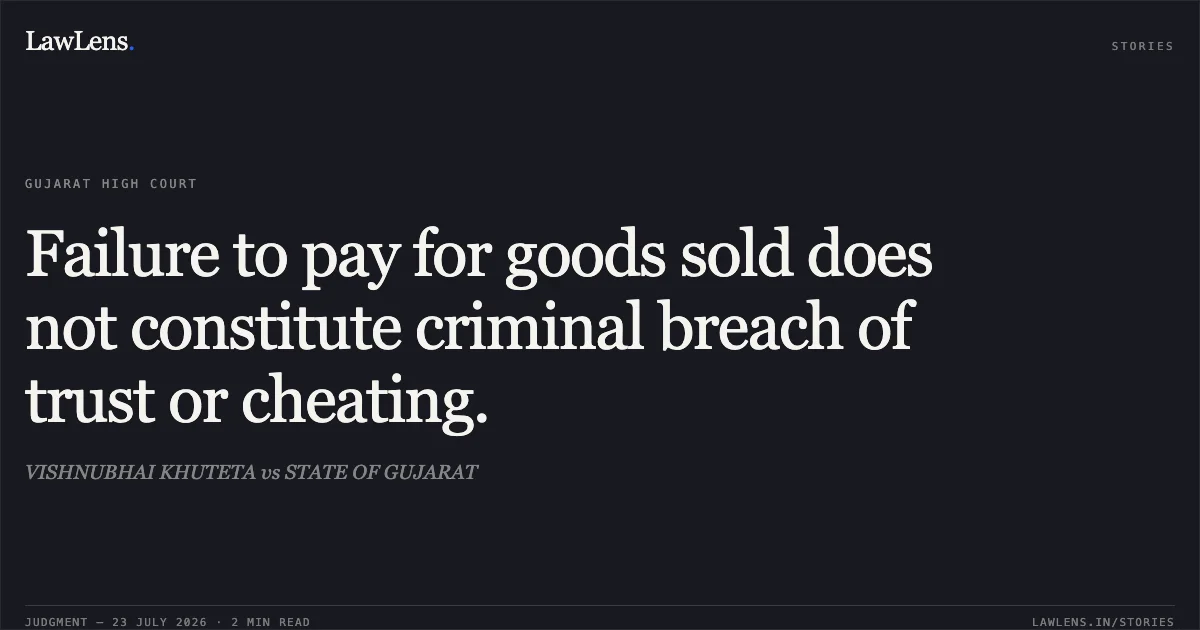
The court allowed the petition and held that the dispute was purely commercial in nature and the continuation of criminal proceedings would constitute an abuse of the process of law.
The court quashed the FIR and all consequential proceedings under parameters 1, 3, 5, and 7 of the Bhajan Lal guidelines, clarifying that this order would not affect any pending or future civil litigation between the parties.
Source reference: p.20-21Acts & Sections Cited
13 provisions across 3 statutes referred to in this judgment. Each provision opens on LawLens.
Code of Criminal Procedure, 19733
Indian Penal Code, 18608
Sale of Goods Act, 19302
Original Court PDF
VISHNUBHAI KHUTETAvsSTATE OF GUJARAT
Click to open original judgment
Original judgment, available to read, download and summarize on LawLens.in