Facts
The appellant, a Head Constable, was prosecuted under Sections 7 and 13(1)(d) read with Section 13(2) of the Prevention of Corruption Act, 1988.
Source reference: p. 2–4The prosecution alleged that he demanded money to execute a warrant against Manjula, accepted Rs.100 initially, and later demanded and accepted the remaining Rs.900 near the court canteen on 20 August 2009
Source reference: p. 2–4The trial court convicted him and imposed terms of imprisonment and fines
Source reference: p. 5On appeal under Section 374(2) CrPC, the High Court reviewed the conviction and the evidence concerning demand, acceptance, recovery, and the alleged electronic recording
Source reference: p. 1, 5–6Issues
1. Whether the trial court’s conviction and sentence suffered from perversity or material illegality warranting appellate interference
Source reference: p. 13; para. 202. Whether the prosecution proved the alleged demand and acceptance of illegal gratification beyond reasonable doubt, including whether the evidence of recovery and the electronic recording reliably supported the charge
Source reference: p. 15–28Law Applied
The Court considered Sections 7, 13(1)(d) and 13(2) of the Prevention of Corruption Act, 1988, and the prosecution’s burden to prove the essential elements of the alleged corruption offences beyond reasonable doubt
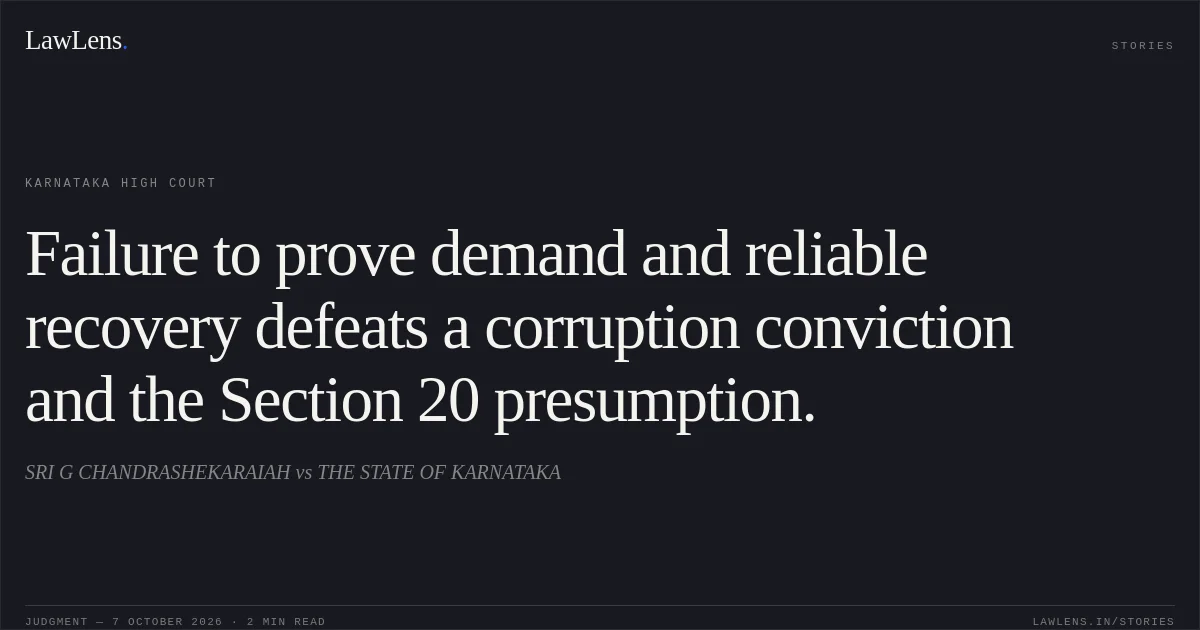
Source reference: p. 2–3, 28It applied the principle that recovery or possession of tainted currency, without proof of demand, is insufficient to establish the charged offences; the Court also held that the Section 20 presumption could not assist the prosecution where the foundational facts had not been proved
Source reference: p. 10–11, 28For the mobile-phone recording, the Court considered the certificate requirement under Section 65B(4) of the Evidence Act
Source reference: p. 15–16Reasoning
The prosecution did not produce the warrant or other adequate material establishing that the appellant had been entrusted with its execution, and the investigating officer had not collected evidence showing that the appellant received it for that purpose. The Court therefore found the alleged motive and demand insufficiently established
Source reference: p. 16–19The mobile recording lacked the required Section 65B(4) certificate, and the prosecution had not collected the complainant’s mobile chip
Source reference: p. 15–16The trap mahazar was prepared at the Lokayukta office rather than at the place of the alleged acceptance, despite the Court finding that suitable space was available at the court premises; in the circumstances, this cast doubt on the alleged seizure, particularly given the defence that the complainant had put the money in the appellant’s pocket
Source reference: p. 19–25The Court also found the complainant’s testimony unreliable in light of inconsistencies and the trial court’s observation about his demeanour
Source reference: p. 26–28Taken together, these deficiencies left reasonable doubt about demand and acceptance, so the Section 20 presumption was unavailable
Source reference: p. 28Holding
The Court ultimately held that the prosecution had failed to prove the case beyond reasonable doubt and allowed the appeal, set aside the conviction and sentence, and acquitted the appellant
It directed the trial court to refund the amount deposited by the appellant upon proper identification
Source reference: p. 30Acts & Sections Cited
9 provisions across 3 statutes referred to in this judgment. Each provision opens on LawLens.
Code of Criminal Procedure, 19735
Prevention of Corruption Act, 19883
Negotiable Instruments Act, 18811
Original Court PDF
SRI G CHANDRASHEKARAIAHvsTHE STATE OF KARNATAKA
Click to open original judgment
Original judgment, available to read, download and summarize on LawLens.in