Facts
The respondent-complainant alleged that he provided a hand loan of ₹2,50,000 to the applicant-accused in October 2013, claiming he paid ₹85,000 in cash and withdrew ₹1,65,000 via ATM/cheque
Source reference: p. 3-4A cheque for ₹2,50,000 dated 27.03.2014 was issued by the accused, which was returned with the endorsement "Funds Insufficient"
Source reference: p. 4The trial court (Judicial Magistrate First Class, Visnagar) convicted the accused under Section 138 of the N.I. Act, sentencing her to one year of imprisonment and ₹2,50,000 compensation
Source reference: p. 2This conviction was confirmed by the 5th Ad-hoc Sessions Judge, Mehsana
Source reference: p. 1-2The accused challenged these orders, contending that the cheque was lost/misused and that the complainant failed to prove the withdrawal of the loan amount despite a court order
Source reference: p. 5-7Issues
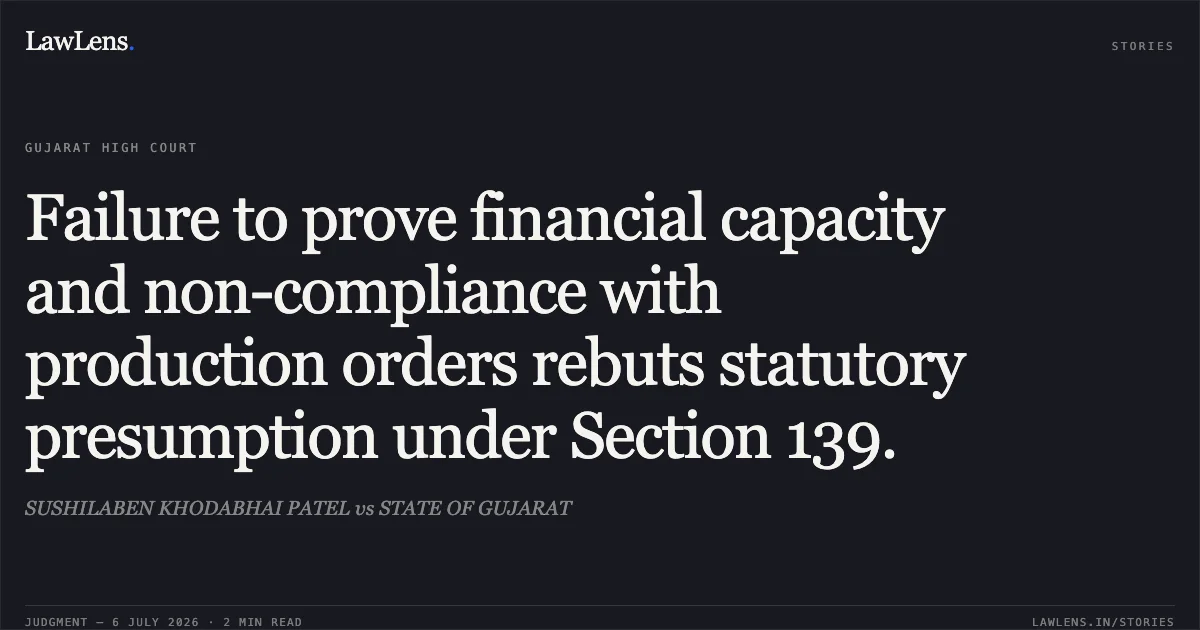
1. Whether the complainant's failure to produce bank documents proving the withdrawal of funds, despite a court direction under Exhibit 23, shifted the burden of proof back to the complainant to establish the existence of a legally enforceable debt
Source reference: p. 16 / para. 82. Whether the applicant-accused successfully rebutted the statutory presumption under Sections 118 and 139 of the N.I. Act through the standard of preponderance of probabilities
Source reference: p. 14 / para. 7Law Applied
The court applied Section 138, Section 118, and Section 139 of the Negotiable Instruments Act, 1881, which create a rebuttable presumption that a cheque was issued for a legally enforceable debt
Source reference: p. 2; 8; 11It relied on Rajesh Jain v. Ajay Singh (2023) regarding the "preponderance of probabilities" standard for rebuttal
Source reference: p. 13-14It distinguished Ashok Singh v. State of U.P. (2025), noting that while a complainant need not initially prove financial capacity, an obligation arises when the accused makes a "sincere attempt" to negate the stand through court-ordered production of documents
Source reference: p. 19-20Reasoning
The High Court found that the accused raised a "strong probable defence" by demonstrating that stop-payment instructions for a series of lost cheques (including the disputed one) were issued on 21.10.2013, months before the cheque was allegedly issued in 2014
Source reference: p. 5-6; 21Crucially, the accused had moved an application (Exh. 23) directing the complainant to produce bank statements to prove he actually withdrew ₹1,65,000 to lend the money
Source reference: p. 6-7Although the trial court granted this application, the complainant admitted in cross-examination that he had no evidence to support the withdrawal
Source reference: p. 7; 18-19The court reasoned that once the accused successfully created doubt about the transaction via Exh. 23 and the bank letter (Exh. 36), the onus shifted back to the complainant
Source reference: p. 20-21The complainant’s failure to discharge this shifted burden nullified the statutory presumption
Source reference: p. 21Holding
The High Court answered both issues in the affirmative, holding that the accused met the standard of preponderance of probabilities to rebut the presumption
The court allowed the Revision Application, quashed the judgments of both the trial court and the first Appellate Court, and acquitted the applicant of the charges under Section 138 of the N.I. Act
Source reference: p. 21The Record & Proceedings were ordered to be returned to the lower court forthwith
Source reference: p. 22Acts & Sections Cited
7 provisions across 2 statutes referred to in this judgment. Each provision opens on LawLens.
Code of Criminal Procedure, 19734
Negotiable Instruments Act, 18813
Original Court PDF
SUSHILABEN KHODABHAI PATELvsSTATE OF GUJARAT
Click to open original judgment
Original judgment, available to read, download and summarize on LawLens.in