Facts
The petitioner, Hasina Begum, challenged an opinion dated 15.06.2018 (sic) by the Foreigners Tribunal, Kamrup (Rural) No. 1, which declared her a foreigner of the post-25.03.1971 stream
Source reference: p. 3The matter originated as an IM(DT) case in 2001 and was later transferred to the Foreigners Tribunal following the Sarbananda Sonowal judgment
Source reference: p. 3The petitioner claimed to be the daughter of Gias Uddin Mondal and granddaughter of Karim Mandal @ Abdul Karim Mandal, asserting her birth in Goalpara, Assam, in 1985
Source reference: p. 4She relied on 27 documents, including several voters lists (1966, 1970, 1979-2019), a school certificate, land documents (sale deeds and Jamabandi), and certificates from a Gaonburah and Gaon Panchayat Secretary to establish her lineage and link to Indian ancestors prior to the 25.03.1971 cutoff date
Source reference: p. 5-8Issues
1. Whether the petitioner discharged the burden of proof under Section 9 of the Foreigners Act, 1946, to establish her Indian citizenship by proving her linkage to an Indian ancestor prior to 25.03.1971
Source reference: p. 12/132. Whether the documentary evidence produced, including the Gaonburah certificate and school certificate, possessed sufficient evidentiary value to establish said linkage
Source reference: p. 15/16Law Applied
Section 9 of the Foreigners Act, 1946, which mandates that the burden of proving citizenship lies upon the person asserting it
Source reference: p. 14Sarbananda Sonowal v. Union of India, which establishes that facts regarding birth and parentage are within the "personal knowledge" of the proceedee under Section 106 of the Evidence Act
Source reference: p. 14Rupajan Begum v. Union of India and Ramila Khatun v. Union of India, which necessitate the examination of the issuing authority to prove the contents of a certificate
Source reference: p. 17, 18State Emblem of India (Regulation of Use) Rules, 2007, to invalidate documents bearing unauthorized emblems
Source reference: p. 16Sudha Devi v. M.P. Narayanan, which clarifies that self-declared affidavits do not constitute evidence under Section 3 of the Evidence Act
Source reference: p. 19Reasoning
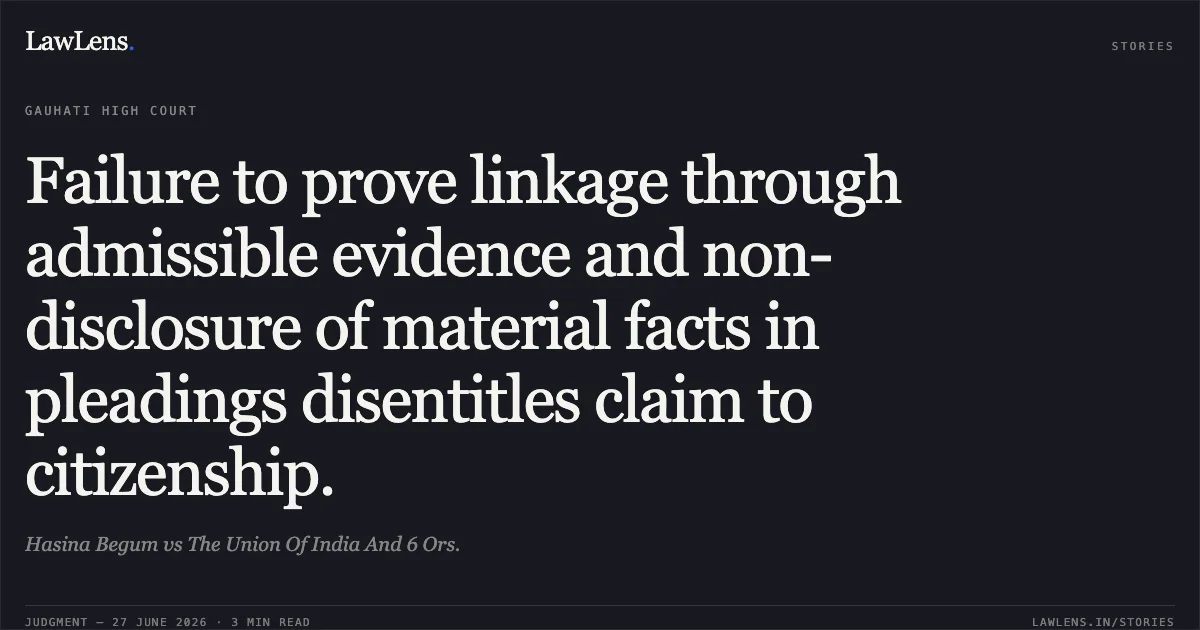
The Court found that the petitioner failed to disclose material facts (such as siblings) in her written statement, which is the foundational document of defense
Source reference: p. 14-15Although the petitioner produced voters lists of 1966 and 1970 featuring her projected grandfather and father, the Court held that she failed to establish a documentary link between herself and them
Source reference: p. 18The school certificate was rejected because the issuing authority was not examined; the LDA (DW3) who testified lacked personal knowledge and did not produce the original register
Source reference: p. 15The Gaonburah and Gaon Panchayat certificates were deemed unreliable because they were issued solely based on the petitioner's information without independent verification
Source reference: p. 16Additionally, the Gaonburah certificate was inadmissible for unauthorized use of the State Emblem
Source reference: p. 16The Jamabandi and sale deeds were post-1971 and thus insufficient to prove legacy
Source reference: p. 19The court concluded that the petitioner had failed to provide a continuous "chain of linkage" to ancestors residing in India prior to the 1971 cutoff
Source reference: p. 21Holding
The Court answered the issues in the negative, holding that the petitioner failed to discharge her burden of proof under Section 9 of the Foreigners Act
The High Court upheld the Tribunal's declaration that the petitioner is a foreigner of the post-25.03.1971 stream
Source reference: p. 21The Writ Petition was dismissed, the interim stay on the Tribunal's order was vacated, and the authorities were directed to proceed in accordance with the law
Source reference: p. 22Acts & Sections Cited
2 provisions across 2 statutes referred to in this judgment. Each provision opens on LawLens.
State Emblem of India (Prohibition of Improper Use) Act, 20051
Code of Civil Procedure, 19081
Original Court PDF
Hasina BegumvsThe Union Of India And 6 Ors.
Click to open original judgment
Original judgment, available to read, download and summarize on LawLens.in


