Facts
The appellant was convicted by the Trial Court on 12.01.2024 for kidnapping and sexual assault of a victim alleged to be a minor
Source reference: para. 3The prosecution case stated that on 16.01.2022, the victim went missing from her home and was later found to have lived with the appellant in a rented house in Madhya Pradesh for over a month
Source reference: para. 4, 20The Trial Court relied on a school dakhil-kharij (admission-discharge) register [Ex. P-27C] to determine the victim’s date of birth as 06.06.2006, making her a minor at the time of the incident
Source reference: para. 8, 10The appellant challenged the conviction, contending that the victim was a consenting adult and that her age was not legally proven
Source reference: para. 7Issues
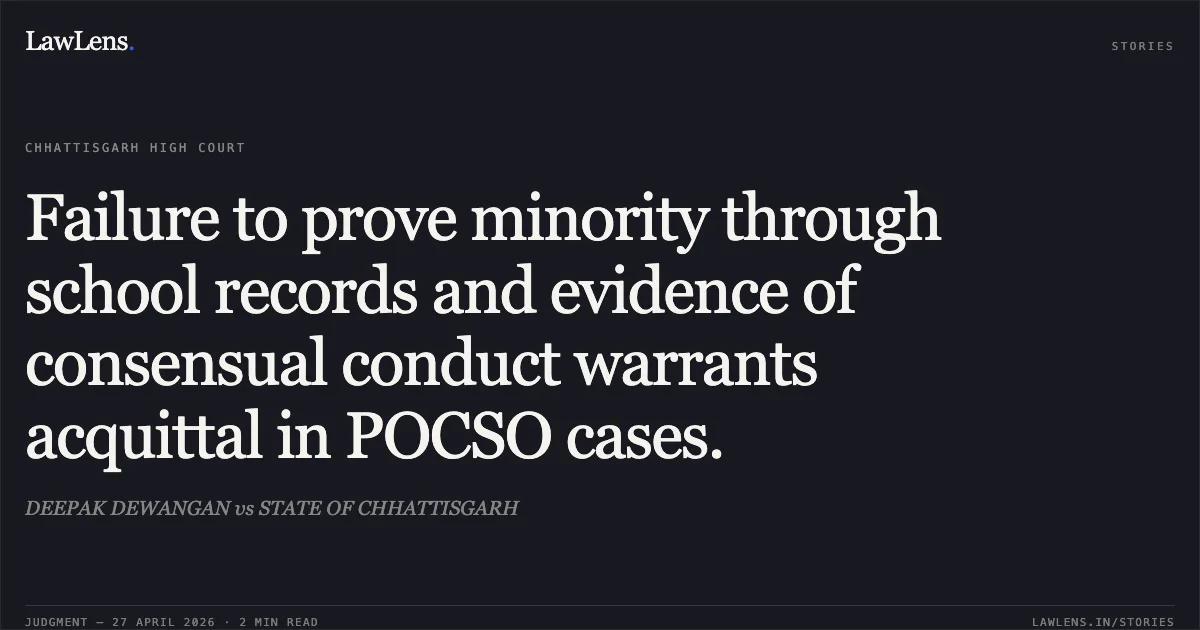
1. Whether the school dakhil-kharij register, without supporting foundational evidence, is sufficient to prove the victim's minority under the POCSO Act.
Source reference: para. 7, 122. Whether the acts of the appellant constitute offences under Sections 363, 366, and 376(3) IPC and Sections 5(l)/6 of the POCSO Act given the victim's conduct and testimony.
Source reference: para. 23Law Applied
The Court applied Section 35 of the Indian Evidence Act, 1872, regarding the admissibility of public records, noting that while school registers are admissible, they hold little evidentiary value in the absence of the material (e.g., birth certificate) upon which the entry was based
Source reference: para. 13-14It relied on Ravinder Singh Gorkhi v. State of UP (2006) and Alamelu v. State (2011) to establish that a higher standard of proof for age is required in criminal trials to protect the accused’s rights under Article 21
Source reference: para. 13-14Furthermore, it followed Rishipal Singh Solanki v. State of UP (2022) and P. Yuvaprakash v. State (2023), emphasizing that the hierarchy of documents under Section 94 of the JJ Act must be strictly followed for age determination
Source reference: para. 15-16Reasoning
The Court found the prosecution failed to provide clinching evidence of the victim's age. The Headmistress (PW-9) admitted the birth entry was made solely on oral information from the father without verifying birth certificates or Kotwari registers
Source reference: para. 10-11Citing the contradictions between the victim’s statement and PW-9, the Court held it unsafe to rely on the school register alone
Source reference: para. 12Regarding the merits, the Court observed from the victim’s Section 164 CrPC statement and trial testimony (PW-2) that she accompanied the appellant voluntarily, lived as his wife for a month in a rented house, and never raised an alarm despite having ample opportunity
Source reference: para. 18-21Testing her testimony, the Court concluded it did not inspire confidence to support a charge of rape, as her conduct demonstrated she was a "willing and consenting party" who was likely above 18 years of age
Source reference: para. 22-23Holding
The Court held that the prosecution failed to prove the victim's minority and that the evidence established a consensual relationship
The High Court allowed the appeal and set aside the judgment of conviction and sentence dated 12.01.2024. The appellant was acquitted of all charges under Sections 363, 366, 376(3) IPC and Section 5(l)/6 of the POCSO Act and ordered to be released forthwith
Source reference: para. 24Acts & Sections Cited
9 provisions across 4 statutes referred to in this judgment. Each provision opens on LawLens.
Indian Penal Code, 18603
Juvenile Justice (Care and Protection of Children) Act, 2015.2
Bharatiya Nagarik Suraksha Sanhita, 20231
Original Court PDF
DEEPAK DEWANGANvsSTATE OF CHHATTISGARH
Click to open original judgment
Original judgment, available to read, download and summarize on LawLens.in