Facts
The appellant was convicted by the Sessions Court for offences under Sections 376(2)(i) and (n), and 354-A(1)(i) of the IPC, and Sections 4, 6 and 8 of the POCSO Act.
Source reference: pp. 3–7, 10The prosecution alleged that he repeatedly sexually assaulted PW2, his stepdaughter, and sexually assaulted PWs3 and 4, his younger daughters.
Source reference: pp. 3–7, 10PW2 was about 13 at the relevant time; PWs3 and 4 were below 12.
Source reference: pp. 3–7, 10The allegations came to light after the children spoke to their teacher, and a complaint was lodged on 13 February 2018.
Source reference: pp. 3–7, 10The appellant challenged the conviction, contending that the children had been tutored and that the medical evidence did not support the allegations.
Source reference: pp. 6–7Issues
1. Whether the victims’ testimony, considered alongside the medical evidence, established that PW2 had been subjected to penetrative sexual assault.
Source reference: pp. 10–132. Whether the evidence established sexual assault against PWs3 and 4, and whether the convictions and applicable POCSO provisions required alteration.
Source reference: pp. 13–15Law Applied
The Court considered Sections 376(2)(i) and (n), and 354-A(1)(i) of the IPC, together with Sections 4, 6, 8, 9(l), 9(m) and 10 of the POCSO Act.
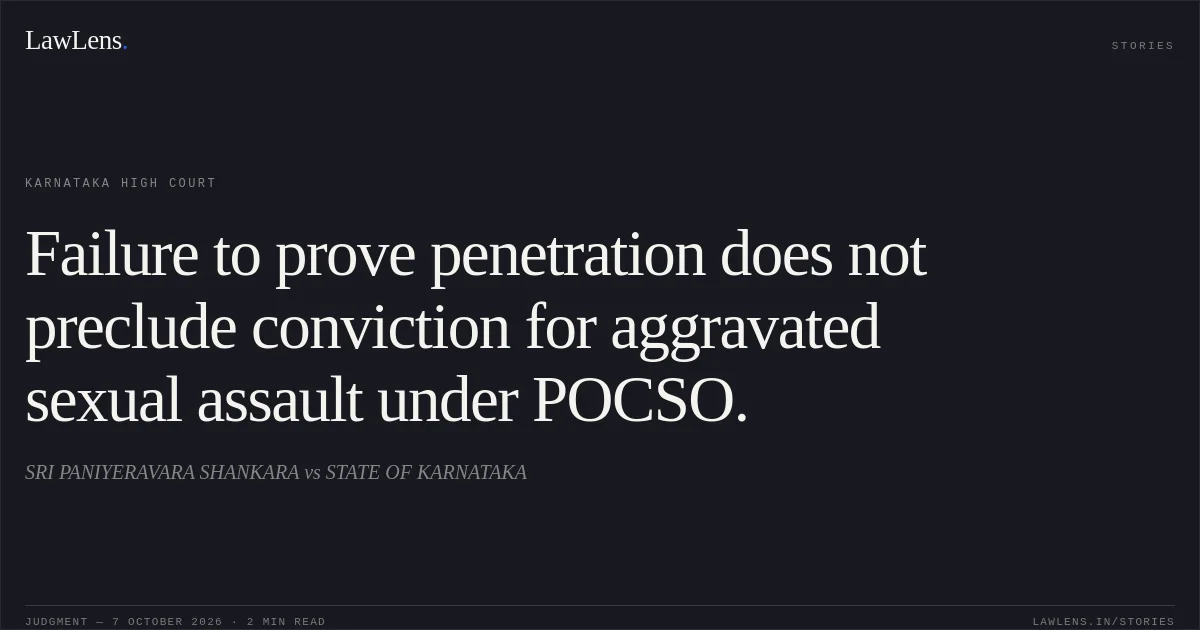
Source reference: no citationIt distinguished proof of penetrative sexual assault from proof of sexual assault: the evidence was insufficient to sustain the penetrative-assault convictions under Section 376 and Sections 4 and 6, but supported liability under Sections 9(l) and 9(m), punishable under Section 10, for repeated sexual assault and assault on a child below 12.
Source reference: no citationThe Court cited no precedent.
Source reference: no citationReasoning
The Court rejected the tutoring argument, relying on the victims’ evidence, their written statements, and the accounts of the persons to whom they had disclosed the abuse; their mother had not supported the prosecution.
Source reference: p. 9As to PW2, the medical examination and FSL findings did not establish penetration, and the Court held that her testimony was not sufficiently corroborated to sustain the penetrative-sexual-assault conviction, notwithstanding the doctor’s explanation for the negative FSL result.
Source reference: pp. 10–13The evidence nevertheless established sexual assault against PW2, while the testimony of PWs3 and 4 established that the appellant touched their private parts and chests.
Source reference: pp. 13–14Because PWs3 and 4 were below 12, the Court held that the offences fell under Sections 9(l) and 9(m), punishable under Section 10, rather than Section 8.
Source reference: pp. 13–14Holding
The appeal was allowed in part.
The Court set aside the convictions under Section 376(2)(i) and (n) of the IPC and Sections 4, 6 and 8 of the POCSO Act, but confirmed the conviction under Section 354-A(1)(i) of the IPC.
Source reference: pp. 14–16It substituted a conviction under Sections 9(l) and 9(m), punishable under Section 10 of the POCSO Act, and sentenced the appellant to seven years’ rigorous imprisonment and a fine of ₹25,000, with one year’s simple imprisonment in default.
Source reference: pp. 14–16The fine was directed to be paid to PW2 as compensation; the trial court’s direction concerning consideration of compensation for PWs2–4 and the appellant’s entitlement to set-off were maintained.
Source reference: pp. 14–16Acts & Sections Cited
10 provisions across 3 statutes referred to in this judgment. Each provision opens on LawLens.
Code of Criminal Procedure, 19733
Indian Penal Code, 18601
Original Court PDF
SRI PANIYERAVARA SHANKARAvsSTATE OF KARNATAKA
Click to open original judgment
Original judgment, available to read, download and summarize on LawLens.in