Facts
On 15 November 1977, the Food Inspector (P.W.1) inspected the respondents’ mill and allegedly collected a sample of mustard oil.
Source reference: para. 1–3The sample was sent to the Public Analyst, whose report stated that the oil was highly adulterated and unfit for human consumption.
Source reference: para. 1–3A prosecution was thereafter instituted, and the respondents were charged under Section 248(1) of the Code of Criminal Procedure.
Source reference: para. 1–3The Trial Court, in Case No. 509D of 1977, acquitted the respondents on 20 September 1984.
Source reference: para. 1–3The Calcutta Municipality/KMC preferred the present appeal against the acquittal.
Source reference: para. 1–3The prosecution examined the Food Inspector, a seizure witness (P.W.2), and one other witness, but did not examine Dr. A.K. Chanda, who had accompanied P.W.1 during the inspection, or A. Mukherjee, the Public Analyst who prepared the report.
Source reference: para. 13–15, 21The seized mustard oil was also not produced before the Trial Court.
Source reference: para. 8–10, 18–20P.W.2 stated that the sampling mug was old and had not been checked in his presence, and that he signed the seizure papers later at his shop.
Source reference: para. 8–10, 18–20Issues
Whether the prosecution established, through reliable and legally sufficient evidence, that the sample allegedly collected from the respondents’ mill was adulterated and unfit for human consumption.
Source reference: para. 14–15, 20–23Whether the non-examination of the Public Analyst and the officer accompanying the Food Inspector, together with the non-production of the seized oil and alleged irregularities in sampling and seizure, materially undermined the prosecution case.
Source reference: para. 13–21Whether the Trial Court’s order of acquittal disclosed such perversity or manifest error as to warrant interference in an appeal against acquittal.
Source reference: para. 24Law Applied
The prosecution bears the primary burden of proving every ingredient of the alleged criminal offence beyond reasonable doubt and must establish the evidentiary foundation, identity and integrity of the sample relied upon.
Source reference: para. 22, 25–27A scientific or expert report is not, by its mere marking as an exhibit, insulated from scrutiny where its maker is not examined and the accused is thereby deprived of an opportunity to test its basis and methodology.
Source reference: para. 15, 26In a prosecution founded on adulteration, the prosecution must satisfactorily prove the collection, preservation, chain of custody and connection of the analysed sample with the commodity allegedly seized.
Source reference: para. 20, 25On an appeal against acquittal, although the appellate court may reappraise the evidence, interference is unwarranted where the Trial Court’s view is a reasonably possible view and the accused continues to enjoy the presumption of innocence.
Source reference: para. 24Reasoning
The Public Analyst’s report was a central link in the prosecution case, yet its maker, A. Mukherjee, was neither cited nor examined, leaving the respondents unable to test the opinion through cross-examination.
Source reference: para. 14–15, 26The non-examination of Dr. A.K. Chanda deprived the prosecution of corroboration regarding the inspection, sampling and seizure.
Source reference: para. 13, 21The evidence of P.W.2 created further doubt: the mug used for sampling was old and unchecked in his presence, raising a possibility of contamination, while his later signing of the seizure papers weakened the reliability of the alleged seizure proceedings.
Source reference: para. 18–19The prosecution also failed to produce the seized mustard oil or explain how the identity and integrity of the analysed sample were maintained.
Source reference: para. 20The documents allegedly placed before the competent authority for sanction or consent to prosecute were likewise not produced.
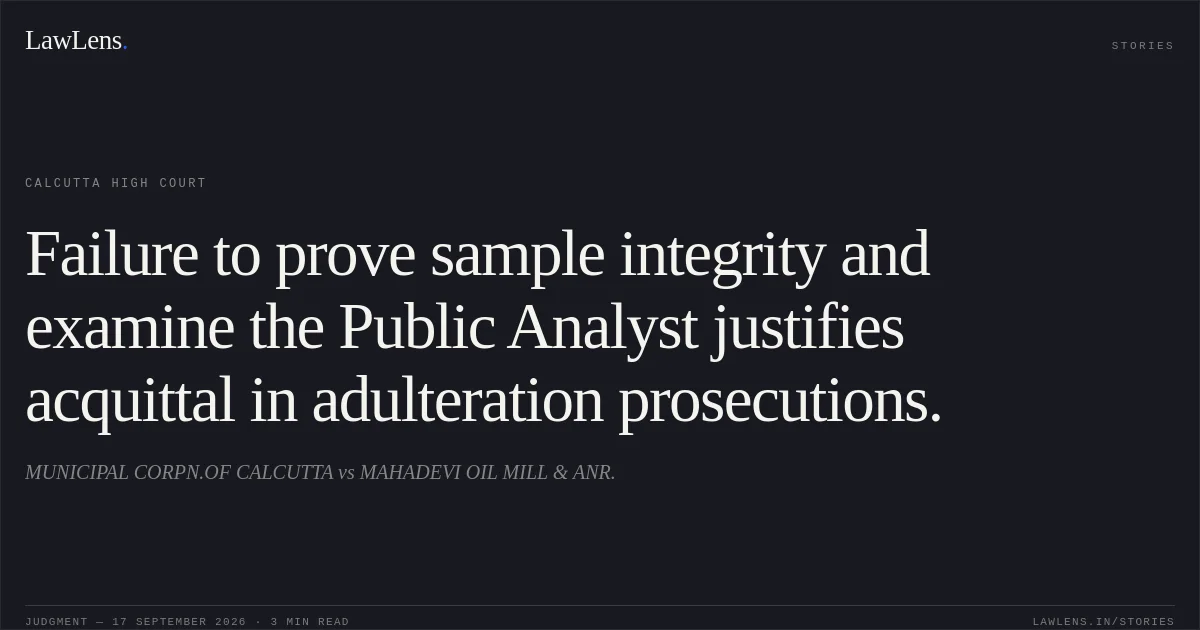
Source reference: para. 16These deficiencies, considered cumulatively, prevented the prosecution from establishing the adulteration charge beyond reasonable doubt.
Source reference: no citationThe respondents’ failure to effectively challenge the analyst’s report could not cure the prosecution’s failure to prove its foundational facts.
Source reference: para. 22Holding
The Court answered the issues against the appellant.
It found that the prosecution had failed to prove the alleged adulteration and the integrity of the sample through reliable and complete evidence.
Source reference: para. 23–28The Trial Court’s acquittal was held to be a reasonably possible and legally sustainable view, not perverse or manifestly erroneous.
Source reference: para. 23–28The appeal was dismissed, and the judgment and order of acquittal dated 20 September 1984 in Case No. 509D of 1977 were affirmed.
Source reference: para. 28–30The Trial Court Records were directed to be transmitted to the learned Trial Court.
Source reference: para. 31Acts & Sections Cited
1 provisions across 1 statute referred to in this judgment. Each provision opens on LawLens.
Code of Criminal Procedure, 19731
Original Court PDF
MUNICIPAL CORPN.OF CALCUTTAvsMAHADEVI OIL MILL & ANR.
Click to open original judgment
Original judgment, available to read, download and summarize on LawLens.in