Facts
On 31 May 2006, a PGVCL/GEB checking squad allegedly found the respondent directly abstracting electricity from an electricity line near his house at Bhenakvad village by using an electric cable and apparatus.
Source reference: p. 1An inspection report was prepared, the alleged unauthorized consumption was assessed at ₹44,642.77, and a supplementary bill was issued, which remained unpaid.
Source reference: p. 1The complainant, a Deputy Engineer who was not part of the checking squad and had not visited the site, lodged the complaint on 1 January 2007, approximately seven months after the inspection.
Source reference: p. 5The trial court framed a charge under Section 135 of the Electricity Act, 2003, but acquitted the respondent after the prosecution examined five witnesses and produced documentary evidence.
Source reference: p. 2The State challenged the acquittal under Section 378(1) and (3) of the Code of Criminal Procedure, 1973.
Source reference: para. 1Issues
Whether the trial court was justified in acquitting the respondent of the offence under Section 135 of the Electricity Act, 2003.
Source reference: para. 10(1)Whether the trial court properly appreciated the oral and documentary evidence while recording the acquittal.
Source reference: para. 10(2)Whether the impugned judgment suffered from any illegality, irregularity, or perversity warranting appellate interference.
Source reference: para. 10(3)Law Applied
Section 135 of the Electricity Act, 2003 requires the prosecution to establish unauthorized abstraction or use of electricity and the accused’s connection with the premises or alleged act.
Source reference: no citationSection 151 restricts cognizance of offences under the Act to a written complaint by the Appropriate Government, Appropriate Commission, an authorized officer, Chief Electrical Inspector, Electrical Inspector, licensee, generating company, or a police report/special-court proceeding falling within the statutory provision.
Source reference: p. 6Section 50 concerns the electricity supply code and related measures for prevention and regulation of unauthorized use.
Source reference: p. 6The Court relied on State of Gujarat v. Mohamad Nathabhai Sumara and other electricity-theft decisions for the requirement of proper authorization and reliable proof of the accused’s connection with the premises.
Source reference: para. 14–15On appeals against acquittal, Chandrappa v. State of Karnataka, Rajesh Prasad v. State of Bihar, Babu Sahebagouda Rudragoudar v. State of Karnataka, and Ramesh v. State of Karnataka establish that although the appellate court may reappreciate the evidence, the accused enjoys a reinforced or double presumption of innocence, and an acquittal should not be disturbed where two reasonable views are possible.
Source reference: paras. 19–22Reasoning
The High Court found that the prosecution failed to prove the respondent’s ownership, occupation, or possession of the premises from which electricity was allegedly abstracted.
Source reference: pp. 5, 7The complainant had no first-hand knowledge of the inspection, while the checking officer admitted that no site panchnama was prepared, no signatures of panch witnesses or nearby residents were obtained, and no material was collected to establish the respondent’s possession or ownership.
Source reference: pp. 5, 7The alleged seized material was neither handed over to the police nor produced before the trial court, and the investigating officer admitted that he had not recovered any muddamal or obtained the requisite approval.
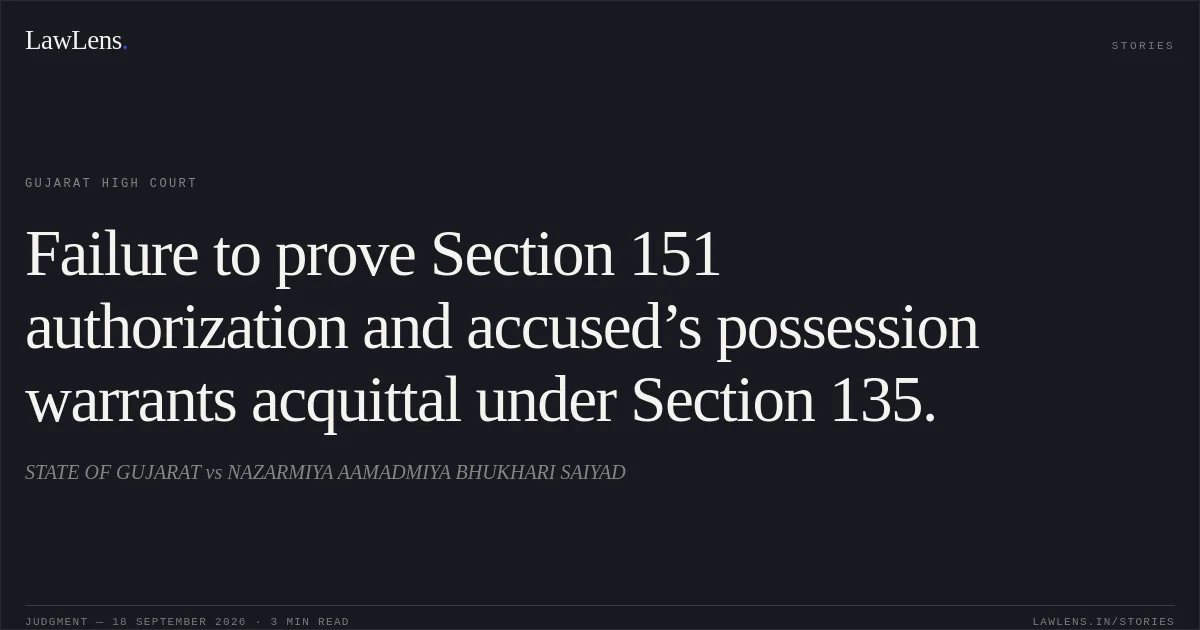
Source reference: p. 7The Court further held that the prosecution had not produced the authorization contemplated under Section 151 of the Electricity Act.
Source reference: para. 18These evidentiary and procedural deficiencies created substantial doubt regarding both the occurrence and the respondent’s involvement.
Source reference: no citationApplying the restrictive principles governing interference with an acquittal, the Court concluded that the trial court’s view was reasonable and neither perverse nor legally unsustainable.
Source reference: paras. 18–24Holding
The High Court answered all issues against the State.
It held that the prosecution had failed to prove the offence under Section 135 of the Electricity Act beyond reasonable doubt and that the trial court had rightly acquitted the respondent.
Source reference: paras. 23–24The State’s appeal was dismissed, the order of acquittal was confirmed, the respondent’s bail bond was cancelled, and the record and proceedings were directed to be returned to the trial court.
Source reference: para. 25Acts & Sections Cited
7 provisions across 2 statutes referred to in this judgment. Each provision opens on LawLens.
Code of Criminal Procedure, 19733
Electricity Act, 20034
Original Court PDF
STATE OF GUJARATvsNAZARMIYA AAMADMIYA BHUKHARI SAIYAD
Click to open original judgment
Original judgment, available to read, download and summarize on LawLens.in