Facts
The appellant, a teacher and private tutor of the prosecutrix, was alleged to have repeatedly had sexual intercourse with her on the assurance of marriage while her parents were away. The prosecutrix subsequently became pregnant. Her parents approached the appellant’s family for marriage, but the proposal was refused, following which a village panchayati was convened and the complaint case was instituted on 4 May 2015.
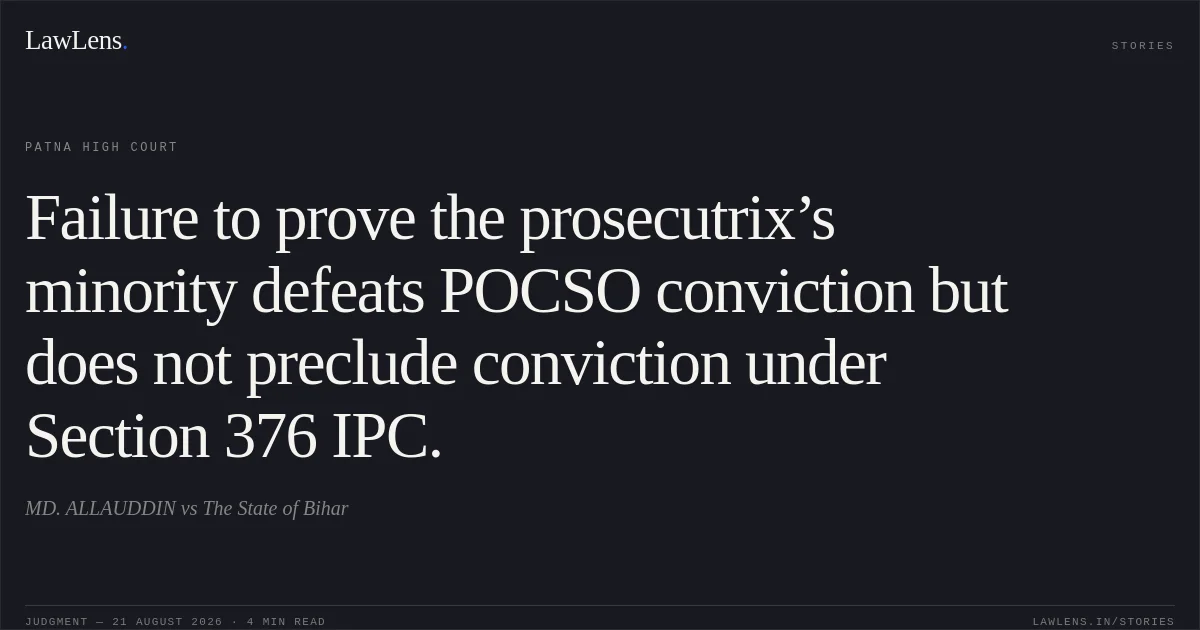
Source reference: paras. 2–3; pp. 2–4The trial court framed charges under Sections 323, 341, 376, 504, 493 and 506 of the IPC and Section 6 of the POCSO Act. It convicted the appellant under Sections 376 and 341 IPC and Section 6 POCSO, while acquitting him of the remaining charges.
Source reference: paras. 4, 10; pp. 4–6The prosecution relied principally on the testimony of the prosecutrix, her mother, who claimed to be an eyewitness, her father, and three co-villagers.
Source reference: paras. 5–8; pp. 4–6The documents allegedly showing the prosecutrix’s date of birth were only photocopies, were not exhibited, and were not proved through any official from the Madarsa Board; no medical age-assessment report was produced.
Source reference: paras. 5–8, 27, 44; pp. 4–6, 24, 35–36The defence claimed that the prosecutrix was already married to another man and that the pregnancy was attributable to her husband, relying on a voter list and a panchayati panchnama.
Source reference: paras. 16, 26, 36–38; pp. 9, 14–15, 25–27Issues
Whether the prosecution proved beyond reasonable doubt that the prosecutrix was below eighteen years of age so as to attract Section 6 of the POCSO Act?
Source reference: paras. 11–13, 43–46; pp. 6–8, 30–37Whether the uncorroborated or inadequately medically corroborated testimony of the prosecutrix, supported by her mother’s eyewitness account and surrounding circumstances, was sufficient to sustain the conviction under Section 376 IPC?
Source reference: paras. 20–25, 28–35, 40–42; pp. 11–29Whether the alleged promise of marriage vitiated the prosecutrix’s consent under Section 375 IPC by constituting a false promise or misconception of fact?
Source reference: paras. 40–42; pp. 28–30Whether the conviction under Section 341 IPC was sustainable in the absence of specific evidence of wrongful restraint?
Source reference: para. 47; p. 38Law Applied
The Court applied Section 376 IPC, governing rape, and Section 341 IPC, governing wrongful restraint, together with Section 6 of the POCSO Act concerning aggravated penetrative sexual assault.
Source reference: no citationUnder Section 34 POCSO read with Section 94 of the Juvenile Justice (Care and Protection of Children) Act, 2015, age is ordinarily determined through legally reliable documentary or medical evidence in the prescribed hierarchy.
Source reference: paras. 11–12, 44; pp. 6–8, 35–36The Court reiterated from State of Maharashtra v. Chandraprakash Kewalchand Jain, State of Punjab v. Gurmit Singh and Phool Singh v. State of Madhya Pradesh that a credible and trustworthy prosecutrix can sustain a conviction without corroboration, although the Court must assess her testimony with care.
Source reference: paras. 28–31; pp. 15–21It further held that the presumptions under Sections 29 and 30 POCSO arise only after the prosecution establishes the foundational facts, including the victim’s minority.
Source reference: paras. 45–46; pp. 36–37Applying Pramod Suryabhan Pawar v. State of Maharashtra, a promise-to-marry vitiates consent where it was false from the inception, made in bad faith, and had a direct nexus with the woman’s decision to engage in sexual intercourse.
Source reference: paras. 40–41; pp. 28–30Mere production of documents does not prove their contents unless they are properly proved in accordance with the law of evidence.
Source reference: paras. 11, 44; pp. 6–7, 35–36Reasoning
The Court found the prosecutrix’s account consistent from the complaint through her deposition and cross-examination, and considered it materially corroborated by her mother’s eyewitness testimony, her father’s evidence regarding the pregnancy and failed marriage negotiations, and the evidence of the village panchayat witnesses.
Source reference: paras. 21–25, 32; pp. 11–14, 21–22The absence of medical evidence and the delay in reporting did not discredit the prosecution because the delay was explained by the appellant’s assurance of marriage, the family’s concern for social honour, the late discovery of the pregnancy, and the unsuccessful approach to the police.
Source reference: paras. 33–35; pp. 22–24The defence theory of a prior marriage was rejected because the alleged husband and nikahnama were not produced, the voter list was only a photocopy, and the defence witnesses gave inconsistent accounts regarding the timing of the alleged marriage.
Source reference: para. 36; p. 25The Court held that the appellant’s promise of marriage was false and made without intention to honour it, particularly because he refused marriage after the pregnancy became known; accordingly, the promise had a direct nexus with the prosecutrix’s submission and the conviction under Section 376 IPC was sustainable.
Source reference: paras. 40–42; pp. 28–30However, the prosecution failed to legally establish minority: the Madarsa Board documents were neither exhibited nor proved, and no medical age determination was conducted. Consequently, the foundational fact necessary for invoking Sections 6, 29 and 30 POCSO was absent.
Source reference: paras. 44–46; pp. 35–37The conviction under Section 341 IPC was also set aside because no witness gave material evidence proving wrongful restraint.
Source reference: para. 47; p. 38Holding
The appeal was partly allowed.
The conviction under Section 6 of the POCSO Act was set aside because the prosecutrix’s minority was not proved in accordance with law.
Source reference: paras. 48–49; pp. 38–39The conviction under Section 341 IPC was also set aside for want of evidence of wrongful restraint.
Source reference: paras. 48–49; pp. 38–39The conviction and sentence under Section 376 IPC, including the ten-year rigorous imprisonment and fine of ₹25,000 payable to the victim, were affirmed; the appellant was directed to serve the remainder of the sentence.
Source reference: paras. 48–49; pp. 38–39The District Legal Services Authority, Supaul, was directed to report within eight weeks on the determination and disbursement of victim compensation under Section 357A CrPC and the applicable Victim Compensation Scheme.
Source reference: para. 50; p. 39Acts & Sections Cited
16 provisions across 4 statutes referred to in this judgment. Each provision opens on LawLens.
Indian Penal Code, 1860
Protection of Children from Sexual Offences Act, 20124
Code of Criminal Procedure, 19732
Juvenile Justice (Care and Protection of Children) Act, 2015.1
Original Court PDF
MD. ALLAUDDINvsThe State of Bihar
Click to open original judgment
Original judgment, available to read, download and summarize on LawLens.in