Facts
The State appealed against the judgment dated 31.12.2013 of the Additional Sessions Judge, Chamba, acquitting Des Raj of an offence under Section 376 of the Indian Penal Code.
Source reference: paras. 1, 4The prosecution alleged that, in June–July 1999, the respondent, then a Junior Engineer residing at Chamba, raped the victim in his house while she was assisting his family, resulting in her pregnancy and the birth of a child in February 2000.
Source reference: paras. 12–16The FIR was registered on 24.02.2000, approximately 8–10 months after the alleged incident.
Source reference: paras. 12, 14The respondent had initially been acquitted on 16.12.2004. In an earlier appeal, the High Court remanded the matter and permitted the State to lead additional evidence under Section 391 Cr.P.C. to prove the victim’s date of birth.
Source reference: paras. 2, 8–10The prosecution thereafter examined a witness from the Chief Medical Officer’s office and produced birth-register material asserting that the victim was born on 02.07.1983.
Source reference: paras. 2, 8–10The Trial Court again acquitted the respondent, leading to the present appeal.
Source reference: no citationThe prosecution also relied on the victim’s testimony, the evidence of her parents, the recovery of the child’s body, and the post-mortem report.
Source reference: para. 13The post-mortem report recorded that the child was a fully developed female child, approximately 9–10 months old, and had died from asphyxia due to suffocation.
Source reference: paras. 20–21Issues
Whether the prosecution proved, by reliable and admissible evidence, that the victim was below 16 years of age—the applicable age of discretion under Section 375 IPC at the relevant time—when the alleged incident occurred?
Source reference: paras. 4–10, 27–29Whether the testimony of the victim and the surrounding circumstances established that the respondent had sexual intercourse with her against her will or without her consent, thereby committing rape under Section 376 IPC?
Source reference: paras. 11, 17, 22–33Whether the High Court, in an appeal against acquittal, had sufficient grounds to interfere with the Trial Court’s acquittal?
Source reference: paras. 30, 34–35Law Applied
The Court applied Section 376 IPC to determine the respondent’s criminal liability for rape and Section 375 IPC as it stood in 1999, when the statutory age of discretion was 16 years.
Source reference: para. 4Where the victim is not proved to be below the statutory age, the prosecution must establish absence of consent or intercourse against her will; the victim’s testimony may form the basis of conviction if it is reliable and inspires confidence, but an untrustworthy or materially contradicted version cannot sustain a conviction.
Source reference: paras. 11, 17The Court also applied the principle that radiological age estimation carries a possible margin of error of approximately one to two years on either side.
Source reference: para. 6In an appeal against acquittal, the presumption of innocence is strengthened by the acquittal, and interference is justified only where the evidence discloses cogent grounds warranting reversal.
Source reference: para. 34The procedural history additionally involved Section 391 Cr.P.C., concerning reception of additional evidence in an appellate proceeding, and Section 437-A Cr.P.C. concerning post-judgment bail bonds.
Source reference: paras. 2, 36Reasoning
The Court held that the prosecution failed to establish the victim’s age through cogent and reliable evidence.
Source reference: paras. 5, 9–10Although the birth-register extract and school certificate referred to 02.07.1983, the additional witness could not connect the unnamed female entry in the register with the victim.
Source reference: paras. 5, 9–10The register lacked material particulars, including a serial number, proper signatures, and authentication by the competent Registrar, and the witness could not identify the author or date of the entry.
Source reference: paras. 5, 9–10The radiological evidence was itself inconclusive, estimating the victim’s age within ranges subject to a margin of error.
Source reference: paras. 6–7The victim’s testimony was also found unreliable.
Source reference: no citationHer account that the respondent’s wife had recently delivered a child was inconsistent with the defence birth certificate showing that the respondent’s wife delivered a child on 17.07.2000.
Source reference: para. 19The post-mortem report contradicted the victim’s assertion that the child had been born dead, recording death by suffocation after birth.
Source reference: paras. 20–21The Court further considered it implausible that a nine-month pregnancy remained undiscovered despite the victim living with her parents, and noted her failure to disclose the alleged rape during her hospitalisation or immediately after delivery.
Source reference: paras. 22–26The unexplained identification of the burial place by the victim’s brother, who was not examined, also created doubt regarding the prosecution narrative.
Source reference: paras. 24–25Since the prosecution could not prove that the victim was below 16 years of age at the time of the alleged incident, her consent became legally material.
Source reference: paras. 11, 27–30However, the Court found that neither the alleged absence of consent nor intercourse against her will was established through dependable evidence.
Source reference: paras. 11, 27–30The uncertainty regarding the exact date of the incident was particularly significant because, even if the asserted date of birth was accepted, the alleged occurrence could have taken place shortly before or after the victim attained 16 years.
Source reference: paras. 19, 28–29In these circumstances, the strengthened presumption of innocence arising from the acquittal required dismissal of the State’s appeal.
Source reference: paras. 30, 34Holding
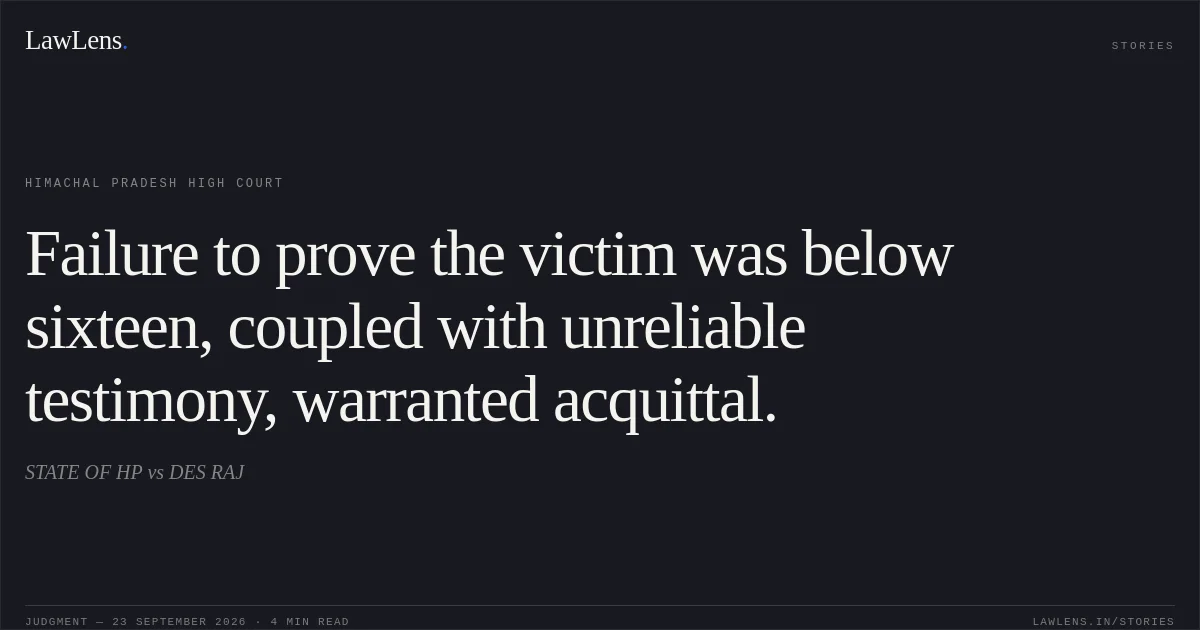
The High Court held that the prosecution failed to prove either that the victim was below 16 years of age at the time of the alleged incident or that the respondent had sexual intercourse with her against her will or without her consent.
The victim’s testimony and the supporting evidence were not sufficiently reliable to sustain a conviction under Section 376 IPC.
Source reference: paras. 27–33Finding no cogent basis to interfere with the acquittal, the Court dismissed the State’s appeal and affirmed the respondent’s acquittal.
Source reference: para. 35The State was directed to furnish bail bonds under Section 437-A Cr.P.C. in the sum of ₹25,000 with one surety for six months, and the pending miscellaneous applications were disposed of accordingly.
Source reference: paras. 36–37Acts & Sections Cited
6 provisions across 3 statutes referred to in this judgment. Each provision opens on LawLens.
Indian Penal Code, 18602
Code of Criminal Procedure, 19733
Bharatiya Nagarik Suraksha Sanhita, 20231
Original Court PDF
STATE OF HPvsDES RAJ
Click to open original judgment
Original judgment, available to read, download and summarize on LawLens.in