Facts
The Appellant (wife) filed an FIR (SC/ST P.S. Case No. 09/2024) against Respondent No. 2 (husband) under Section 498A/34 of the IPC, Section 3(1)(r)(s) of the SC/ST Act, and Sections 3 and 4 of the Dowry Prohibition (DP) Act.
Source reference: para. 5, 7Following investigation, the police submitted a charge-sheet against Respondent No. 2 for the aforementioned IPC and DP Act offences.
Source reference: para. 5, 7On 06.09.2024, the Special Judge, SC/ST (POA) Act, Purnea, took cognizance only for the offence under Section 498A of the IPC.
Source reference: para. 4The Appellant challenged this order, contending that the court failed to take cognizance under Sections 3 and 4 of the DP Act despite sufficient evidence and the police report.
Source reference: para. 5Issues
1. Whether the Special Court erred in law by failing to take cognizance of offences under Sections 3 and 4 of the Dowry Prohibition Act despite the charge-sheet asserting the same.
Source reference: para. 5 / 72. Whether the omission of specific sections in a cognizance order, without assigned reasons, renders the order mechanical and legally infirm.
Source reference: para. 7Law Applied
The court applied Section 14(A)(1) of the Scheduled Castes and Scheduled Tribes (Prevention of Atrocities) Act regarding the maintainability of the appeal.
Source reference: para. 4The court considered the penal provisions of Section 498A of the Indian Penal Code and Sections 3 and 4 of the Dowry Prohibition Act.
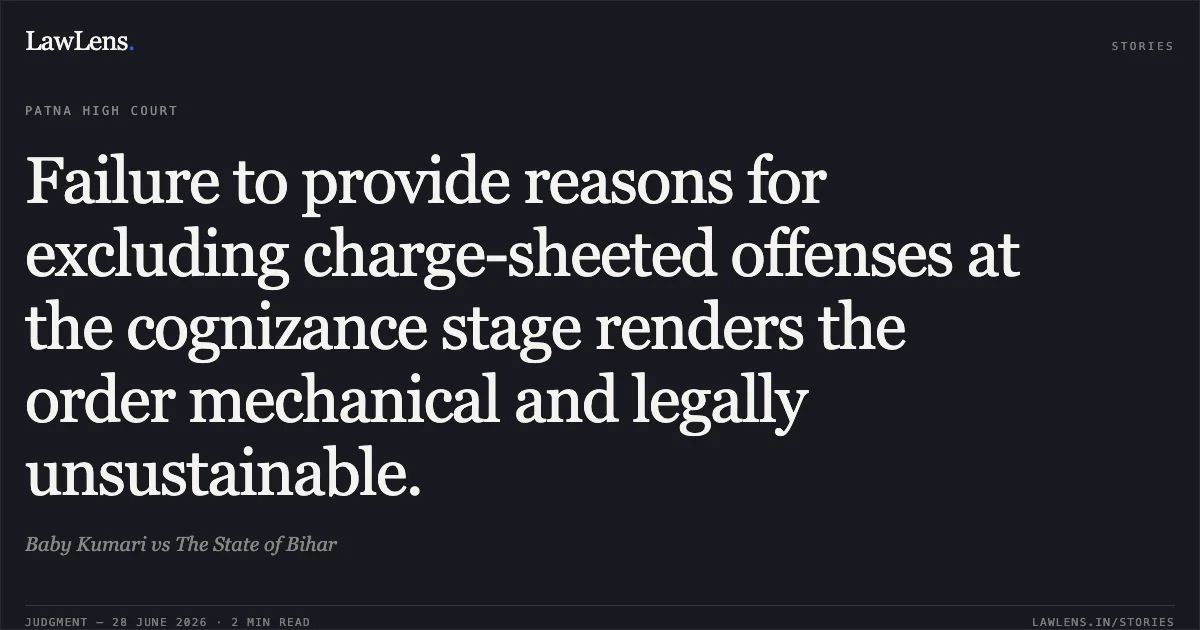
Source reference: para. 4, 7The guiding legal principle established is that a judicial order taking cognizance must not be passed in a mechanical manner and must reflect the application of mind to the materials on record, especially when excluding specific offences mentioned in a police charge-sheet.
Source reference: para. 7Reasoning
The High Court observed that the FIR and the subsequent charge-sheet contained specific allegations regarding the demand and receipt of household articles as dowry from the Appellant’s family.
Source reference: para. 7These materials were prima facie sufficient to attract the offences under Sections 3 and 4 of the DP Act.
Source reference: para. 7The court noted that while the Special Judge’s order reflected the sections from the charge-sheet in its preamble, the operative portion was silent regarding the DP Act offences.
Source reference: para. 5The High Court reasoned that since no specific reasons were assigned for the non-taking of cognizance for the dowry-related offences, the order was passed mechanically.
Source reference: para. 7The argument from Respondent No. 2—that the error could be rectified at the stage of framing charges—was superseded by the necessity for the cognizance order itself to be legally sound.
Source reference: para. 6, 7Holding
The High Court allowed the appeal and partly set aside the order dated 06.09.2024 to the extent that it failed to deal with Sections 3 and 4 of the Dowry Prohibition Act.
The court upheld the cognizance taken under Section 498A of the IPC but directed the trial court to pass a fresh order on the point of cognizance specifically regarding Sections 3 and 4 of the DP Act, based on its own merits and in accordance with law.
Source reference: para. 7, 9Acts & Sections Cited
4 provisions across 3 statutes referred to in this judgment. Each provision opens on LawLens.
Scheduled Castes and the Scheduled Tribes (Prevention of Atrocities) Act, 19891
Indian Penal Code, 18601
Original Court PDF
Baby KumarivsThe State of Bihar
Click to open original judgment
Original judgment, available to read, download and summarize on LawLens.in