Facts
The applicant, Raju, was arrested on 11 April 2025 in connection with FIR No. 0052 of 2025 registered at Police Station Pulbhatta, District Udham Singh Nagar, for offences under Sections 8/20 read with Sections 29 and 60 of the Narcotic Drugs and Psychotropic Substances Act, 1985 (“NDPS Act”).
Source reference: para. 1A vehicle was intercepted and searched, resulting in the alleged recovery of 437.748 kilograms of a substance described in the recovery documents as “Dry Green Colour Leaf” or “Ganja”.
Source reference: para. 2; para. 6The inventory was certified by a Magistrate, and samples drawn from the packets were sent for forensic analysis; the FSL report confirmed the presence of cannabis elements.
Source reference: para. 2The applicant was chargesheeted only under Section 8/20 of the NDPS Act.
Source reference: para. 2He contended that the recovered material consisted of leaves, whereas the statutory definition of “ganja” covers flowering or fruiting tops, and that the actual weight of such tops had not been separately determined.
Source reference: para. 3The State opposed bail on the ground that the recovery was substantially above the commercial quantity and that the applicant had a similar NDPS antecedent.
Source reference: para. 5Issues
1. Whether the recovery described as “Dry Green Colour Leaf” could, at the bail stage, prima facie be treated as the commercial quantity of legally defined “ganja” so as to attract the stringent conditions under Section 37 of the NDPS Act?
Source reference: para. 62. Whether the applicant’s prior NDPS criminal antecedent and the alleged commercial-quantity recovery disentitled him from bail under Section 37 of the NDPS Act?
Source reference: paras. 5–63. Whether the applicant’s prolonged incarceration, completion of investigation, and the early stage of trial justified grant of bail?
Source reference: para. 6Law Applied
The Court applied Sections 8/20 of the NDPS Act, concerning prohibited possession of cannabis, and Section 37, which imposes stringent conditions for bail in cases involving commercial quantity.
Source reference: no citationIt relied on Section 2(iii)(b) of the NDPS Act, under which “ganja” comprises the flowering or fruiting tops of the cannabis plant, while seeds and leaves are excluded when not accompanied by the tops.
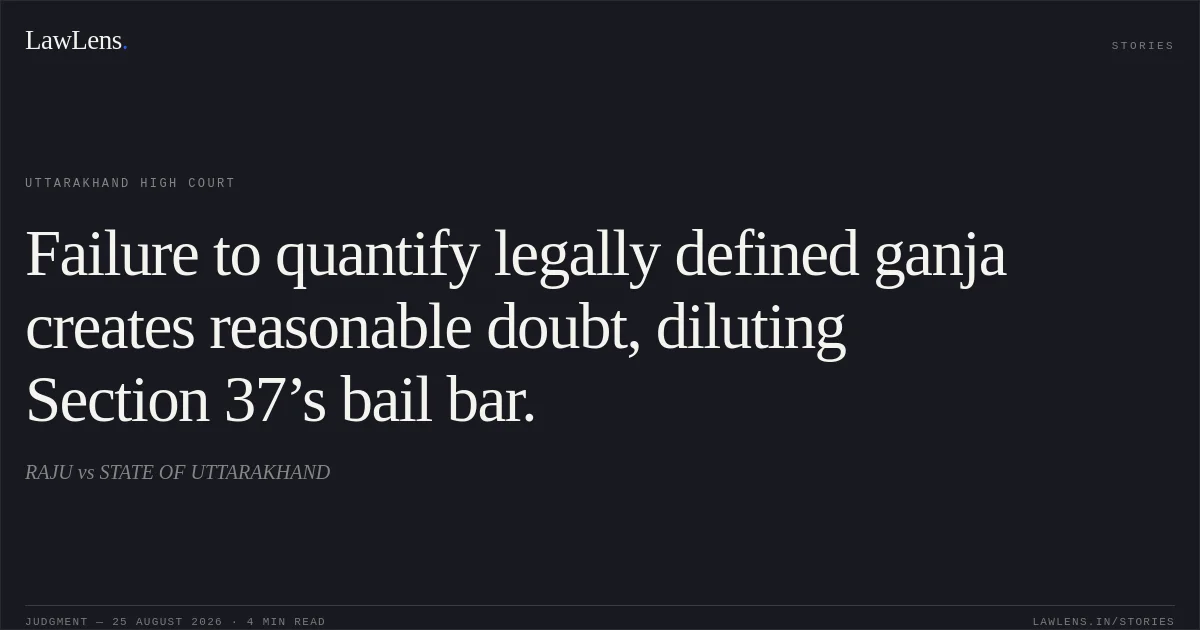
Source reference: para. 3The Court held that where the recovered material is described as leaves and the flowering or fruiting tops have not been separately identified or weighed, clubbing the entire bulk quantity to establish commercial quantity may create a reasonable doubt regarding the applicability of Section 37.
Source reference: para. 6It further applied the principle that a prior criminal case, in which the accused is already on bail, is not by itself an absolute bar to bail where the alleged commercial quantity is legally doubtful.
Source reference: para. 6Prolonged pre-trial incarceration, completion of investigation, and the likelihood of delay in trial were also treated as relevant considerations under the applicant’s right to personal liberty under Article 21 of the Constitution.
Source reference: para. 6Reasoning
The Court focused on the physical description of the seized substance rather than merely its aggregate weight.
Source reference: no citationAlthough the prosecution alleged recovery of 437.748 kilograms of ganja and relied on the FSL report, the recovery documents described the material as “Dry Green Colour Leaf”.
Source reference: paras. 2, 6Since Section 2(iii)(b) limits “ganja” to flowering or fruiting tops and excludes leaves when unaccompanied by such tops, the Court found a prima facie doubt as to whether the entire seized quantity legally constituted ganja of commercial quantity.
Source reference: para. 6The absence of a separate determination of the weight of the flowering or fruiting tops weakened the prosecution’s reliance on the commercial-quantity threshold and, consequently, diluted the operation of the Section 37 bar at the bail stage.
Source reference: paras. 3, 6The Court also considered that the investigation was complete, the trial was at an initial stage, and the applicant had been incarcerated since 11 April 2025.
Source reference: para. 6His single prior NDPS case, in which he had already been granted bail, was not considered sufficient by itself to justify continued detention.
Source reference: para. 6Holding
The Court held that the applicant had shown reasonable grounds for believing that the recovered material might not constitute commercial-quantity “ganja” as legally defined under Section 2(iii)(b) of the NDPS Act.
The bail application was accordingly allowed without expressing any final opinion on the merits of the prosecution case.
Source reference: para. 7Raju was directed to be released on furnishing a personal bond of ₹1 lakh with two local sureties of the like amount, subject to conditions including non-interference with witnesses, surrender of passport and restriction on leaving India, regular appearance before the trial court, and potential cancellation of bail in the event of involvement in a similar subsequent offence.
Source reference: para. 8The trial court was directed to proceed independently and not be influenced by the observations made in the bail order.
Source reference: para. 9Acts & Sections Cited
6 provisions across 1 statute referred to in this judgment. Linked provisions open on LawLens.
Narcotic Drugs and Psychotropic Substances Act, 19856
Original Court PDF
RAJUvsSTATE OF UTTARAKHAND
Click to open original judgment
Original judgment, available to read, download and summarize on LawLens.in
![Courts will not interfere with transfers absent mala fides or violation of statutory rules.. M Ramya vs EMPLOYEES STATE INSURANCE CORPORATION (ESIC). CAT - ['Chennai']. LawLens](/stories/thumbnails/courts-will-not-interfere-with-transfers-absent-mala-fides-or-violation-of-statutory-rules-a6845e9ca6f548fca284c51c8351957f.webp)
![Courts cannot direct one-time recruitment age relaxation absent authority in the governing rules or advertisement.. UT OF PUDUCHERRY vs M ANDAL. CAT - ['Chennai']. LawLens](/stories/thumbnails/courts-cannot-direct-one-time-recruitment-age-relaxation-absent-authority-in-the-governing-895d78fde47143e2a8ed0207c4b6a44f.webp)
![A review cannot correct an allegedly erroneous decision absent an error apparent on the record.. Ajit Kumar Jha vs RAILWAY BOARD. CAT - ['Delhi']. LawLens](/stories/thumbnails/a-review-cannot-correct-an-allegedly-erroneous-decision-absent-an-error-apparent-on-the-re-8ac952fd4eba470c92f7da20af72a220.webp)