Facts
The respondent initially filed an eviction petition under the Delhi Rent Control Act on the ground of bona fide requirement, but withdrew it after the petitioner denied the landlord–tenant relationship.
Source reference: p.2, para. 3The respondent thereafter instituted a civil suit for possession, arrears of rent and damages concerning Shop M.C. No. 2409, Chawri Bazar, Delhi.
Source reference: p.2, para. 4On 4 May 2022, the Trial Court, allowing the respondent’s application under Order XV-A CPC, directed the petitioner to deposit rent at ₹1,500 per month, observing prima facie that the petitioner’s pleas of ownership and adverse possession were unsupported and contradictory.
Source reference: pp.2–3, para. 5Upon reconsideration, the Trial Court, by order dated 10 July 2023, directed the petitioner to deposit ₹50,000 per month from 1 December 2020 until disposal of the suit, along with arrears.
Source reference: p.3, paras. 8–9The petitioner’s review was also dismissed on 18 December 2024, with a direction to pay arrears within 45 days, failing which his defence could be struck off.
Source reference: p.5, para. 13The petitioner challenged the orders dated 4 May 2022, 10 July 2023 and 18 December 2024 under Article 227 of the Constitution.
Source reference: p.5, paras. 14–15During hearing, the petitioner stated that he would not lead defence evidence and agreed that the suit could be decided on the evidence already led by the respondent and the material on record.
Source reference: pp.7–8, paras. 21, 27–28Issues
Whether the orders directing the petitioner to deposit ₹1,500 per month and subsequently ₹50,000 per month under Order XV-A CPC and Section 151 CPC required interference under Article 227 of the Constitution?
Source reference: pp.2–4, 6–7, paras. 5, 8–9, 17–20Whether the petitioner’s pleas concerning title, adverse possession, limitation and denial of the landlord–tenant relationship could be adjudicated at the interlocutory stage in the present Article 227 proceedings?
Source reference: pp.5–8, paras. 17–20, 26–30Whether, in view of the advanced stage of the suit and the petitioner’s undertaking not to lead defence evidence, the impugned orders should be set aside and the issues left for determination by the Trial Court on the existing record?
Source reference: pp.7–8, paras. 26–30Law Applied
The Court exercised its supervisory jurisdiction under Article 227 of the Constitution, while declining to undertake a merits-based reappraisal where the suit had reached an advanced stage.
Source reference: pp.7–8, paras. 26–30Order XV-A CPC, read with Section 151 CPC, empowers the Court to direct deposit of rent or occupation charges during the pendency of specified proceedings, subject to judicial assessment of the material on record.
Source reference: pp.2–4, paras. 5, 8–9The parties relied upon Saroop Singh v. Banto, concerning adverse possession and limitation; K.K. Verma v. Union of India, concerning the significance of the landlord–tenant relationship; Raghubir Rai v. Prem Lata and M/s Embassy Restaurant v. M/s Atma Ram Builders (P) Ltd., concerning a non-arbitrary determination of rent under Order XV-A CPC; A.K. Kraipak v. Union of India, concerning procedural fairness; and S.P. Chengalvaraya Naidu v. Jagannath, concerning suppression of material facts and the requirement of approaching the Court with clean hands.
Source reference: pp.6–7, paras. 18–25The High Court expressly left these legal questions open and did not finally apply or determine them on merits.
Source reference: p.8, paras. 30–31Reasoning
The Court considered that the respondent’s evidence before the Trial Court had concluded and that the Trial Court was consequently better placed to assess the competing claims in light of the pleadings and evidence already on record.
Source reference: p.7, para. 27Since the petitioner undertook not to lead defence evidence, further interlocutory adjudication by the High Court on title, adverse possession, limitation, landlord–tenant relationship or the appropriate amount of rent would risk prejudging issues pending before the Trial Court.
Source reference: pp.7–8, paras. 28–30Accordingly, without examining whether the rent of ₹50,000 per month was properly fixed or whether the petitioner’s substantive defences were legally sustainable, the Court adopted a procedural course enabling the Trial Court to bring the suit to final determination without further delay.
Source reference: p.8, paras. 29–31Holding
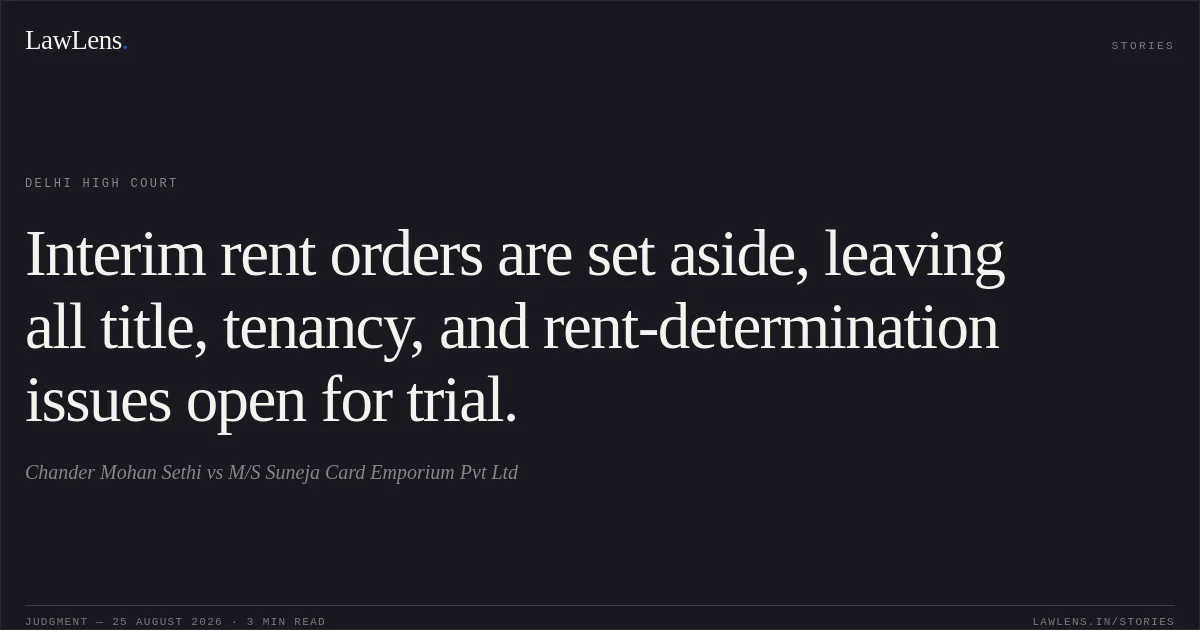
The High Court set aside the orders dated 4 May 2022, 10 July 2023 and 18 December 2024, without expressing any opinion on the merits of the suit or on the questions of title, adverse possession, limitation, landlord–tenant relationship or rent/occupation charges.
All such issues were left open for adjudication by the Trial Court on the basis of the pleadings, evidence already led and material on record.
Source reference: p.8, paras. 30–31The Trial Court was requested to endeavour to dispose of the suit preferably within three months, subject to its board.
Source reference: p.8, para. 32The petition and all pending applications were disposed of accordingly.
Source reference: p.9, para. 33Acts & Sections Cited
1 provisions across 1 statute referred to in this judgment. Each provision opens on LawLens.
Code of Civil Procedure, 19081
Original Court PDF
Chander Mohan SethivsM/S Suneja Card Emporium Pvt Ltd
Click to open original judgment
Original judgment, available to read, download and summarize on LawLens.in
![Courts will not interfere with transfers absent mala fides or violation of statutory rules.. M Ramya vs EMPLOYEES STATE INSURANCE CORPORATION (ESIC). CAT - ['Chennai']. LawLens](/stories/thumbnails/courts-will-not-interfere-with-transfers-absent-mala-fides-or-violation-of-statutory-rules-a6845e9ca6f548fca284c51c8351957f.webp)
![Courts cannot direct one-time recruitment age relaxation absent authority in the governing rules or advertisement.. UT OF PUDUCHERRY vs M ANDAL. CAT - ['Chennai']. LawLens](/stories/thumbnails/courts-cannot-direct-one-time-recruitment-age-relaxation-absent-authority-in-the-governing-895d78fde47143e2a8ed0207c4b6a44f.webp)
![A review cannot correct an allegedly erroneous decision absent an error apparent on the record.. Ajit Kumar Jha vs RAILWAY BOARD. CAT - ['Delhi']. LawLens](/stories/thumbnails/a-review-cannot-correct-an-allegedly-erroneous-decision-absent-an-error-apparent-on-the-re-8ac952fd4eba470c92f7da20af72a220.webp)