Facts
Respondent No. 5 (original petitioner) was subjected to a departmental inquiry and punished with the stoppage of one increment with cumulative effect.
Source reference: para. 12He challenged this in W.P. No. 3049/2014, impleading the Appellant (then S.P., now I.G.) as Respondent No. 5, alleging that the proceedings were initiated out of personal malafides.
Source reference: para. 2Specifically, Respondent No. 5 alleged the Appellant sought to grab his wife’s land for a senior official.
Source reference: para. 7A report by the DIG, Chambal Zone, dated 28.10.2013, supported these claims, describing the action as revengeful.
Source reference: para. 2, 9The Single Judge set aside the punishment and observed that the action was initiated with mala fide intention.
Source reference: para. 4The Appellant filed this writ appeal seeking to expunge these remarks, despite having failed to respond to notices during the original writ proceedings.
Source reference: para. 5, 8Issues
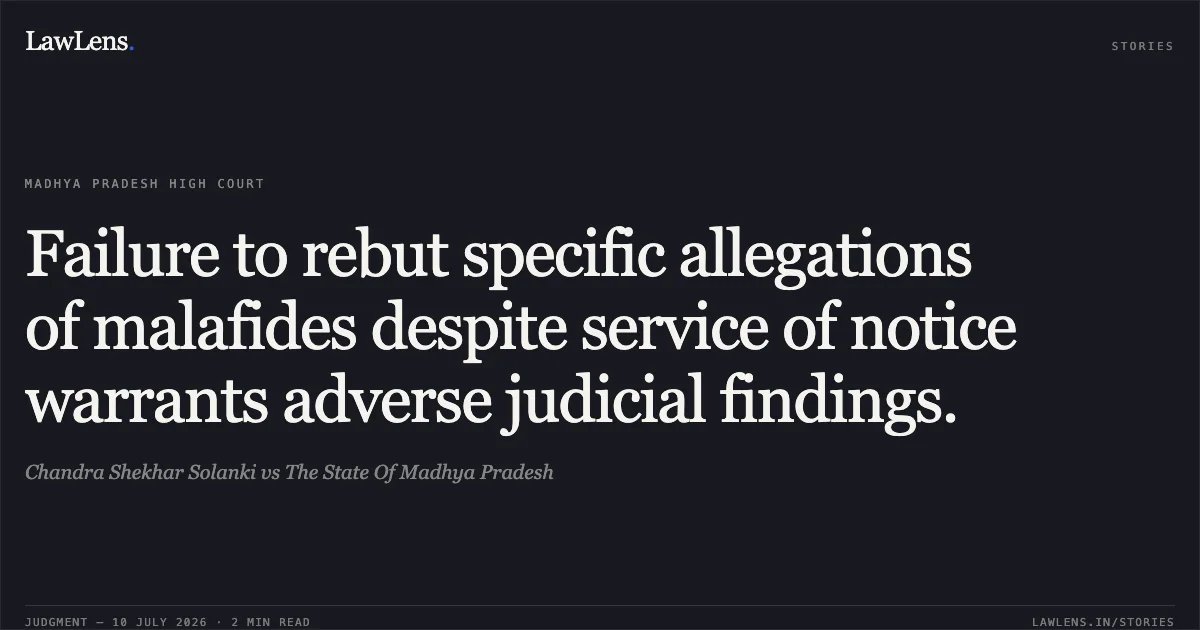
1. Whether a court can pass adverse remarks against an officer for malafide conduct if the officer was impleaded and served but failed to file a reply.
Source reference: para. 13-142. Whether the findings of malafides and the setting aside of the punishment order were legally sustainable given the Appellant's non-participation in the original hearing.
Source reference: para. 12Law Applied
Section 2 of the Madhya Pradesh Uchcha Nyayalaya (Khand Nyayapeeth ko Appeal) Adhiniyam, 2005 regarding writ appeals.
Source reference: para. 1The principle of Natural Justice, specifically the requirement that an officer must be given an opportunity to be heard before adverse remarks are passed against them.
Source reference: para. 13The principle that senior officers' influence can prejudice departmental findings by subordinates, and the doctrine that malafide exercise of power vitiates administrative actions.
Source reference: para. 9Reasoning
The Court noted that the Appellant was specifically impleaded to answer allegations of malice but failed to file a return despite repeated notices.
Source reference: para. 8, 14The Court rejected the argument that remarks were improper in the absence of a specific prayer for action against the Appellant, holding that if a court finds an action arbitrary or malafide, it has the jurisdiction to highlight such conduct.
Source reference: para. 13The Court observed that the DIG’s report explicitly stated the Appellant’s actions were intended to harass and were born of a "feeling of revenge" (pratishodh ki bhavna).
Source reference: para. 9Furthermore, the Court offered the Appellant a chance to remand the case for a fresh hearing on the condition of depositing costs (to be paid to the subordinate), but the Appellant refused, insisting on a decision on merits.
Source reference: para. 10-12Consequently, because the allegations of malice remained unrebutted by the Appellant despite opportunity, the Single Judge’s findings were deemed justified.
Source reference: para. 12, 14Holding
The High Court held that no illegality was committed in quashing the punishment orders or in passing adverse remarks, as the Appellant was given an opportunity to rebut the malafide allegations and chose not to do so.
The High Court dismissed the writ appeal, affirming the order of the Single Judge, and directed the departmental authorities to decide the matter afresh without being pressured by the Appellant.
Source reference: para. 15, 12Acts & Sections Cited
1 provisions across 1 statute referred to in this judgment. Linked provisions open on LawLens.
M.P. Uchcha Nyayalaya (Khand Nyayapeeth Ko Appeal) Adhiniyam, 20051
Original Court PDF
Chandra Shekhar SolankivsThe State Of Madhya Pradesh
Click to open original judgment
Original judgment, available to read, download and summarize on LawLens.in