Facts
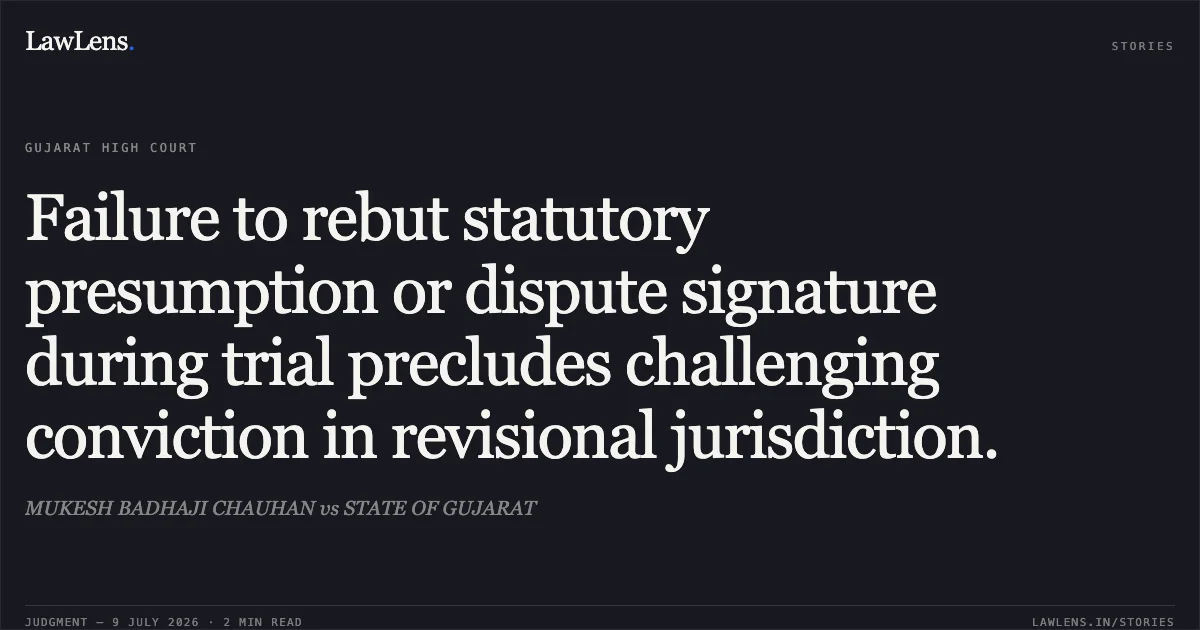
The applicant (original accused) challenged a judgment of the Special Sessions Judge, Ahmedabad, which upheld his conviction under Section 138 of the Negotiable Instruments (N.I.) Act.
Source reference: p.1-2The trial court had sentenced the applicant to one year of simple imprisonment and ordered compensation of ₹2,80,000.
Source reference: p.2The applicant contended that he did not know the complainant, had not borrowed the money, and that the signature on the disputed cheque was forged.
Source reference: p.3He further alleged that the complainant had obtained blank cheques from his brother and misused them.
Source reference: p.3During the revision, the applicant relied on a private handwriting expert report regarding a separate receipt to dispute his signature.
Source reference: p.4Issues
1. Whether the applicant successfully rebutted the statutory presumptions under Sections 118 and 139 of the N.I. Act regarding the existence of a legally enforceable debt.
Source reference: p.72. Whether the applicant could raise the defense of a forged signature at the revisional stage when no such application for expert verification was moved during the trial.
Source reference: p.6-7Law Applied
Section 138 of the Negotiable Instruments Act, 1881, regarding the dishonor of cheques for insufficiency of funds.
Source reference: p.2Statutory presumptions under Sections 118 and 139 of the N.I. Act, which mandate that unless the contrary is proved, a holder of a cheque is presumed to have received it for the discharge of a debt or liability.
Source reference: p.7The evidentiary standard of "preponderance of probabilities" for the accused's defense.
Source reference: p.8The Supreme Court precedent in Tedhi Singh v. Narayan Dass Mahant (2022) 6 SCC 735, which establishes that failure to reply to a statutory notice limits the accused's ability to later challenge the complainant's financial capacity or raise specific defenses.
Source reference: p.8Reasoning
The court found that the applicant failed to respond to the statutory legal notice despite it being duly served.
Source reference: p.8Applying Tedhi Singh, the court noted that this failure weakened the applicant's later defenses regarding the complainant's financial capacity.
Source reference: p.8Regarding the forgery claim, the court observed that the applicant never applied for an FSL or handwriting expert examination during the trial.
Source reference: p.7The handwriting expert report submitted during the revision was deemed irrelevant because it examined a signature on a receipt, not the signature on the disputed cheque itself.
Source reference: p.6Conversely, the complainant provided oral testimony from witnesses and documentary evidence, including Income Tax returns and ledger accounts, specifically showing a payment entry of ₹1,20,000.
Source reference: p.9The court concluded that the applicant failed to meet the "preponderance of probabilities" standard required to shift the onus back to the complainant.
Source reference: p.8-9Holding
The High Court dismissed the Revision Application, confirming the conviction and sentence.
The court held that there was no jurisdictional error or palpable illegality in the concurrent findings of the lower courts.
Source reference: p.9The applicant was directed to repay the entire cheque amount within four weeks and surrender to the jail authorities to undergo the sentence.
Source reference: p.10The suspension of the sentence was revoked, and the complainant was granted liberty to withdraw the amounts already deposited in court.
Source reference: p.10Acts & Sections Cited
10 provisions across 3 statutes referred to in this judgment. Each provision opens on LawLens.
Code of Criminal Procedure, 19733
Negotiable Instruments Act, 18813
Indian Penal Code, 18604
Original Court PDF
MUKESH BADHAJI CHAUHANvsSTATE OF GUJARAT
Click to open original judgment
Original judgment, available to read, download and summarize on LawLens.in