Facts
The respondent-complainant filed a complaint under Section 138 of the Negotiable Instruments Act, alleging that the petitioner-accused borrowed ₹2,70,000 for personal needs and issued a cheque (dated 21.08.2013) which was dishonored due to "insufficient funds" on 12.11.2013.
Source reference: p. 2Despite a legal notice issued on 22.11.2013, the accused failed to pay.
Source reference: p. 3The Chief Judicial Magistrate, Lahaul & Spiti at Kullu, convicted the accused on 01.04.2023, sentencing him to three months of simple imprisonment and ₹3,50,000 in compensation.
Source reference: p. 2This was affirmed by the Additional Sessions Judge, Kullu, on 04.10.2023.
Source reference: p. 1, 3The accused challenged these concurrent findings via criminal revision, while failing to comply with interim orders to deposit 20% of the compensation.
Source reference: p. 4Issues
1. Whether the courts below correctly applied the statutory presumptions under Sections 118 and 139 of the Negotiable Instruments Act in the absence of a probable defense.
Source reference: p. 52. Whether the complaint was premature or void due to the alleged non-service of the statutory demand notice.
Source reference: p. 13Law Applied
The court applied Sections 118 and 139 of the Negotiable Instruments Act, which mandate a presumption that a cheque is issued for the discharge of a debt or liability.
Source reference: p. 5The court relied on M/s Laxmi Dyechem v. State of Gujarat (2013) regarding the accused's burden to raise a "probable defense" through a preponderance of probabilities to rebut said presumption.
Source reference: p. 6-8The court utilized Bir Singh v. Mukesh Kumar (2019), establishing that a drawer is liable even if a cheque is handed over blank, provided the signatures are admitted.
Source reference: p. 11-12Regarding service of notice, the court applied Section 27 of the General Clauses Act, 1897, and the "deemed service" doctrine from C.C. Alavi Haji v. Palapetty Muhammed (2007) and Krishna Swaroop Agarwal v. Arvind Kumar (2025).
Source reference: p. 14-17Reasoning
The court observed that the accused did not dispute his signatures on the cheque, thereby triggering the statutory presumptions under the Act.
Source reference: p. 5The accused failed to lead any defense evidence and his cross-examination of the complainant did not establish a probable alternative version of events.
Source reference: p. 5, 9The court rejected the argument that the cheque was "blank," noting that under Bir Singh, the voluntary handing over of a signed cheque leaf fulfills the criteria for prosecution.
Source reference: p. 11On the procedural issue of notice, the court found that since the complainant sent the notice to the correct address (where summons were later successfully served), service must be deemed effective under Section 27 of the General Clauses Act.
Source reference: p. 15The court calculated that after allowing 7 days for postal transit and the mandatory 15-day notice period, the complaint filed on 03.01.2014 was not premature.
Source reference: p. 18-25Holding
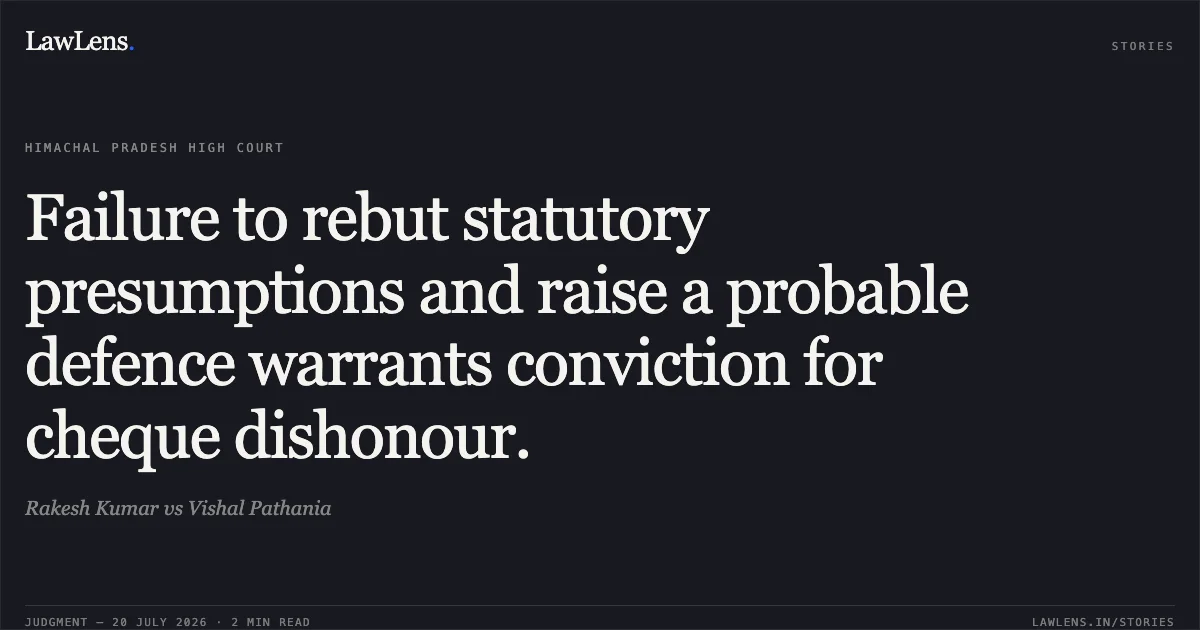
The High Court dismissed the revision petition, holding that the complainant successfully proved all ingredients of Section 138 and the accused failed to rebut the legal presumptions.
The court affirmed the concurrent judgments of conviction and sentence; the petitioner was directed to surrender before the Trial Court within two months to serve his sentence, and all interim protections were vacated.
Source reference: p. 28, 29Acts & Sections Cited
9 provisions across 3 statutes referred to in this judgment. Each provision opens on LawLens.
Code of Criminal Procedure, 19733
General Clauses Act, 18971
Negotiable Instruments Act, 18815
Original Court PDF
Rakesh KumarvsVishal Pathania
Click to open original judgment
Original judgment, available to read, download and summarize on LawLens.in