Facts
The Respondent No. 2 (complainant) filed a complaint under Section 138 of the Negotiable Instruments Act (NI Act) alleging that the Petitioner issued a cheque for Rs. 2,50,000/- dated May 4, 2019, to repay a loan, which was returned unpaid with the remark "Account Closed" on May 7, 2019
Source reference: p. 2Despite a legal notice dated June 4, 2019, the Petitioner failed to pay. The Petitioner admitted to signing the cheque and receiving the notice but contended the loan was only for Rs. 50,000/- (repaid with interest) and that the cheque was a blank security cheque misused by the complainant
Source reference: p. 2-3The Trial Court convicted the Petitioner on July 7, 2023, sentencing him to three months' imprisonment and a fine of Rs. 3,50,000/-; this was upheld by the Appellate Court on December 22, 2023
Source reference: p. 1-2Issues
1. Whether the impugned order upholding the conviction under Section 138 of the NI Act suffers from any error, illegality, or perversity warranting interference under the court's revisional jurisdiction
Source reference: p. 7 / para. 122. Whether the Petitioner successfully rebutted the statutory presumptions under Sections 118 and 139 of the NI Act regarding the existence of a legally enforceable debt
Source reference: p. 8 / para. 14-15Law Applied
The court applied Section 138 of the NI Act, which criminalizes the dishonor of cheques issued for the discharge of debt
Source reference: p. 7It specifically relied on the statutory presumptions under Section 118 (presumption of consideration) and Section 139 (presumption that the holder received the cheque for the discharge of debt)
Source reference: p. 3-4The court followed the precedent in Rohitbhai Jivanlal Patel v. State of Gujarat, establishing that once signatures are admitted, the onus shifts to the accused to rebut the presumption with cogent evidence
Source reference: p. 6, 8It further noted that under Kishan Rao v. Shankargouda, failure to provide transaction records or police complaints regarding misused cheques weakens the defense
Source reference: p. 8Reasoning
The court reasoned that all essential ingredients of Section 138 were satisfied: the cheque was issued from the Petitioner's account, presented timely, dishonored, and followed by a legal notice to which the Petitioner failed to comply
Source reference: p. 7-8The court found that because the Petitioner admitted his signature on the cheque and the receipt of the legal notice, a mandatory legal presumption arose in favor of the complainant
Source reference: para. 14The court observed that the Petitioner provided only "bald denials" and "unsubstantiated claims" regarding the repayment of the loan and the status of the cheque as "security"
Source reference: p. 8Crucially, the Petitioner failed to produce any documentary evidence (receipts, bank records) of the alleged repayment or any police complaint regarding the alleged misuse of his security cheque
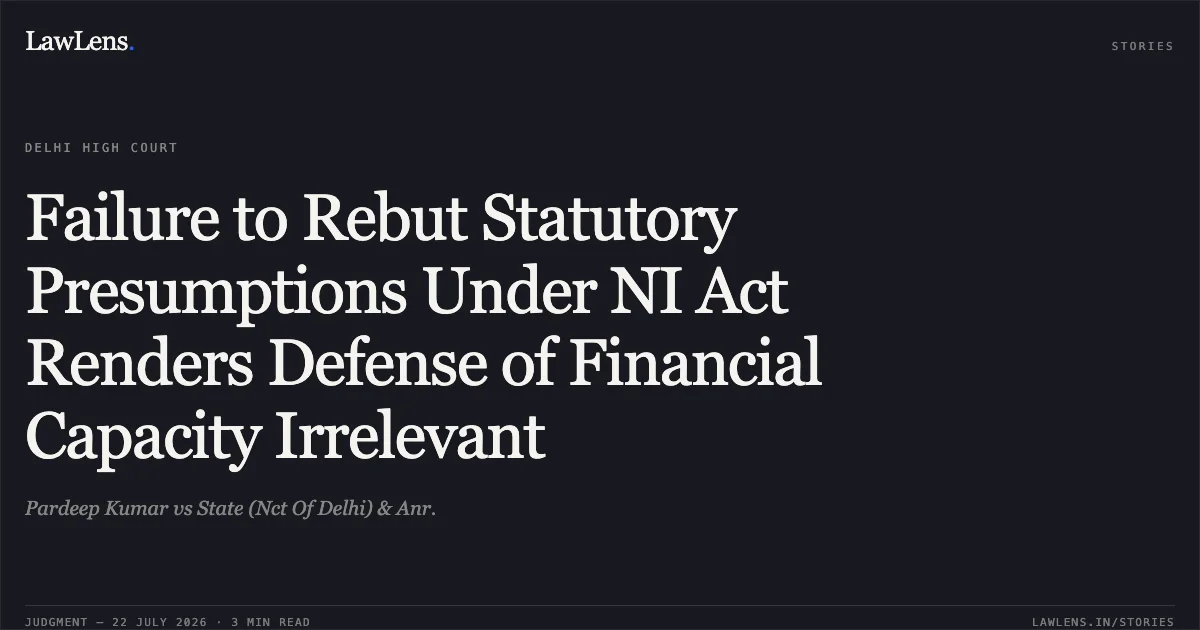
Source reference: p. 4, 9Consequently, arguments regarding the complainant's financial capacity or tax returns were deemed irrelevant as the Petitioner failed to discharge the initial evidentiary burden to shift the onus back to the complainant
Source reference: p. 9Holding
The High Court dismissed the revision petition and upheld the conviction and sentence passed by the lower courts
The court held that there was no perversity in the findings, as the Petitioner failed to rebut the statutory presumptions under Sections 118 and 139 of the NI Act
Source reference: p. 9The Petitioner was ordered to serve the remainder of his three-month simple imprisonment and pay the fine of Rs. 3,50,000/- to the Respondent No. 2
Source reference: p. 10Acts & Sections Cited
4 provisions across 2 statutes referred to in this judgment. Each provision opens on LawLens.
Code of Criminal Procedure, 19731
Negotiable Instruments Act, 18813
Original Court PDF
Pardeep KumarvsState (Nct Of Delhi) & Anr.
Click to open original judgment
Original judgment, available to read, download and summarize on LawLens.in