Facts
The petitioner, Ram Swaroop Sinha, was accused of failing to repay a loan of ₹3,00,000 borrowed from the complainant-informant, a friend.
Source reference: para. 4A complaint (C/1 Case No. 2077 of 2015) was filed, which was referred to the police under Section 156(3) of the Cr.P.C., resulting in Sakchi P.S. Case No. 193 of 2016.
Source reference: para. 5Following an investigation, the police submitted a charge sheet, and the Chief Judicial Magistrate, Jamshedpur, took cognizance of offences under Sections 406 (Criminal Breach of Trust) and 420 (Cheating) of the Indian Penal Code (IPC) via an order dated 17.03.2017.
Source reference: para. 2, 5The petitioner moved the High Court under Section 482 of the Cr.P.C. to quash the proceeding, arguing that the dispute was purely civil and did not meet the criminal ingredients of the alleged offences.
Source reference: para. 2, 6-8Issues
1. Whether the mere inability or failure to return a loan amount, without evidence of dishonest intention at the inception of the transaction, constitutes the offence of Cheating under Section 420 of the IPC.
Source reference: para. 10, 122. Whether the retention of money without proof of dishonest misappropriation or disposal is sufficient to establish a case of Criminal Breach of Trust under Section 406 of the IPC.
Source reference: para. 6, 13Law Applied
Section 406 and Section 420 of the IPC.
Source reference: no citationCriminal breach of trust requires showing that the accused not only retained money but did so dishonestly or disposed of it dishonestly (Binod Kumar & Others v. State of Bihar & Another, 2014).
Source reference: para. 6A breach of contract only amounts to cheating if fraudulent inducement and mens rea (dishonest intention) existed at the very inception of the transaction (Satish Chandra Ratan Lal Shah v. State of Gujarat & Anr., 2019 and Uma Shankar Gopalika v. State of Bihar & Another, 2005).
Source reference: para. 10-11Reasoning
The court observed that the crux of the allegation was simply a failed loan repayment.
Source reference: para. 4, 12Applying the Satish Chandra precedent, the court reasoned that the record lacked any evidence suggesting the petitioner played a deception or had a dishonest intention at the beginning of the transaction, which is a condition precedent for Section 420 IPC.
Source reference: para. 10, 12Regarding Section 406 IPC, the court noted that the mere retention of funds does not satisfy the legal requirement unless there is clear evidence of dishonest misappropriation or disposal.
Source reference: para. 6, 13Since the allegations, even if accepted as true, only demonstrated a civil liability (repayment of a loan) and failed to fulfill the essential criminal ingredients of entrustment or fraudulent inducement, the court determined that the criminal proceedings were an abuse of the process of law.
Source reference: para. 13Holding
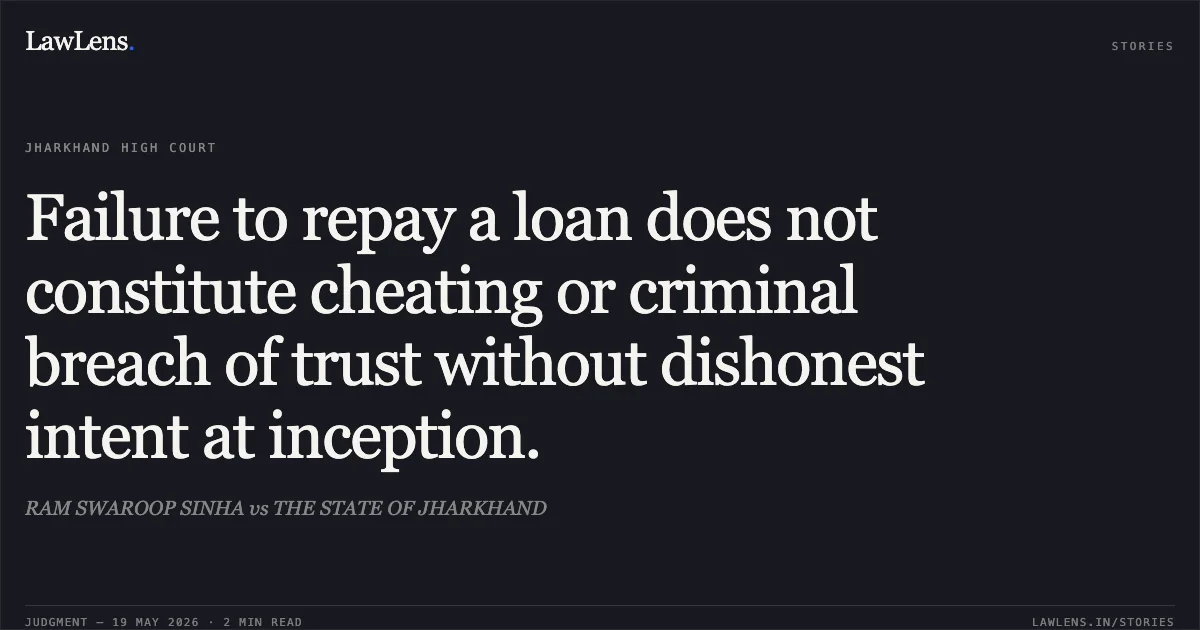
The court held that inability to repay a loan does not invite criminal prosecution under Sections 406 or 420 of the IPC in the absence of evidence showing dishonest intention at the inception of the loan or dishonest misappropriation of entrusted property.
The High Court allowed the petition and quashed the entire criminal proceeding, including the cognizance order dated 17.03.2017.
Source reference: para. 14-15Acts & Sections Cited
6 provisions across 2 statutes referred to in this judgment. Each provision opens on LawLens.
Code of Criminal Procedure, 19732
Indian Penal Code, 18604
Original Court PDF
RAM SWAROOP SINHAvsTHE STATE OF JHARKHAND
Click to open original judgment
Original judgment, available to read, download and summarize on LawLens.in