Facts
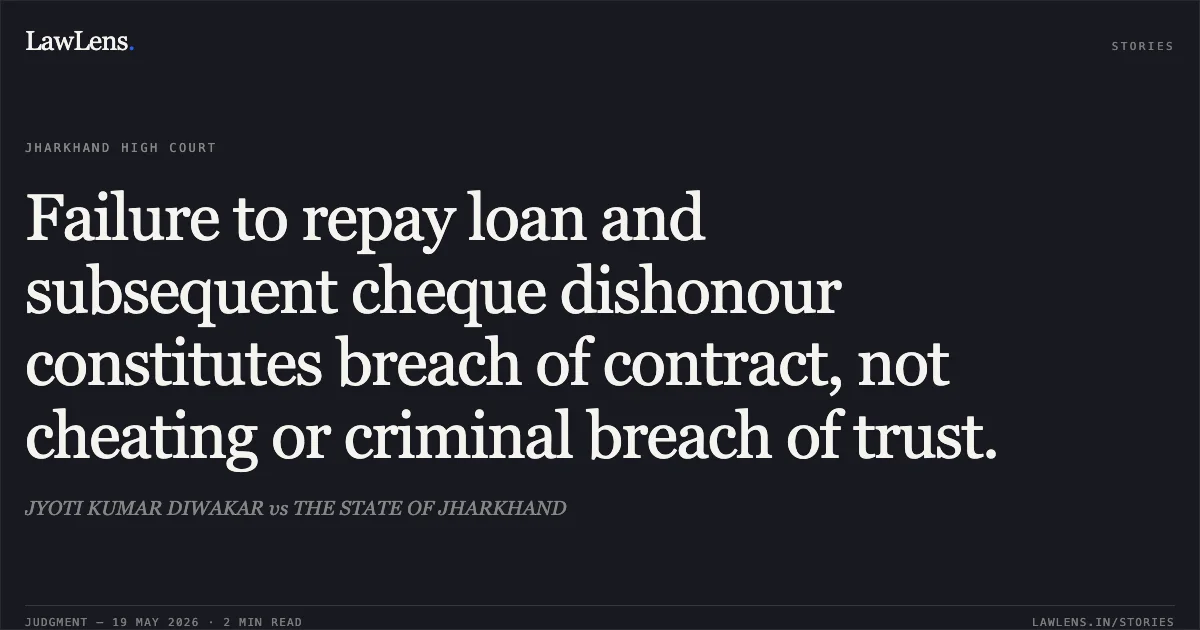
The petitioner, Jyoti Kumar Diwakar, was accused of taking a loan of Rs. 8,00,000/- from the informant and failing to repay it.
Source reference: para. 4Although the petitioner issued cheques twice to satisfy the debt, they were dishonoured.
Source reference: para. 4Consequently, an FIR (B.S. City P.S. Case No. 37 of 2024) was registered for offences punishable under Sections 406 (Criminal Breach of Trust) and 420 (Cheating) of the Indian Penal Code (IPC).
Source reference: para. 2The petitioner moved the High Court under Section 528 of the BNSS 2023 to quash the FIR, arguing that a mere failure to repay a loan or a breach of contract does not constitute a criminal offence.
Source reference: para. 2-3Issues
1. Whether the failure to repay a loan amount and the subsequent dishonour of cheques, without an allegation of dishonest misappropriation, constitutes the offence of criminal breach of trust under Section 406 IPC.
Source reference: para. 42. Whether a breach of contract amounts to cheating under Section 420 IPC in the absence of fraudulent or dishonest intention at the very inception of the transaction.
Source reference: para. 5, 11Law Applied
The court applied the definition of criminal breach of trust under Section 405 IPC (punishable under Section 406), noting that mere retention of money without dishonest disposal does not suffice, as established in Binod Kumar v. State of Bihar.
Source reference: para. 4For cheating under Section 420 IPC, the court relied on Uma Shankar Gopalika v. State of Bihar and Satish Chandra Ratan Lal Shah v. State of Gujarat, holding that mens rea—specifically a fraudulent inducement at the inception of the agreement—is a condition precedent; a subsequent failure to fulfil a promise does not satisfy this requirement.
Source reference: para. 5, 7, 11Reasoning
The court observed that the core of the allegation was a purely civil dispute regarding the non-repayment of a loan.
Source reference: para. 12Regarding Section 406 IPC, the court reasoned that while the petitioner retained the money, there was no evidence or allegation that he dishonestly disposed of it or intended to cause wrongful loss, which is essential for criminal breach of trust.
Source reference: para. 4, 13Regarding Section 420 IPC, the court found that the FIR lacked any assertion that the petitioner played a deception at the "very inception" of the loan transaction.
Source reference: para. 6, 13Citing Satish Chandra Ratan Lal Shah, the court emphasized that the mere inability to return a loan due to economic crisis or other reasons cannot be criminalized unless a dishonest representation is inferred from the start.
Source reference: para. 11Since the petitioner attempted to repay via cheques (even if they were dishonoured), a fraudulent intent at the beginning could not be established.
Source reference: para. 12-13Holding
The Court answered both issues in the negative, holding that the continuation of criminal proceedings would amount to an abuse of the process of law.
The High Court allowed the petition and quashed the FIR being B.S. City P.S. Case No. 37 of 2024 against the petitioner.
Source reference: para. 14-15Acts & Sections Cited
6 provisions across 2 statutes referred to in this judgment. Each provision opens on LawLens.
Bharatiya Nagarik Suraksha Sanhita, 20231
Indian Penal Code, 18605
Original Court PDF
JYOTI KUMAR DIWAKARvsTHE STATE OF JHARKHAND
Click to open original judgment
Original judgment, available to read, download and summarize on LawLens.in


