Facts
The appellant-husband’s marriage with the respondent was solemnized on 21 January 2014. According to the husband, the respondent intermittently visited the matrimonial home, insisted that he live separately from his parents, and thereafter refused to resume cohabitation. The parties have lived separately since May 2016 following allegations of assault and the registration of an FIR.
Source reference: pp. 1–2The husband had earlier instituted a petition for restitution of conjugal rights under Section 9 of the Hindu Marriage Act, 1955, which was decreed in his favour on 10 July 2018. Despite the decree, the parties did not resume matrimonial cohabitation. The respondent instituted proceedings under Section 498A IPC, Sections 3 and 4 of the Dowry Prohibition Act, and Section 125 CrPC.
Source reference: pp. 2–4The husband subsequently filed Matrimonial Case No. 26 of 2020 seeking dissolution of marriage by divorce. The Principal Judge, Family Court, Aurangabad, dismissed the suit on 2 July 2024. The husband challenged that dismissal in the present appeal. The respondent disputed the allegations and made counter-allegations of physical and mental cruelty.
Source reference: pp. 2–4Issues
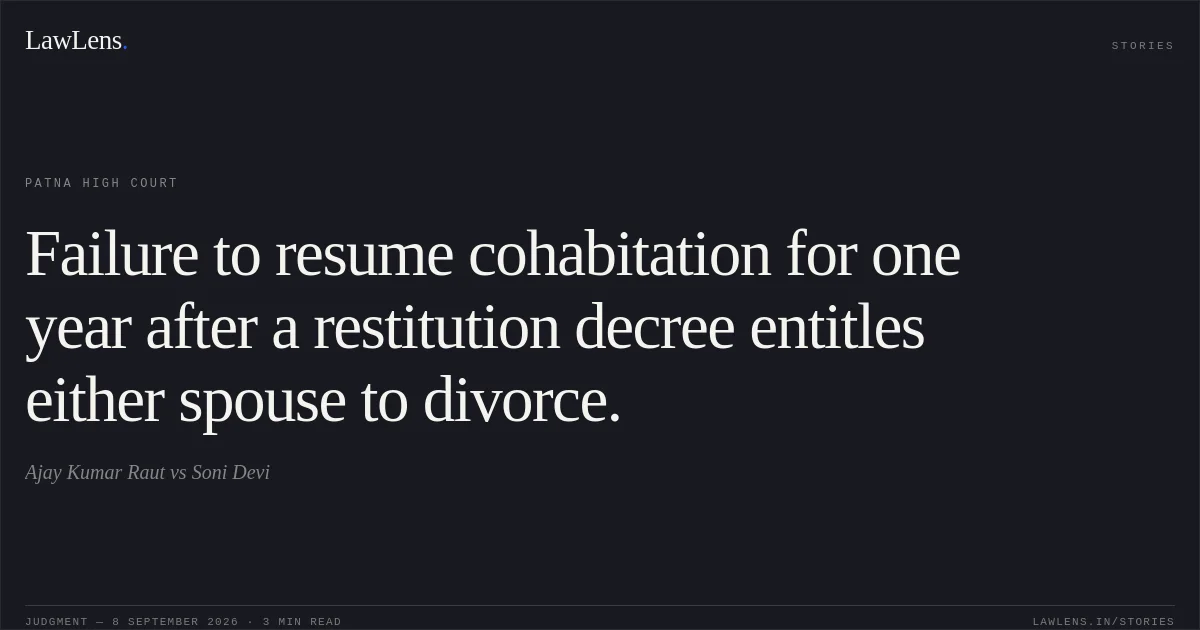
Whether the appellant was entitled to a decree of divorce under Section 13(1-A)(ii) of the Hindu Marriage Act, 1955, on the ground that there had been no restitution of conjugal rights for one year or more after the decree for restitution of conjugal rights?
Source reference: para. 9Whether the judgment and decree dismissing the husband’s matrimonial suit were legally sustainable?
Source reference: para. 12Law Applied
Section 13(1-A)(ii) of the Hindu Marriage Act, 1955, permits either spouse to seek dissolution of marriage where there has been no restitution of conjugal rights between the parties for a period of one year or more after the passing of a decree for restitution of conjugal rights in proceedings to which they were parties.
Source reference: para. 9The provision creates an independent statutory ground for divorce once its requirements are satisfied; the court must therefore examine whether cohabitation or restitution occurred after the decree and whether the statutory period had elapsed.
Source reference: para. 9Reasoning
The Court found that the husband had obtained a decree for restitution of conjugal rights on 10 July 2018 and that the parties had remained separated thereafter without restoration of their matrimonial relationship.
Source reference: para. 8The pending criminal and maintenance proceedings, together with the parties’ prolonged separation, demonstrated that their relationship was neither happy nor cordial.
Source reference: para. 7Since more than one year had elapsed after the decree without restitution of conjugal rights, the statutory condition under Section 13(1-A)(ii) was satisfied.
Source reference: paras. 10–12The Family Court failed to apply this relevant statutory provision and therefore erred in dismissing the divorce petition.
Source reference: paras. 10–12Although paragraph 10 uses the expression that the marital relationship “were restored,” the Court’s operative reasoning and conclusion proceeded on the basis that there had been no restitution or resumption of cohabitation after the decree.
Source reference: para. 10Holding
The appeal was allowed.
The Patna High Court set aside the judgment and decree dated 2 July 2024 passed by the Principal Judge, Family Court, Aurangabad, in Matrimonial Case No. 26 of 2020.
Source reference: paras. 11–13Applying Section 13(1-A)(ii) of the Hindu Marriage Act, the Court dissolved the marriage between Ajay Kumar Raut and Soni Devi by a decree of divorce and directed the Registry to draw up the decree at the earliest.
Source reference: paras. 11–13Acts & Sections Cited
6 provisions across 4 statutes referred to in this judgment. Each provision opens on LawLens.
Hindu Marriage Act, 19552
Indian Penal Code, 18601
Code of Criminal Procedure, 19731
Original Court PDF
Ajay Kumar RautvsSoni Devi
Click to open original judgment
Original judgment, available to read, download and summarize on LawLens.in