Facts
On 3 June 2006, Customs/DRI officials intercepted truck No. UP-53/1662 near Motipur on NH-28 and found the appellant occupying the vehicle. No contraband was recovered from his person; however, 25 packets allegedly containing ganja, weighing 110 kg, were recovered from a concealed wooden chamber beneath the truck floor.
Source reference: paras. 3–4; pp. 2–5The appellant’s statements under Section 67 of the NDPS Act were recorded, and the seized substance and truck were taken into custody.
Source reference: para. 3; pp. 3–4The registration number displayed on the truck was subsequently found to relate to a scooter, and the vehicle’s ownership could not be verified.
Source reference: para. 3; pp. 4–5The trial court initially proceeded with the matter as a warrant trial and framed charges on 22 September 2008; the procedural error was later corrected, and the charge under Section 20(b)(ii)(C) of the NDPS Act was reframed on 3 September 2012.
Source reference: para. 6; pp. 5–6Five prosecution witnesses were examined, including Customs officials, an independent seizure witness, and the godown in-charge.
Source reference: paras. 7–9; pp. 6–8The trial court convicted the appellant under Section 20(b)(ii)(C) and sentenced him to ten years’ rigorous imprisonment and a fine of ₹1,00,000, with one year’s rigorous imprisonment in default.
Source reference: para. 2; p. 2Issues
1. Whether the alleged non-compliance with Sections 42, 50 and 52-A of the NDPS Act vitiated the search, seizure, sampling or conviction?
Source reference: paras. 34–42; pp. 18–222. Whether the prosecution proved through reliable scientific evidence that all 25 seized packets contained ganja?
Source reference: paras. 44–47; pp. 22–283. Whether the appellant could be convicted for possessing or transporting a commercial quantity under Section 20(b)(ii)(C) of the NDPS Act?
Source reference: paras. 46–49; pp. 27–294. If the conviction under Section 20(b)(ii)(C) was unsustainable, what lesser conviction and sentence were warranted?
Source reference: paras. 50–54; pp. 29–31Law Applied
The Court applied Section 43 of the NDPS Act, holding that seizure from a vehicle intercepted in transit on a public road attracts Section 43 rather than Section 42.
Source reference: para. 34; p. 18Section 50 was held applicable only to personal searches and not to recovery from a vehicle or a concealed compartment therein.
Source reference: para. 35; p. 19Sections 35 and 54 permit presumptions regarding culpable mental state and possession only after the prosecution establishes the foundational facts of possession and recovery.
Source reference: para. 29; p. 16The Court considered Section 52-A and held, relying on Narcotics Control Bureau v. Kashif , 2024 INSC 1045, and Bharat Aambale v. State of Chhattisgarh , 2025 INSC 78, that non-compliance or incomplete compliance with the prescribed sampling procedure is not automatically fatal unless it creates doubt regarding the identity or integrity of the seized substance.
Source reference: paras. 36–41; pp. 19–22However, the NCB Standing Order No. 1/88 requires representative sampling from the seized packages, ordinarily by drawing duplicate samples from each package or appropriately constituted lot, after homogenisation.
Source reference: paras. 45–45.1; pp. 22–27Section 20(b)(ii)(C) applies to commercial quantity, whereas Section 20(b)(ii)(B) applies to an intermediate quantity.
Source reference: paras. 48–50; pp. 28–29Procedural irregularities in the trial do not warrant interference under Section 465 Cr.P.C., corresponding to Section 511 BNSS, absent demonstrated prejudice.
Source reference: para. 16.1; pp. 10–11Reasoning
The Court held that the interception occurred while the truck was in transit on a public highway; therefore, Section 43, and not Section 42, governed the seizure.
Source reference: para. 34; p. 18Since the ganja was recovered from a secret chamber in the truck rather than from the appellant’s person, Section 50 was not attracted.
Source reference: para. 35; p. 19Although the samples were not drawn before a Magistrate, the Court found substantial compliance because samples were drawn on the date of seizure in the presence of an independent witness, sealed, forwarded for chemical examination without unexplained delay, and a second set was produced in sealed condition.
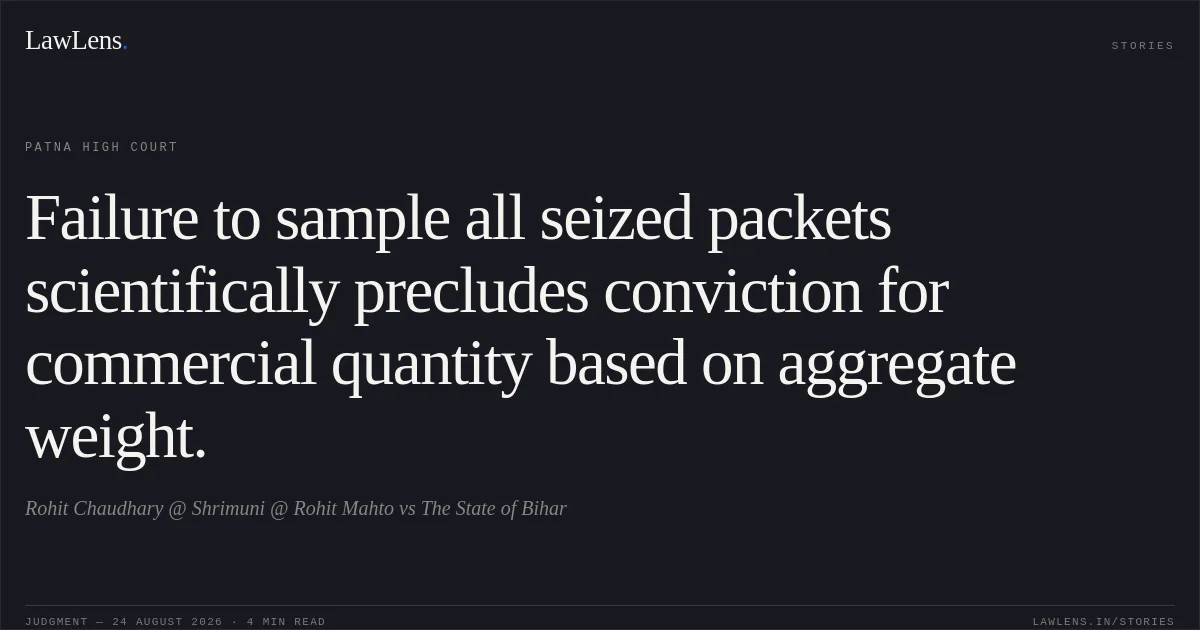
Source reference: paras. 36–41; pp. 19–22The decisive defect concerned the representativeness of the samples. The seizure memo recorded that only three samples of 25 grams each were drawn from three packets, while PW-4 stated that sampling was conducted from only one packet.
Source reference: para. 45.2; pp. 27–28The remaining 22 packets were not scientifically examined. Consequently, the chemical report established that the substance in the sampled packets was ganja, but did not reliably establish the identity of the substance in the unsampled packets.
Source reference: paras. 46–47; pp. 27–28Assuming equal distribution among the 25 packets, the quantity represented by the three sampled packets was approximately 13.2 kg, which constituted an intermediate rather than commercial quantity.
Source reference: paras. 45.3, 47–48; pp. 27–28The prosecution therefore failed to prove the essential ingredient of commercial quantity necessary for conviction under Section 20(b)(ii)(C), although recovery and possession of the sampled quantity were sufficiently established.
Source reference: paras. 46–49; pp. 27–29Holding
The appeal was partly allowed.
The conviction under Section 20(b)(ii)(C) of the NDPS Act was set aside and modified to conviction under Section 20(b)(ii)(B), concerning an intermediate quantity of ganja.
Source reference: paras. 50, 52–53; pp. 29–31Considering that the appellant had already undergone approximately seven years’ custody, the rigorous-imprisonment sentence was reduced to the period already undergone.
Source reference: para. 51; p. 30The fine of ₹1,00,000 was maintained, with one year’s rigorous imprisonment in default.
Source reference: para. 52; p. 30The appellant was directed to be released forthwith upon payment of the fine, unless required in another case; failing payment, he was to undergo the default sentence and thereafter be released in accordance with law.
Source reference: para. 54; p. 31Acts & Sections Cited
15 provisions across 3 statutes referred to in this judgment. Linked provisions open on LawLens.
Narcotic Drugs and Psychotropic Substances Act, 1985
Code of Criminal Procedure, 19732
Bharatiya Nagarik Suraksha Sanhita, 20231
Original Court PDF
Rohit Chaudhary @ Shrimuni @ Rohit MahtovsThe State of Bihar
Click to open original judgment
Original judgment, available to read, download and summarize on LawLens.in