Facts
The appellant was apprehended on 29.04.2016 near Bokaro river by a police raiding party led by P.W.-5 (Officer-in-Charge, Muffasil P.S.).
Source reference: p. 2Upon a search of his person, a country-made pistol and four .303 bore cartridges were allegedly recovered from his waist and pocket.
Source reference: p. 2-3The appellant was convicted by the Additional Sessions Judge–XII, Hazaribagh, on 27.02.2019 under Sections 25(1-B)a and 26 of the Arms Act and sentenced to rigorous imprisonment for three and four years respectively, to run concurrently.
Source reference: p. 1-2The appellant challenged this conviction on the grounds of procedural lapses and lack of evidence.
Source reference: p. 7Issues
1. Whether the prosecution proved the search and seizure beyond reasonable doubt given the procedural irregularities and lack of independent witnesses
Source reference: p. 7, para 152. Whether the conviction is sustainable in the absence of a proven sanction order and forensic evidence regarding the efficacy of the arms
Source reference: p. 7, para 15Law Applied
The court applied the evidentiary requirements of the Arms Act, 1959, specifically Sections 25(1-B)a and 26.
Source reference: p. 2It emphasized the necessity of a valid Sanction Order for prosecution under the Act.
Source reference: p. 6, 7The court relied on the best evidence rule, requiring identification of seized articles (marking/sealing) and expert verification through a Forensic Report to establish the "firearm" status of the seized items.
Source reference: p. 7Procedural safeguards regarding search and seizure, including the presence of independent witnesses and the "personal search" of the raiding officer before searching the accused, were also treated as essential to maintain the integrity of the recovery.
Source reference: p. 7Reasoning
The High Court found the prosecution's case riddled with fatal lacunae. First, there were no independent witnesses to the search, and the raiding officer (P.W.-5) failed to offer himself for a personal search before searching the appellant.
Source reference: p. 7Second, testimonies of the raiding party (P.W.-1 and P.W.-2) were contradictory regarding who conducted the search.
Source reference: p. 4Third, the seized arms and ammunition were neither marked nor sealed at the time of seizure, and the Investigating Officer (P.W.-6) admitted receiving them in an unsealed condition, creating a gap in the chain of custody.
Source reference: p. 4, 5, 6Fourth, the prosecution failed to examine a forensic expert or provide a report proving the seized items were functional firearms.
Source reference: p. 6Finally, the court noted that the mandatory sanction order (Ext.-6) was not legally proved, and the case diary showed no request for such sanction.
Source reference: p. 6, 7Holding
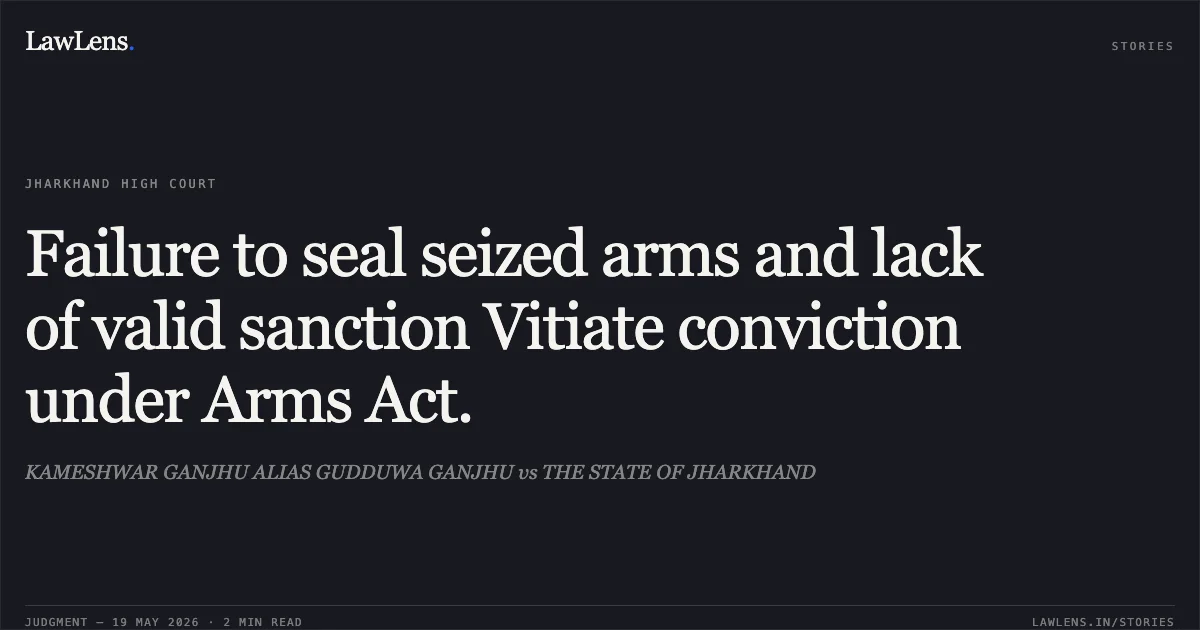
The Court held that the conviction was not sustainable as the prosecution failed to adhere to mandatory procedural safeguards and failed to prove the recovery/efficacy of the arms beyond a reasonable doubt.
The appeal was allowed, and the judgment of conviction and order of sentence dated 27.02.2019 were quashed and set aside. The appellant was discharged from the liability of his bail bond.
Source reference: p. 7-8Acts & Sections Cited
2 provisions across 1 statute referred to in this judgment. Each provision opens on LawLens.
Arms Act, 19592
Original Court PDF
KAMESHWAR GANJHU ALIAS GUDDUWA GANJHUvsTHE STATE OF JHARKHAND
Click to open original judgment
Original judgment, available to read, download and summarize on LawLens.in