Facts
The petitioner electricity company filed a case against the respondent alleging theft of electricity for commercial purposes (consuming 8.5 K.V.A.) via a welding machine and grinder.
Source reference: para 5The Special Court (Electricity), Bhopal, vide judgment dated 18.11.2013, acquitted the respondent of charges under Sections 135 and 139 of the Electricity Act, 2003.
Source reference: para 1-2The petitioner challenged this acquittal, asserting that the trial court failed to appreciate evidence proving the offense beyond reasonable doubt.
Source reference: para 3Issues
1. Whether the trial court’s judgment of acquittal was perverse or based on a manifest error in the appreciation of evidence regarding the alleged theft of electricity.
Source reference: para 3, 92. Whether the failure to seize the material objects (welding machine and grinder) used for the alleged theft was fatal to the prosecution's case.
Source reference: para 5Law Applied
Section 378(3) of the Code of Criminal Procedure regarding appeals against acquittal.
Source reference: para 1Ramesh Babulal Doshi v. State of Gujarat (1996) 9 SCC 225, which mandates that an appellate court should only disturb an acquittal if the trial court's findings are "palpably wrong" or "manifestly erroneous".
Source reference: para 6Ajit Savant Majagvai v. State of Karnataka (1997) 7 SCC 110, holding that if two reasonable views are possible, the view favoring the accused must be adopted.
Source reference: para 7Nikhil Chandra Mondal v. State of W.B. (2023) 6 SCC 605, which reinforces the double presumption of innocence in favor of an acquitted accused.
Source reference: para 8Reasoning
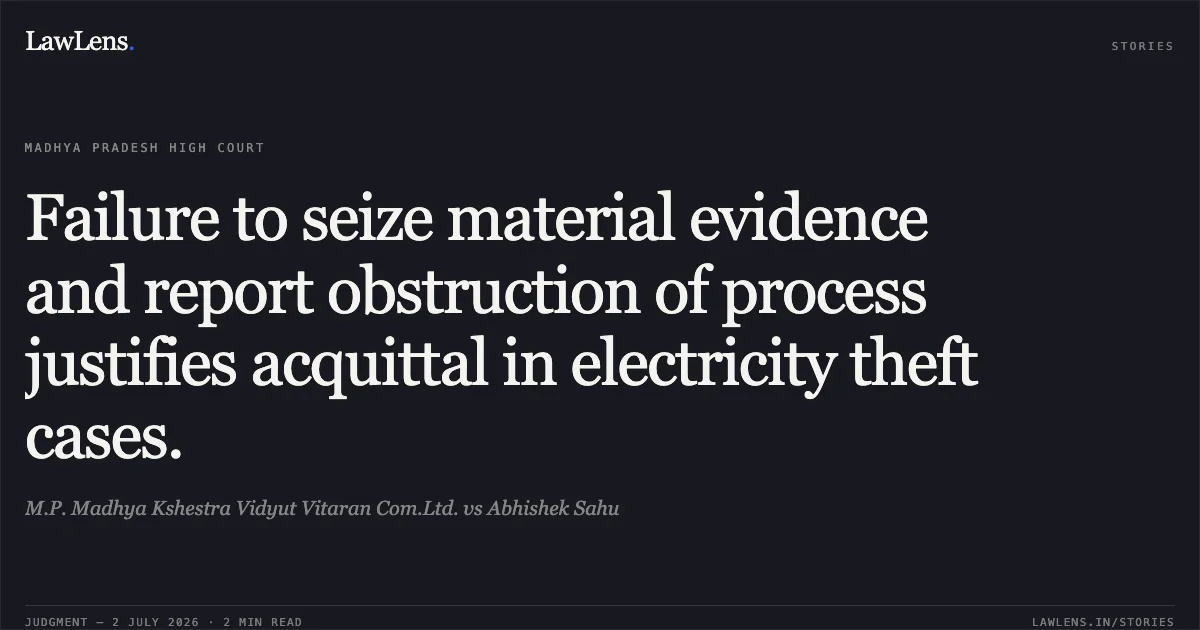
The High Court observed that while the prosecution claimed the respondent used a welding machine and grinder for electricity theft, these material pieces of evidence were never seized.
Source reference: para 5Although prosecution witnesses (PW-1 and PW-3) explained in cross-examination that they were obstructed and abused by the respondent’s father, the Court noted this crucial fact was absent from the initial complaint and official documents.
Source reference: para 5No police report was filed regarding the alleged obstruction.
Source reference: para 5Consequently, the Court found that the trial court’s decision to disbelieve the complainant’s evidence was a reasonable view.
Source reference: para 5, 9Applying the cited precedents, the High Court determined there was no illegality or perversity in the trial court's reasoning that would justify interfering with the acquittal.
Source reference: para 9-10Holding
The Court answered the issues in the negative, holding that the trial court’s order was well-reasoned and based on a proper appreciation of the evidence.
The High Court affirmed that the benefit of the doubt was rightly extended to the respondent due to the lack of seized material evidence and inconsistencies in the prosecution's narrative.
Source reference: para 5, 9The petition was dismissed.
Source reference: para 10Acts & Sections Cited
3 provisions across 2 statutes referred to in this judgment. Each provision opens on LawLens.
Code of Criminal Procedure, 19731
Electricity Act, 20032
Original Court PDF
M.P. Madhya Kshestra Vidyut Vitaran Com.Ltd.vsAbhishek Sahu
Click to open original judgment
Original judgment, available to read, download and summarize on LawLens.in