Facts
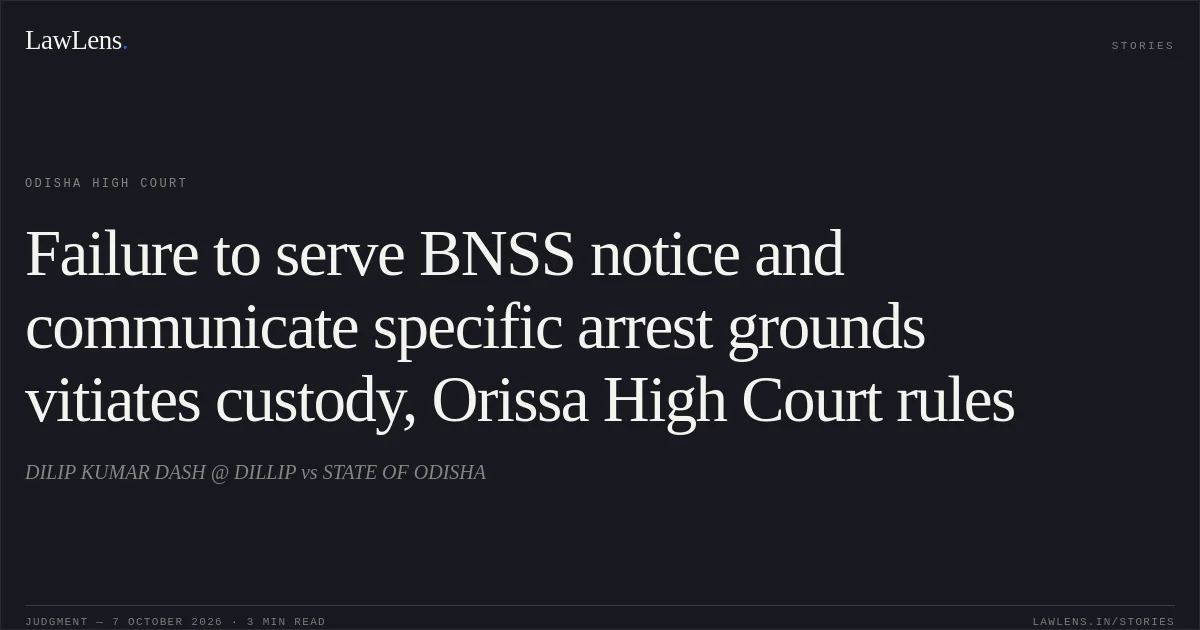
The petitioner was an accused in Badagad P.S. Case No. 13 of 2026, registered following a complaint alleging, among other things, that he and a business partner had misused a development agreement and power of attorney in connection with a housing project on joint-family land.
Source reference: p.2–3The petitioner alleged that, after the FIR was registered on 7 January 2026, he was not called to participate in the investigation and was arrested on 23 July 2026 without prior notice under Section 35(3) of the Bharatiya Nagarik Suraksha Sanhita, 2023 (BNSS), or proper communication of the grounds of arrest.
Source reference: p.3–4He also challenged his remand on the ground that the case diary had not been produced before the Magistrate. The Magistrate rejected his application challenging the arrest and remand; the petitioner then sought relief from the High Court.
Source reference: p.4–5Issues
Whether the petitioner’s arrest and consequential remand were unlawful because the investigating officer did not comply with Section 35(3) BNSS before arresting him.
Source reference: p.24–28Whether the arrest and remand were vitiated by failure to communicate the constitutional grounds of arrest, as distinct from general reasons for arrest.
Source reference: p.29–32Whether the non-production of the case diary at the time of the petitioner’s production before the Magistrate, by itself, invalidated the remand.
Source reference: p.9–16Law Applied
Section 35(3) BNSS requires the police to issue a notice of appearance where arrest is not necessary; the Court, relying on Satender Kumar Antil v. CBI, treated compliance with the corresponding safeguards under Sections 41 and 41-A CrPC as obligatory and held that non-compliance may entitle the accused to bail.
Source reference: p.24, 27Article 22(1) of the Constitution and Section 47 BNSS require communication of the grounds of arrest, which are distinct from general reasons for arrest and must convey the basic facts necessitating the arrest; the Court relied on Prabir Purkayastha v. State (NCT of Delhi), Vihaan Kumar v. State of Haryana and Mihir Rajesh Shah v. State of Maharashtra on the content, communication and proof of compliance with that requirement.
Source reference: p.6–7, 29–32Section 187 BNSS requires transmission of relevant case-diary entries to the Magistrate for consideration of remand. Although their production is obligatory, non-production does not automatically invalidate a remand if other materials enable the Magistrate to apply judicial mind and justify detention.
Source reference: p.10–16, 22–24Reasoning
The Court found no material showing that the petitioner had avoided investigation, that a notice under Section 35(3) BNSS had been attempted or refused, or that the stated apprehensions of absconding, repetition of offences or witness-tampering justified dispensing with notice.
Source reference: p.25–28It also found that the materials relied on by the investigating officer—such as witness statements, alleged non-cooperation and the possibility of tampering—were general reasons for arrest, not the specific grounds required to be communicated to the petitioner. Those failures vitiated the arrest and consequential remand.
Source reference: p.29–32By contrast, the absence of the case diary alone did not warrant release: the Magistrate had considered the forwarding report and other materials and recorded satisfaction regarding the need for detention.
Source reference: p.12–19Holding
The High Court held that the petitioner’s arrest and consequential remand were vitiated by non-compliance with Section 35(3) BNSS and the safeguards governing communication of grounds of arrest; non-production of the case diary was not, by itself, sufficient to invalidate the remand.
It set aside the Magistrate’s order dated 28 July 2026 and directed the Magistrate to release the petitioner on bail upon furnishing a bond of ₹1,00,000 with one solvent surety for the like amount, subject to further appropriate conditions.
Source reference: p.33Acts & Sections Cited
25 provisions across 3 statutes referred to in this judgment. Each provision opens on LawLens.
Bharatiya Nyaya Sanhita, 20238
Bharatiya Nagarik Suraksha Sanhita, 2023
Code of Criminal Procedure, 19736
Original Court PDF
DILIP KUMAR DASH @ DILLIPvsSTATE OF ODISHA
Click to open original judgment
Original judgment, available to read, download and summarize on LawLens.in