Facts
The Assam Irrigation Department issued a Notice Inviting Tender on 06.02.2026 for a flood mitigation project.
Source reference: no citationThe petitioner participated as one of three bidders and had earlier approached the High Court regarding non-issuance of a Site Visiting Certificate, which was subsequently resolved.
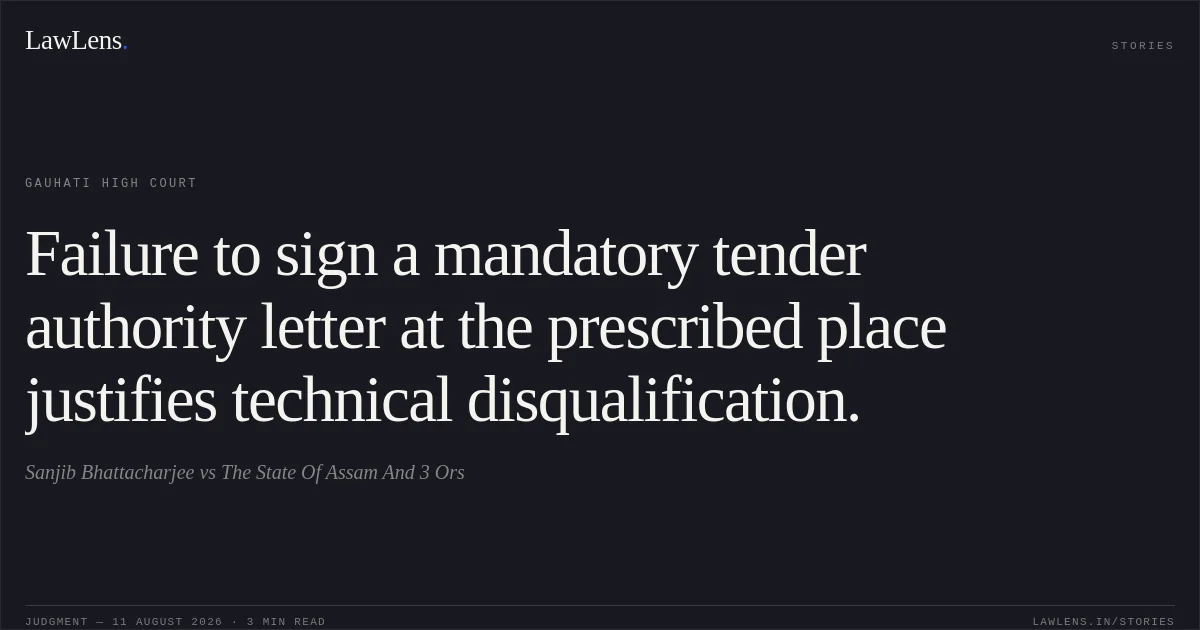
Source reference: p.3, para. 2The petitioner’s technical bid was rejected by the Bid Evaluation Committee on 09.03.2026 on the ground that the “Authority to Seek Reference Certificate” had not been signed by the bidder at the prescribed place.
Source reference: p.3, para. 2; p.8, para. 13Although the document contained the petitioner’s signature at its foot, the Department treated that signature as compliance only with the requirement that every page of the technical bid be signed, and not as execution of the authority letter itself.
Source reference: pp.6–7, para. 8; p.9, para. 16During the proceedings, the successful bidder was impleaded.
Source reference: no citationA formal work order had also been issued on 07.05.2026, but it was not challenged.
Source reference: p.7, para. 10; p.10, para. 20Issues
Whether the petitioner’s technical bid was unlawfully or arbitrarily rejected because the authority letter for obtaining a banker’s reference was signed at the foot of the document rather than at the specifically designated place.
Source reference: pp.8–9, paras. 14–18Whether the signature appearing at the foot of the authority letter constituted sufficient compliance with the tender conditions, or whether the requirement was an essential condition warranting strict compliance.
Source reference: pp.8–9, paras. 14–18Whether the petitioner was entitled to an opportunity to rectify the defect before his bid was disqualified, consistent with the principles of natural justice.
Source reference: p.4, para. 5; p.10, para. 18Whether the Court should interfere with the tender process notwithstanding that the formal work order had already been issued and was not under challenge.
Source reference: p.10, para. 20Law Applied
The Court applied the tender-law principle that conditions in a tender may be classified as essential eligibility conditions or ancillary and subsidiary conditions; while essential conditions require strict compliance, a tendering authority may, in appropriate cases, waive a merely technical or insignificant irregularity.
Source reference: pp.4–6, para. 6This principle was drawn from Poddar Steel Corporation v. Ganesh Engineering Works, (1991) 3 SCC 273, relying also on G.J. Fernandez v. State of Karnataka, (1990) 2 SCC 488.
Source reference: pp.4–6, para. 6Section 3(VI)(f) required an authority enabling the Department to obtain references from the bidder’s banker concerning financial soundness.
Source reference: p.9, para. 14Section 3(G)(ix) required every page of the technical bid to be signed by the bidder or authorised representative.
Source reference: p.9, para. 16The Court further recognised that judicial review of tender decisions is warranted where the decision-making process is arbitrary or unreasonable, but not where the authority has evaluated the bid in accordance with the prescribed tender requirements.
Source reference: p.10, para. 18Reasoning
The Court held that the authority letter was not a trivial or ancillary document because its purpose was to authorise verification of the bidder’s financial soundness, an important aspect of assessing technical responsiveness.
Source reference: p.9, para. 15The document contained a specific space, alongside the bidder’s name in block letters, where the bidder’s signature was required.
Source reference: p.9, para. 16The signature placed at the foot of the page corresponded instead to the separate requirement that each page of the technical bid be signed under Section 3(G)(ix).
Source reference: p.9, para. 16Accordingly, the Court accepted the Department’s explanation that the petitioner had not duly executed the authority letter in the manner required by the tender conditions.
Source reference: pp.6–7, para. 8; p.10, paras. 17–18Since the evaluation was carried out strictly in accordance with the bid document, the rejection was neither arbitrary nor unreasonable.
Source reference: p.10, para. 18The Court also rejected the natural justice argument, observing that a bidder is not entitled to an opportunity at every stage of technical evaluation where the decision is based on clear tender requirements.
Source reference: p.10, para. 18Poddar Steel was distinguished because it concerned a comparatively trivial deviation involving a cheque drawn on a different bank, whereas the present defect affected a document relating to financial verification.
Source reference: p.10, para. 19The existence of an unchallenged work order further militated against interference.
Source reference: p.10, para. 20Holding
The Court answered the issues against the petitioner.
It held that the authority to seek a banker’s reference was a material requirement, that the signature at the foot of the document did not satisfy the specific signature requirement, and that the Bid Evaluation Committee acted lawfully in disqualifying the petitioner’s technical bid.
Source reference: p.10, paras. 18–20No violation of natural justice or arbitrariness was established.
Source reference: p.10, paras. 18–20Since the work order dated 07.05.2026 had already been issued and was not challenged, no case for judicial interference was made out.
Source reference: p.10, paras. 20–21The writ petition was accordingly dismissed.
Source reference: p.10, paras. 20–21Acts & Sections Cited
3 provisions across 1 statute referred to in this judgment. Each provision opens on LawLens.
Commercial Documents Evidence Act, 19393
Original Court PDF
Sanjib BhattacharjeevsThe State Of Assam And 3 Ors
Click to open original judgment
Original judgment, available to read, download and summarize on LawLens.in