Facts
The informant, Sneha, and petitioner no. 2, Pawan Kumar, underwent a ring ceremony on 9 March 2019, and their marriage was fixed for 25 May 2019.
Source reference: p. 2, para. 4The informant alleged that her family incurred approximately ₹3,00,000 in connection with the ceremony and that the petitioners subsequently demanded ₹10 lakh and a car as dowry.
Source reference: p. 2, para. 4It was further alleged that, despite the marriage arrangements having been completed, Pawan Kumar and his family members did not attend the marriage.
Source reference: p. 2, para. 4Kanti P.S. Case No. 421 of 2019 was registered, and the learned S.D.J.M. took cognizance on 8 March 2022 for offences under Sections 420, 406, 120B and 500/34 of the IPC and Sections 3/4 of the Dowry Prohibition Act.
Source reference: p. 2, para. 3The accused petitioners sought quashing of the cognizance order under Section 482 Cr.P.C.
Source reference: p. 2, para. 5During the proceedings, it was brought on record that petitioner no. 2 and the informant had separately married other spouses in 2021 and were leading settled conjugal lives with their respective spouses and children.
Source reference: p. 4, para. 7Issues
Whether the allegations disclosed the essential ingredients of cheating under Section 420 IPC, particularly deception, dishonest inducement and dishonest intention from the inception of the promise to marry?
Source reference: pp. 4–6, paras. 8–9Whether the allegations established criminal breach of trust under Section 406 IPC in the absence of entrustment and dishonest misappropriation or conversion of property?
Source reference: p. 7, para. 10Whether, in light of the absence of the basic ingredients of the alleged offences and the subsequent remarriage and settled lives of the parties, continuation of the criminal proceedings would amount to an abuse of process warranting exercise of inherent powers under Section 482 Cr.P.C.?
Source reference: pp. 7–8, paras. 12–14Law Applied
The Court applied Section 420 IPC, holding that cheating requires deception, fraudulent or dishonest inducement to deliver property, and dishonest intention existing at the time of the initial promise or representation; mere subsequent failure to fulfil a promise does not, by itself, establish cheating.
Source reference: pp. 4–6, paras. 8–9Relying on Mariam Fasihuddin & Anr. v. State by Adugodi Police Station & Anr., (2024) 11 SCC 733, and V. Ganesan v. State, 2026 INSC 265, the Court reiterated that dishonest intention must exist from inception, although the High Court may quash proceedings where the circumstances do not reflect such intention.
Source reference: pp. 5–6, paras. 8–9Section 406 IPC requires entrustment of property followed by dishonest misappropriation or conversion; the Court relied on Arshad Neyaz Khan v. State of Jharkhand & Anr., 2025 SCC OnLine SC 2058, for this principle.
Source reference: p. 7, para. 10The Court exercised its inherent jurisdiction under Section 482 Cr.P.C. to prevent abuse of process and secure the ends of justice, also relying on Mala Kar & Anr. v. State of Uttarakhand, 2024 SCC OnLine SC 1049, where proceedings were quashed after the parties had remarried and settled their lives.
Source reference: pp. 7–8, paras. 12–13Reasoning
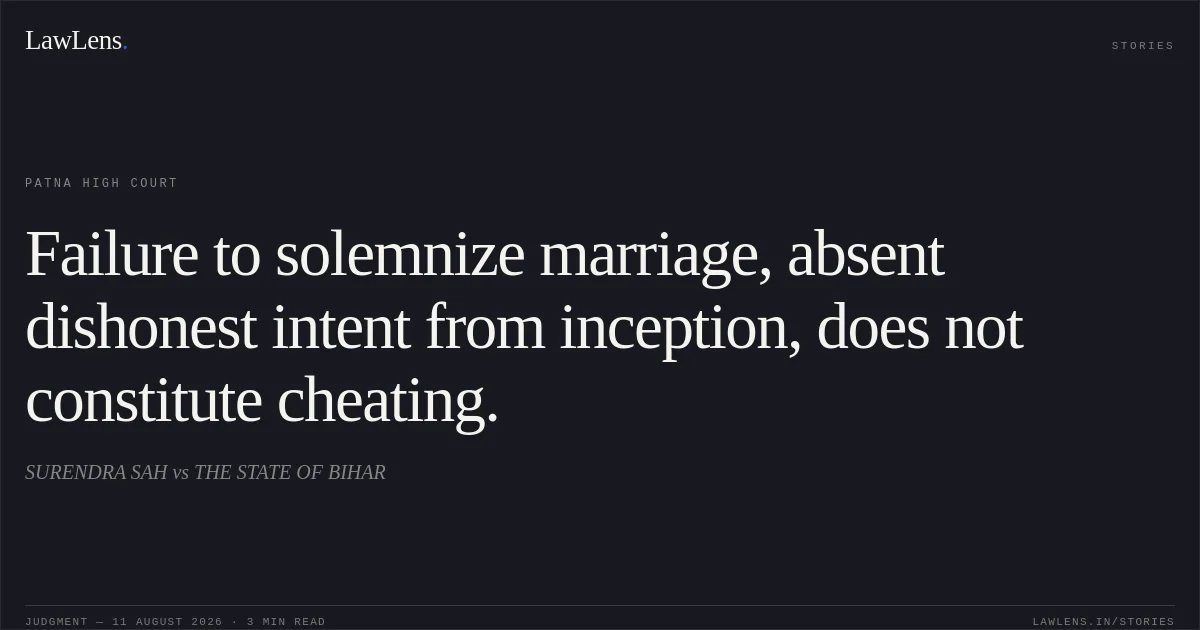
The Court found that the alleged failure to proceed with the marriage, even if accepted, did not establish that the petitioners had a dishonest intention to deceive the informant from the beginning.
Source reference: pp. 4–6, paras. 8–9The facts showed, at most, a failure to fulfil a promise at a later stage due to differences between the proposed bride and bridegroom, which was insufficient to constitute cheating under Section 420 IPC.
Source reference: pp. 4–6, paras. 8–9The alleged expenditure of ₹3,00,000 on the ring ceremony did not establish the entrustment of property or its dishonest misappropriation, and therefore did not satisfy Section 406 IPC.
Source reference: p. 7, paras. 10–11In addition, the subsequent remarriage of both parties and their settled family lives demonstrated that continuation of the prosecution would serve no legitimate purpose.
Source reference: pp. 7–8, paras. 12–14Considering the absence of the essential ingredients of the offences and the changed circumstances, the Court held that the proceedings had become an abuse of process.
Source reference: pp. 7–8, paras. 12–14Holding
The Patna High Court held that the allegations did not make out the offences under Sections 420, 406, 120B or 500/34 IPC and Sections 3/4 of the Dowry Prohibition Act against the petitioners.
The Court consequently quashed the criminal proceedings arising from the cognizance order dated 8 March 2022 in G.R. Case No. 1905 of 2019, arising out of Kanti P.S. Case No. 421 of 2019, by exercising its inherent jurisdiction under Section 482 Cr.P.C.
Source reference: pp. 8–9, paras. 14–15The application was allowed.
Source reference: pp. 8–9, paras. 14–15Acts & Sections Cited
7 provisions across 3 statutes referred to in this judgment. Each provision opens on LawLens.
Indian Penal Code, 18604
Code of Criminal Procedure, 19731
Original Court PDF
SURENDRA SAHvsTHE STATE OF BIHAR
Click to open original judgment
Original judgment, available to read, download and summarize on LawLens.in