Facts
The petitioner, a contractor and regular vendor of the respondent authorities, participated in Tender No. SEC/IND/WS/TS-26/1928 after depositing the tender fee and earnest money deposit.
Source reference: paras. 2–3, pp. 1–2Although the technical bids were stipulated to be opened on 13 November 2025, they were opened on 15 December 2025. The petitioner’s technical bid was rejected with the remark “Not complied with Technical Specification,” without specifying the alleged deficiency or affording an opportunity for clarification.
Source reference: paras. 2–3, pp. 1–2The petitioner also alleged that the technical and financial bids were opened on the same day within approximately 45 minutes and that the evaluation details were not disclosed on the official portal. Representations and a legal notice submitted by the petitioner were not acted upon.
Source reference: paras. 2–3, pp. 1–2In the respondents’ reply, the specific reason for rejection was disclosed: the petitioner’s EPF registration document neither bore a digital signature nor was it self-attested, as required by the tender conditions.
Source reference: para. 4, pp. 2–3Issues
1. Whether the petitioner’s technical bid was arbitrarily and illegally rejected by the vague remark “Not complied with Technical Specification,” with the respondents’ subsequent explanation being impermissible as a post facto justification.
Source reference: paras. 4–7, pp. 2–52. Whether failure to submit a digitally signed or self-attested EPF registration certificate constituted non-compliance with an essential eligibility condition warranting technical disqualification.
Source reference: paras. 6, 8, 15, pp. 4, 6, 123. Whether the alleged postponement of the technical-bid opening date and simultaneous opening of the technical and financial bids justified interference under Article 226 of the Constitution.
Source reference: paras. 2–4, pp. 1–4Law Applied
The Court applied the principles governing judicial review of State action in tender matters under Article 14 and Article 226 of the Constitution.
Source reference: paras. 15–16, pp. 12–18It relied on Tata Cellular v. Union of India, (1994) 6 SCC 651, and Jagdish Mandal v. State of Orissa, (2007) 14 SCC 517, for the rule that judicial review examines the decision-making process, not the merits of a commercial decision, and interference is warranted only where the action is mala fide, arbitrary, irrational, discriminatory, or contrary to public interest.
Source reference: paras. 15–16, pp. 12–18Michigan Rubber (India) Ltd. v. State of Karnataka, (2012) 8 SCC 216, and BTL EPC Ltd. v. Macawber Beekay Pvt. Ltd., (2024) 12 SCC 614, establish that tendering authorities have substantial latitude in prescribing and interpreting eligibility conditions, particularly in technically complex contracts, and courts should not substitute their own view for that of the tender authority.
Source reference: paras. 15–17, pp. 13–19Poddar Steel Corporation v. Ganesh Engineering Works, (1991) 3 SCC 273, distinguishes essential eligibility conditions, which require strict compliance, from ancillary or subsidiary conditions that may, in appropriate cases, be waived.
Source reference: para. 13, pp. 9–10Rashmi Metaliks Ltd. v. Kolkata Metropolitan Development Authority, (2013) 10 SCC 95, supports relaxation or opportunity for rectification where the omitted requirement is merely collateral and not essential to eligibility.
Source reference: para. 14, pp. 11–12The Court also considered Mohinder Singh Gill v. Chief Election Commissioner, (1978) 1 SCC 405, on the principle that an administrative order must ordinarily stand on the reasons stated in it and cannot be improved through subsequent explanations.
Source reference: paras. 4–7, pp. 2–5M/s Star Enterprises v. City and Industrial Development Corporation of Maharashtra Ltd., (1990) 3 SCC 280, on the importance of recording reasons in administrative and tender decisions.
Source reference: para. 6, pp. 4–5Reasoning
The Court accepted that the tender required submission of a self-attested EPF registration certificate or the registration number issued by the EPF Department, and found it undisputed that the petitioner had not supplied the required self-attested EPF certificate.
Source reference: para. 15, p. 12Unlike the collateral requirements considered in Poddar Steel and Rashmi Metaliks, the Court treated the EPF document as part of the prescribed qualification or eligibility criteria.
Source reference: paras. 15, 18–20, pp. 12–20Consequently, its non-submission constituted failure to satisfy an essential tender condition, and the petitioner could not rely on its status as an experienced or regular contractor to overcome that defect.
Source reference: paras. 15, 18–20, pp. 12–20Although the petitioner challenged the cryptic rejection remark and relied on the respondents’ later disclosure of the EPF-related reason, the Court held that the material did not establish mala fides, favouritism, perversity, or such irrationality that no reasonable tender authority could have reached the decision.
Source reference: paras. 18–20, pp. 19–20Applying the restricted scope of review in contractual matters, the Court declined to reassess the technical evaluation or substitute its own view for that of the tendering authority.
Source reference: paras. 18–20, pp. 19–20Holding
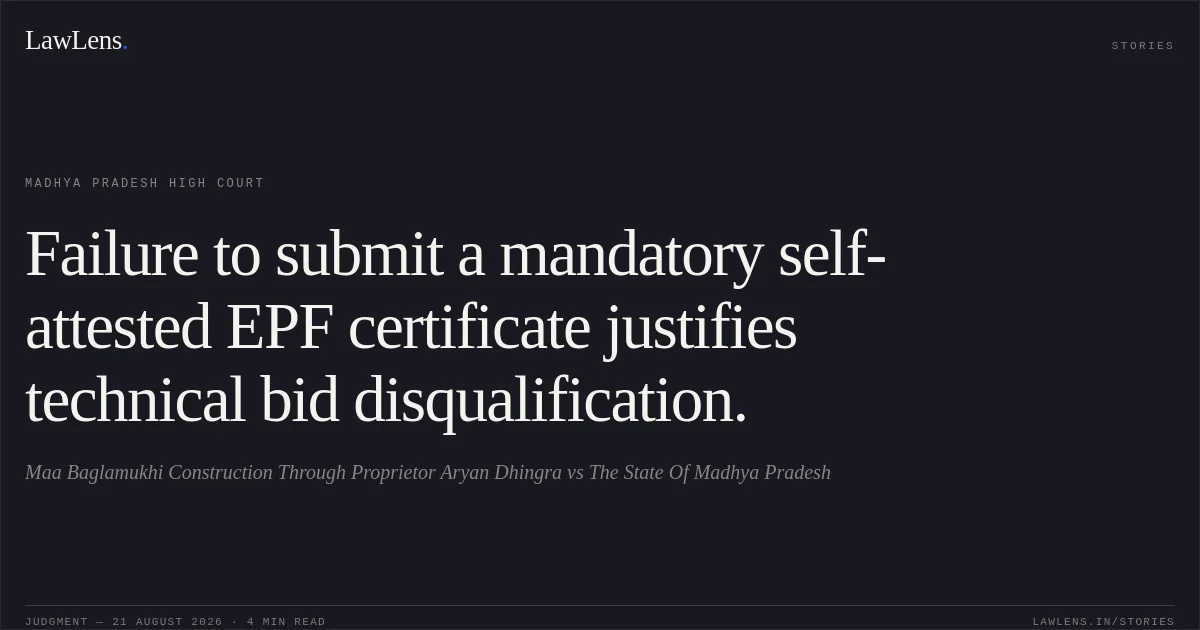
The Court held that failure to submit the required self-attested EPF registration certificate justified rejection of the petitioner’s technical bid and that the respondents’ action was neither mala fide nor arbitrary.
The alleged procedural irregularities and the petitioner’s reliance on the vague initial rejection remark did not warrant interference under Article 226, particularly where an essential eligibility condition had admittedly not been fulfilled.
Source reference: paras. 18–20, pp. 19–20The writ petition was accordingly dismissed as devoid of merit, with no direction to treat the petitioner’s bid as technically qualified or to open and consider its financial bid.
Source reference: para. 21, p. 20Acts & Sections Cited
1 provisions across 1 statute referred to in this judgment. Linked provisions open on LawLens.
the Act (alias, unresolved)1
Original Court PDF
Maa Baglamukhi Construction Through Proprietor Aryan DhingravsThe State Of Madhya Pradesh
Click to open original judgment
Original judgment, available to read, download and summarize on LawLens.in