Facts
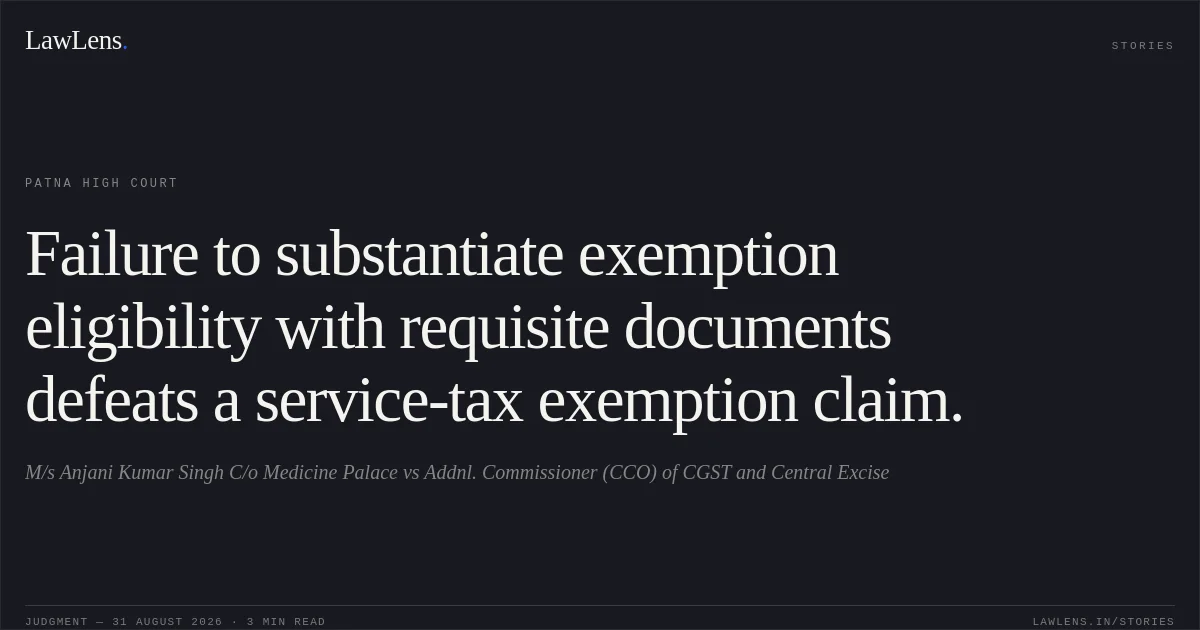
The petitioner, a handling and transport contractor engaged by the Food Corporation of India (FCI), challenged the adjudication order dated 21 March 2024 imposing service tax of ₹60,88,607, interest and various penalties for the period October 2016 to June 2017.
Source reference: p. 2–3; paras. 2–7The petitioner contended that its services relating to transportation and handling of food grains were exempt under Entry 40 of Notification No. 04/2014 dated 17 February 2014 and applicable service-tax exemption notifications.
Source reference: p. 2–3; paras. 3–6Pursuant to a show-cause notice dated 27 April 2022, the petitioner submitted documents including Form 26AS, balance sheets, ST-3 returns, evidence of tax payment and work-related documents.
Source reference: p. 2–3; paras. 4–5The adjudicating authority rejected the exemption claim, principally because the petitioner had not produced the relevant work orders, agreements, invoices or other documents correlating the amounts received with exempt services.
Source reference: p. 4–6; paras. 8–9The petitioner alleged that the adjudicating authority had ignored its written submissions and violated natural justice.
Source reference: p. 6–7; paras. 11–12During the writ proceedings, FCI stated that the tendered transportation rates were inclusive of all taxes and alleged that the petitioner had collected tax without depositing it with the Government.
Source reference: p. 6–7; paras. 11–12The Court noted that the petitioner had not produced the relevant tender documents either before the adjudicating authority or before the Court and had not filed a rejoinder to FCI’s counter-affidavit.
Source reference: p. 7–8; paras. 13–15Issues
Whether the adjudication order imposing service tax, interest and penalties was liable to be quashed for failure to consider the petitioner’s written submissions and alleged violation of natural justice?
Source reference: p. 2–4; paras. 2, 8–9Whether the petitioner had established its entitlement to exemption from service tax in respect of its handling, transportation and related services rendered to FCI?
Source reference: p. 4–6; paras. 9–10Whether the High Court should interfere with the adjudication order in exercise of its extraordinary writ jurisdiction, particularly when the petitioner had an available statutory appellate remedy?
Source reference: p. 8; paras. 16–18Law Applied
The Court considered the exemption provisions under Notification No. 04/2014 dated 17 February 2014 and the Mega Exemption Notification No. 25/2012-ST dated 20 June 2012, along with the relevant provisions of the Finance Act, 1994, including Sections 70, 73, 77 and 78, as extended through Section 174 of the CGST Act, 2017.
Source reference: p. 2–6; paras. 2, 5–6, 9The governing principle was that the burden of proving eligibility for a tax exemption lies on the person claiming it, and exemption cannot be granted merely on assertion or without supporting documentary evidence.
Source reference: p. 5–6; paras. 9–10The Court relied on Commissioner v. Hari Chand Shri Gopal, 2010 (260) E.L.T. 3 (S.C.), Mysore Metal Industries v. Collector of Customs, Bombay, 1988 (36) E.L.T. 369 (S.C.), and Commissioner of Customs (Import) v. Dilip Kumar & Company, 2018 (361) E.L.T. 577 (S.C.).
Source reference: p. 5–6; paras. 9–10The Court also applied the principle that writ interference with an adjudication order is not warranted where the authority has considered the defence and the aggrieved party may pursue the statutory appellate remedy.
Source reference: p. 8; paras. 16–18Reasoning
The Court found that the adjudicating authority had considered the petitioner’s defence and the documents produced during the proceedings; therefore, the allegation that the written submissions were wholly ignored or that natural justice was denied was not established.
Source reference: p. 4–6; paras. 8–9The exemption claim failed because the petitioner did not produce the relevant work orders or agreements, invoices and other material necessary to correlate the amounts reflected in Form 26AS and the financial records with services allegedly covered by the exemption notification.
Source reference: p. 4–6; para. 9Applying the rule that the claimant bears the burden of proving exemption eligibility, the Court found the authority’s refusal to extend the exemption legally sustainable.
Source reference: p. 5–6; paras. 9–10The Court further considered it significant that FCI had asserted that the tender rates included all taxes, while the petitioner neither produced the tender document nor filed a rejoinder disputing that assertion.
Source reference: p. 6–8; paras. 11–15In these circumstances, no ground for interference under the Court’s extraordinary writ jurisdiction was made out.
Source reference: p. 8; para. 16Holding
The Court held that the impugned adjudication order dated 21 March 2024 did not warrant interference.
The writ petition was accordingly dismissed.
Source reference: p. 8; paras. 16, 18The petitioner was granted liberty to pursue any statutory appeal or other remedy available in law.
Source reference: p. 8; paras. 17–18If limitation arose, the competent appellate forum was directed to consider the period spent pursuing the writ petition in accordance with law.
Source reference: p. 8; paras. 17–18Acts & Sections Cited
1 provisions across 1 statute referred to in this judgment. Each provision opens on LawLens.
Central Goods and Services Tax Act, 20171
Original Court PDF
M/s Anjani Kumar Singh C/o Medicine PalacevsAddnl. Commissioner (CCO) of CGST and Central Excise
Click to open original judgment
Original judgment, available to read, download and summarize on LawLens.in