Facts
The petitioner, the eighth defendant and judgment-debtor in E.P.No.2221 of 2018, challenged the dismissal of E.A.No.2 of 2022 by the XXVI Assistant City Civil Court, Chennai, under Article 227 of the Constitution.
Source reference: para. 1The underlying suit, O.S.No.4980 of 2011, was initially instituted on the Original Side of the Madras High Court.
Source reference: para. 3(a)The suit properties were admittedly situated within the territorial jurisdiction of the City Civil Court.
Source reference: paras. 5–6, 16–20The petitioner and her mother had earlier filed I.A.No.116 of 2012 to set aside the ex parte decree and restore the counterclaim, but did not raise any objection regarding pecuniary jurisdiction; the application was dismissed for default on 23.01.2013.
Source reference: paras. 5–6, 16–20The decree directed partition of the “A” and “B” schedule properties, restrained defendants 1 to 4 from dealing with those properties, and dismissed the counterclaim.
Source reference: para. 30Issues
Whether the suit was improperly transferred from the Original Side of the Madras High Court to the City Civil Court merely because leave had been obtained under Clause 12 of the Letters Patent in respect of certain defendants residing outside the jurisdiction?
Source reference: paras. 9–13Whether the alleged excess valuation of the counterclaim deprived the City Civil Court of pecuniary jurisdiction and rendered the decree a nullity capable of being challenged for the first time in execution proceedings?
Source reference: paras. 14–29, 47–52Whether the petitioner, as the eighth defendant, was not bound by or liable under the decree because the decree did not expressly identify her by name?
Source reference: paras. 30–31Law Applied
Clause 12 of the Letters Patent permits the High Court’s Original Side to entertain suits concerning land or immovable property situated within its jurisdiction; where the properties are so situated, leave concerning defendants residing outside the jurisdiction is unnecessary and does not prevent subsequent transfer to a competent subordinate court.
Source reference: paras. 9–13Section 21(2) of the Code of Civil Procedure, 1908 requires an objection to pecuniary jurisdiction to be raised at the earliest possible opportunity and permits its consideration only where there has been a consequent failure of justice.
Source reference: para. 18Section 11 of the Suits Valuation Act, 1887 similarly requires prejudice or failure of justice before a decree is interfered with on valuation or pecuniary-jurisdiction grounds.
Source reference: paras. 24–27The Court relied on Kiran Singh v. Chaman Paswan and Sneh Lata Goel v. Pushpalatha to distinguish objections relating to territorial or pecuniary jurisdiction from a fundamental absence of jurisdiction over the subject matter; the former do not ordinarily render a decree a nullity and must satisfy the statutory conditions.
Source reference: paras. 25–29, 52Under Section 47 CPC, an executing court cannot go behind the decree, sit in appeal over it, or correct mere errors of law; only a decree that is void ab initio or inherently without jurisdiction is inexecutable, as reaffirmed in Hasham Abbas Sayyad, Mantoo Sarkar, Bhawarlal Bhandari and Brakewel Automotive Components.
Source reference: paras. 47–50A decree expressed against “all the defendants” binds each defendant unless otherwise excluded by its terms.
Source reference: paras. 30–31Reasoning
The Court held that the transfer was valid because the immovable properties were situated within the City Civil Court’s territorial jurisdiction.
Source reference: paras. 10–13Leave under Clause 12, even if granted in relation to certain defendants residing outside the jurisdiction, did not require the suit to remain on the Original Side, particularly after the City Civil Court acquired the relevant pecuniary jurisdiction.
Source reference: paras. 10–13The objection based on the counterclaim’s valuation was not an objection to subject-matter jurisdiction.
Source reference: paras. 17–23In any event, the petitioner had failed to raise it when she participated in I.A.No.116 of 2012, which sought to set aside the ex parte decree and restore the counterclaim.
Source reference: paras. 17–23She also failed to establish any consequent failure of justice or prejudice as required by Section 21(2) CPC and Section 11 of the Suits Valuation Act.
Source reference: paras. 24–29The counterclaim had been filed only by defendants 1 to 4, and the petitioner could not independently rely on its dismissal to invalidate the decree, especially when the counterclaimants themselves had not challenged the proceedings.
Source reference: para. 21Finally, the decree’s direction that “all the defendants” were ex parte and the operative terms of the decree were sufficient to bind the petitioner; the absence of a separate reference to the eighth defendant did not exclude her from the decree.
Source reference: paras. 30–31The executing court therefore correctly declined to examine the alleged defects and to obstruct execution.
Source reference: paras. 32–33, 51–52Holding
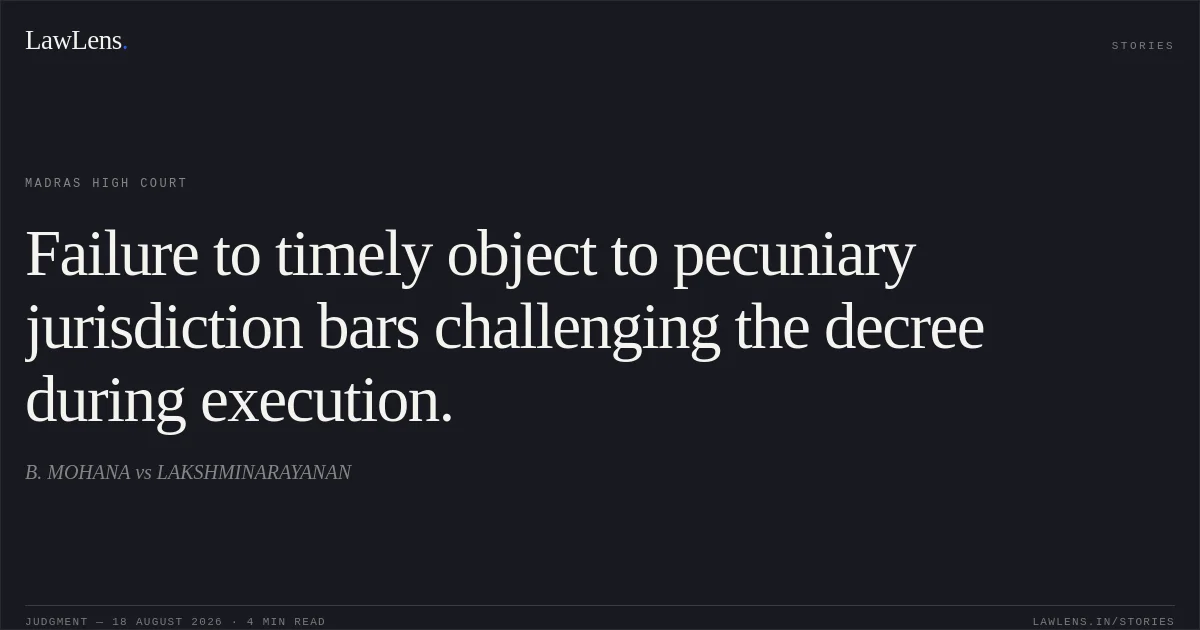
The High Court dismissed the Civil Revision Petition, holding that the suit was validly transferred to and adjudicated by the City Civil Court.
The alleged pecuniary-jurisdiction defect concerning the counterclaim was not a subject-matter jurisdictional nullity and, having not been raised at the earliest opportunity or shown to have caused failure of justice, could not be urged for the first time in execution.
Source reference: paras. 31, 51–53The petitioner was bound by the decree as the eighth defendant, and execution against her was maintainable.
Source reference: paras. 31, 51–53The connected Civil Miscellaneous Petition was closed, with no order as to costs.
Source reference: para. 53Acts & Sections Cited
4 provisions across 3 statutes referred to in this judgment. Each provision opens on LawLens.
Code of Civil Procedure, 19082
Suits Valuation Act, 18871
Limitation Act, 19631
Original Court PDF
B. MOHANAvsLAKSHMINARAYANAN
Click to open original judgment
Original judgment, available to read, download and summarize on LawLens.in