Facts
The litigation originated from a 1992 civil suit for declaration and partition filed by Respondent No. 1 regarding property in District Vidisha
Source reference: para. 12(1)After several procedural stages, an ex-parte decree was passed against the applicant on 28/02/2003
Source reference: para. 12(6)The applicant’s subsequent application under Order 9 Rule 13 CPC to set aside the decree was dismissed in 2005
Source reference: para. 12(8)A Miscellaneous Civil Appeal against said dismissal was also rejected on 13/02/2012 on grounds of unexplained delay and lack of merit
Source reference: para. 12(10)The applicant filed the present Civil Revision on 05/09/2013, seeking to condone a 540-day delay via I.A. No. 3939/2013
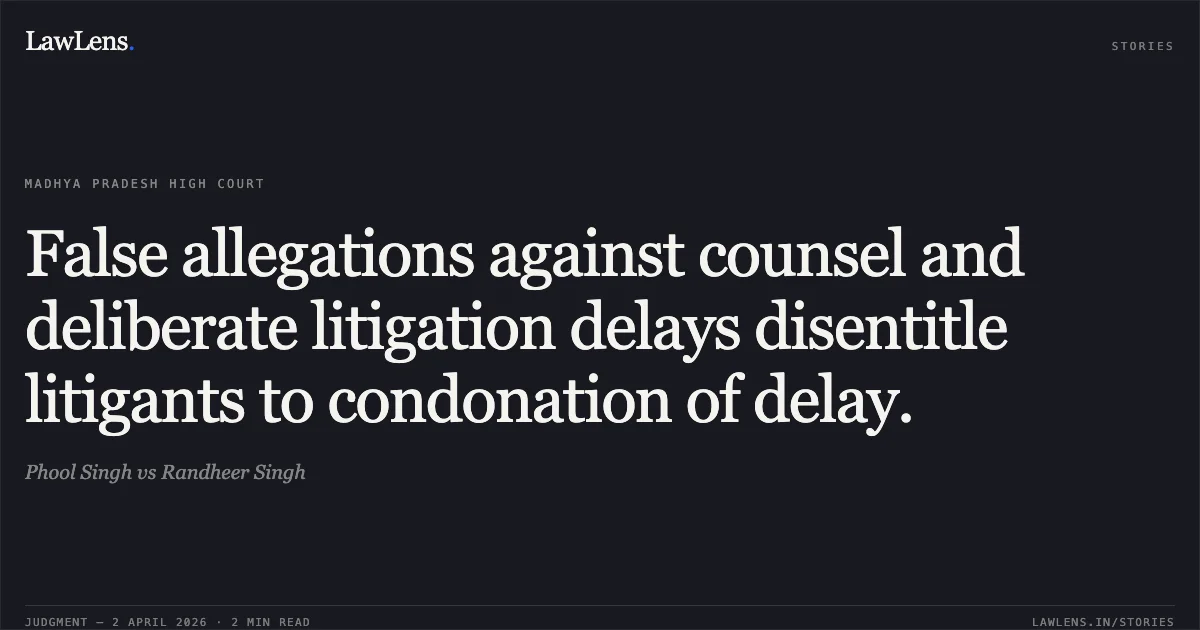
Source reference: para. 12(11)The applicant contended he was a "rustic and illiterate villager" and was not informed of the appellate court’s order by his counsel
Source reference: para. 4, 6the applicant's former counsel refused to provide an affidavit to support the allegation of negligence
Source reference: para. 5, 7Issues
1. Whether the applicant established "sufficient cause" under Section 5 of the Limitation Act to condone a 540-day delay in filing the civil revision
Source reference: para. 142. Whether the applicant's consistent conduct of remaining ex-parte and filing delayed applications constitutes a bona fide attempt at litigation or a strategy to obstruct justice
Source reference: para. 15, 17Law Applied
The court applied Section 5 of the Limitation Act, 1963, which mandates the showing of "sufficient cause" for the condonation of delay
Source reference: para. 6It operated under Section 115 of the Code of Civil Procedure (CPC) regarding revisional jurisdiction
Source reference: para. 1The court emphasized the principle that while procedural laws are handmaids of justice, they cannot be exploited by litigants acting with dishonest intentions to prolong litigation, and every litigation must reach a finality
Source reference: para. 17Reasoning
The Court examined the 34-year history of the suit, observing a recurring pattern where the applicant engaged counsel but subsequently allowed proceedings to go ex-parte at both the trial and appellate stages
Source reference: para. 15The court found that the applicant’s plea of being a "rustic villager" was contradicted by his calculated use of legal remedies with significant delays at every juncture—specifically, the one-and-a-half-year delay in filing the miscellaneous appeal and the subsequent 540-day delay in filing this revision
Source reference: para. 15Crucially, the court noted that the applicant’s attempt to shift blame onto his previous counsel failed when the counsel refused to provide a supporting affidavit, leading the court to conclude the allegation was a "false pretext"
Source reference: para. 8, 15The Court determined that the applicant's actions were a deliberate attempt to prevent the final adjudication of the respondent’s property rights and held that such "dishonest intention" must be dealt with "iron hands"
Source reference: para. 17Holding
The Court answered the issues in the negative, holding that the applicant’s prayer for condonation of delay was not bona fide
The Court rejected I.A. No. 3939/2013 for condonation of delay and dismissed Civil Revision No. 123 of 2013 as barred by time
Source reference: para. 19Acts & Sections Cited
5 provisions across 2 statutes referred to in this judgment. Each provision opens on LawLens.
Code of Civil Procedure, 19084
Limitation Act, 19631
Original Court PDF
Phool SinghvsRandheer Singh
Click to open original judgment
Original judgment, available to read, download and summarize on LawLens.in