Facts
The petitioner sought action under Sections 340 read with 195(b)(1) Cr.P.C., alleging that the respondent made false statements in a civil plaint and supporting affidavits, including allegations about the petitioner’s criminal antecedents.
Source reference: para. 1–2The Civil Judge dismissed the application, finding no relevant variation in the plaint and affidavit and no basis to proceed in the public interest. The appellate court dismissed the petitioner’s appeal under Section 341 Cr.P.C.
Source reference: para. 1–2The underlying civil dispute was later settled by compromise before the First Appellate Court.
Source reference: para. 6, 8Issues
Whether the courts below erred in declining to initiate proceedings under Section 340 Cr.P.C. on the allegation that the respondent had knowingly made false statements in pleadings and affidavits
Source reference: para. 3, 6–8Whether the parties’ compromise made it inexpedient in the interests of justice to initiate an inquiry or complaint for perjury
Source reference: para. 4, 8Law Applied
Section 340 Cr.P.C. permits a court to initiate a complaint for specified offences affecting the administration of justice when the court forms the requisite opinion; under Section 195(b)(1) Cr.P.C., such offences are subject to the statutory complaint requirement.
Source reference: para. 7As explained in Amarsang Nathaji v. Hardik Harshadbhai Patel, (2017) 1 SCC 113, the material must disclose a prima facie case and it must be expedient in the interests of justice to inquire into the alleged offence.
Source reference: para. 7A contradictory statement alone is insufficient: intentional falsity must be indicated.
Source reference: para. 7A preliminary inquiry is discretionary, not mandatory, and even where an offence appears to have been committed, the court must decide whether making a complaint is warranted.
Source reference: para. 7Reasoning
The High Court considered the concurrent findings that no material variation had been established and that proceeding was not expedient in the interests of justice.
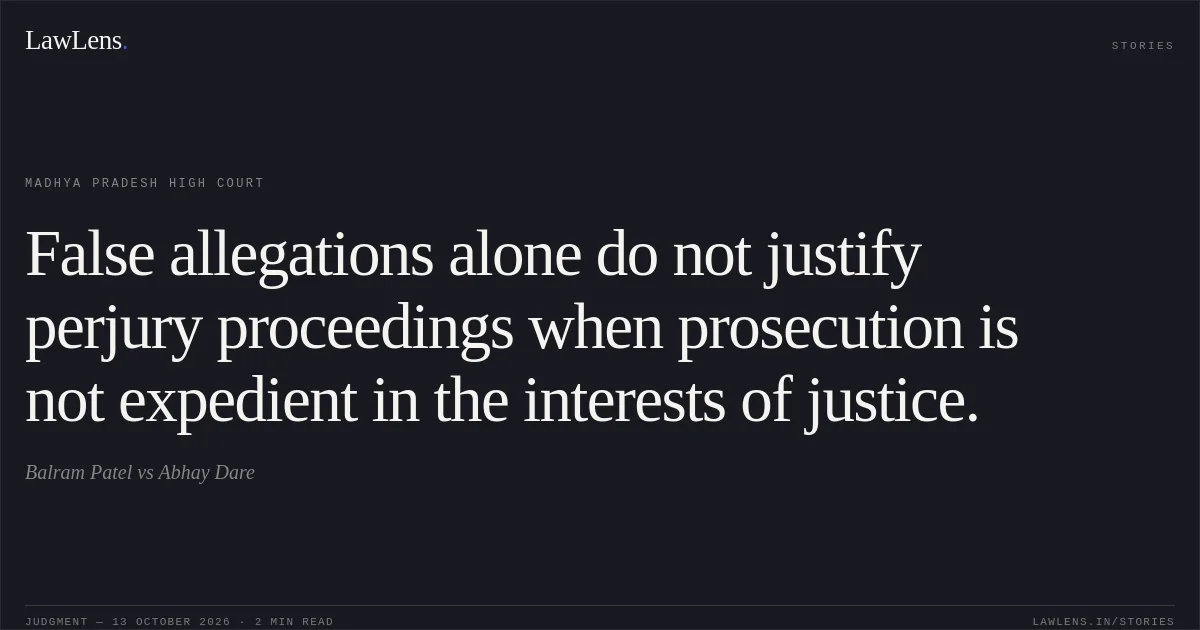
Source reference: para. 6–8Although the respondent had made imputations against the petitioner in an affidavit, those allegations alone did not justify perjury proceedings.
Source reference: para. 6–8The parties had settled the underlying dispute before the First Appellate Court, and the Court concluded that this circumstance, alongside the applicable Section 340 test, did not warrant an inquiry or complaint.
Source reference: para. 6–8Holding
The Court held that the Civil Judge and the Appellate Court committed no error in declining to initiate an inquiry under Section 340 Cr.P.C.
It dismissed the petition as devoid of merit.
Source reference: para. 8–9Acts & Sections Cited
8 provisions across 2 statutes referred to in this judgment. Each provision opens on LawLens.
Code of Criminal Procedure, 19735
Indian Penal Code, 18603
Original Court PDF
Balram PatelvsAbhay Dare
Click to open original judgment
Original judgment, available to read, download and summarize on LawLens.in


![Railway pensioners qualify for additional pension only upon completing 80 years of age.. OM PRAKASH MISHRA vs NORTH EASTERN RAILWAY. CAT - ['Allahabad']. LawLens](/stories/thumbnails/railway-pensioners-qualify-for-additional-pension-only-upon-completing-80-years-of-age-e4a0c68f01cd4886b5cdc93e3a4b5e33.webp)