Facts
The plaintiff filed a suit for permanent prohibitory injunction seeking to restrain defendants from constructing on land in village Shillar, Solan, H.P.
Source reference: para. 2The plaintiff later amended the plaint to seek a mandatory injunction, alleging the defendants forcibly constructed a kitchen in October 1998.
Source reference: para. 4-5A demarcation conducted during proceedings confirmed the defendants were in possession of small fragments (Khasra No. 195/107/2 and 195/107/3) of the suit land.
Source reference: para. 9Evidence revealed the plaintiff had issued a legal notice (Ex. DX) in 1994 asserting the construction was already complete at that time, contradicting the pleaded date of 1998.
Source reference: para. 9, 17The Trial Court granted a prohibitory injunction regarding the remaining land but refused the mandatory injunction for the encroached portions due to the plaintiff’s falsehood and the "old" nature of the possession.
Source reference: para. 9The Appellate Court affirmed this decision.
Source reference: para. 10Issues
Whether the impugned judgment can be sustained given the demarcation report (Ext. PW2/C) confirmed encroachments by the respondents.
Source reference: para. 11Whether the refusal of discretionary relief (mandatory injunction) was justified despite the proof of encroachment, in light of the plaintiff’s conduct.
Source reference: para. 19-23Whether the First Appellate Court failed to independently appreciate the evidence.
Source reference: para. 24Law Applied
The Court applied Sections 36, 39, and 41(i) of the Specific Relief Act, which establish that injunctions (preventive or mandatory) are discretionary remedies and may be refused if the plaintiff's conduct disentitles them to the assistance of the Court.
Source reference: para. 19It relied on Dalip Singh v. State of U.P. (2010) and Rekha Sharad Ushir v. Saptashrungi Mahila Nagari Sahkari Patsansta Ltd. (2025) to affirm that litigants who resort to falsehood or suppress material facts have no right to approach the court and can be denied relief.
Source reference: para. 20-21Regarding appellate procedure, it applied Santosh Hazari v. Purushottam Tiwari (2001), holding that an affirming appellate court need only express general agreement with the trial court’s reasoning rather than restating the entire evidence.
Source reference: para. 24Reasoning
The Court observed that while the encroachment was technically proven by the demarcation report, the plaintiff’s claim was built on a patent falsehood.
Source reference: para. 16The plaintiff pleaded that construction occurred in 1998 to bring the suit within a favorable timeline, yet his own 1994 legal notice and cross-examination admitted the construction was completed by 1994.
Source reference: para. 17-18The Court reasoned that because injunction is a discretionary and equitable relief under the Specific Relief Act, a party "touching the pure fountain of justice with tainted hands" is not entitled to it.
Source reference: para. 20The Court held that even though encroachment existed, the plaintiff’s dishonesty regarding the timeline and the "old" nature of the construction justified the lower courts' refusal to exercise discretion in his favor.
Source reference: para. 23The Appellate Court’s judgment was found valid as it independently discussed oral and documentary evidence before affirming the Trial Court’s findings.
Source reference: para. 25Holding
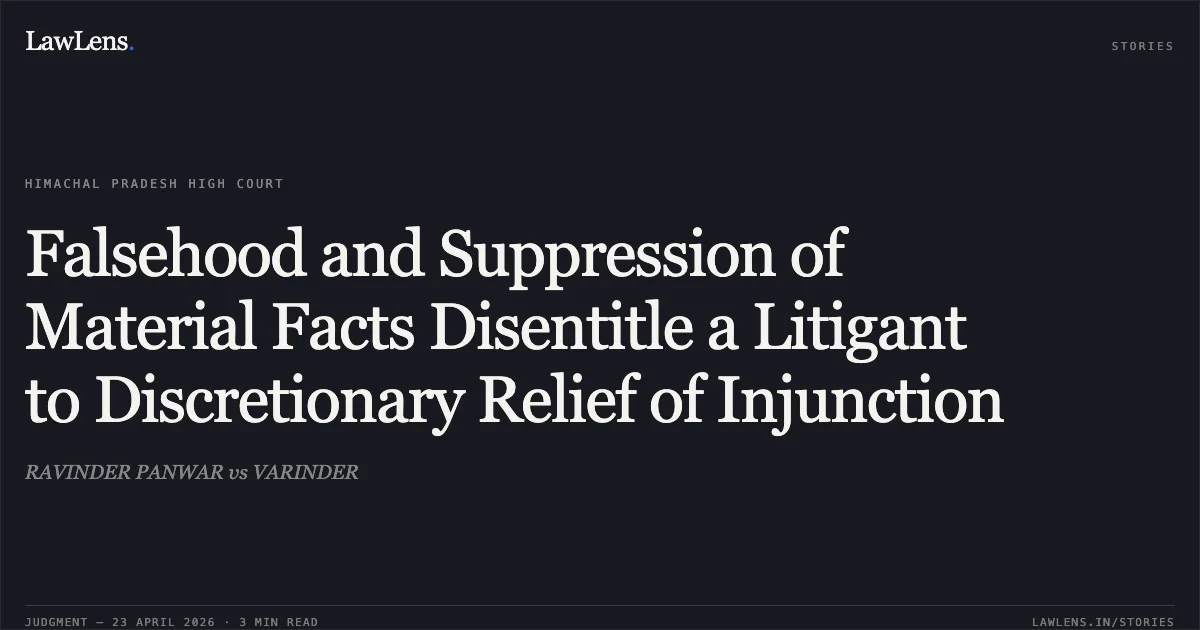
The High Court dismissed the appeal, holding that the lower courts correctly declined the discretionary relief of a mandatory injunction due to the plaintiff’s lack of clean hands and resort to falsehood.
The Court answered both substantial questions of law against the appellants, affirming that a demarcation report showing encroachment does not automatically entitle a dishonest litigant to a mandatory injunction. The judgments and decrees of the Trial Court and District judge were upheld.
Source reference: para. 23, 26Acts & Sections Cited
3 provisions across 1 statute referred to in this judgment. Each provision opens on LawLens.
Specific Relief Act, 19633
Original Court PDF
RAVINDER PANWARvsVARINDER
Click to open original judgment
Original judgment, available to read, download and summarize on LawLens.in