Facts
The petitioners were widows or family members of deceased work-charge/daily-wage employees of the State of Punjab. They sought family pension and consequential benefits by treating their deceased husbands’ services as regularised after completion of ten years, relying principally on the regularisation policies dated 7 May 1993 and 23 January 1995 and the decision in Beant Kaur v. State of Punjab.
Source reference: para. 1; p. 2They also sought compassionate appointment on the ground that their husbands had rendered substantial service before death.
Source reference: para. 1; p. 2The deceased employees were engaged between 1986 and 1990 and had rendered between approximately 12 and 16 years of service when they died. The relevant details were: Jagat Singh—appointed on 25 March 1986 and died on 5 December 2000; Achharjit Singh—appointed on 10 December 1988 and died on 6 August 2002; Pritam Singh—appointed on 1 December 1986 and died on 6 January 2003; and Mohinder Singh—appointed on 21 September 1990 and died on 24 November 2002.
Source reference: para. 7; pp. 4–5The writ petitions were filed after delays ranging from approximately one year to three years and three months.
Source reference: paras. 7–8; pp. 4–5The State opposed the petitions, contending that the employees had not completed ten years of service on the applicable cut-off dates of 31 August 1992 or 30 November 1994, were not selected for regularisation under the policy dated 23 January 2001 because of seniority and availability of sanctioned posts, and were therefore not entitled to pensionary benefits or compassionate appointment.
Source reference: para. 9; pp. 5–14The State further relied on its instructions dated 21 November 2002, under which compassionate appointment was not available in cases involving the death of a daily-wage employee.
Source reference: para. 9; pp. 5–14Issues
Whether the petitioners were entitled to family pension and other pensionary benefits despite the fact that their deceased husbands’ services had never been regularised?
Source reference: para. 6; p. 4Whether the deceased employees were entitled to regularisation under the Punjab Government policies dated 7 May 1993, 23 January 1995 or 23 January 2001, thereby enabling the petitioners to claim consequential benefits?
Source reference: paras. 3–4, 9–10; pp. 2–3, 5–14Whether the petitioners were entitled to compassionate appointment following the death of their husbands, who were engaged as daily-wage/work-charge employees?
Source reference: paras. 1, 4 and 10; pp. 2–3, 14–15Whether the writ petitions were liable to be dismissed on the grounds of delay and laches?
Source reference: paras. 7–8 and 11; pp. 4–5, 15Law Applied
The Court applied the Punjab Government regularisation policy dated 7 May 1993, under which daily wagers completing ten years of service as on 31 August 1992 could be considered for regularisation against available posts after screening.
Source reference: para. 9; pp. 5–7The cut-off date was extended by the policy dated 23 January 1995 to 30 November 1994, with regularisation subject to availability of posts and consideration by the Screening Review Committee.
Source reference: paras. 9–10; pp. 7–14The policy dated 23 January 2001 provided for consideration of daily wagers completing three years of service against regular sanctioned vacant posts, strictly according to category-wise seniority.
Source reference: paras. 9–10; pp. 8–14The Court also relied on the Punjab Government instructions dated 21 November 2002, which restricted compassionate appointment to eligible dependants of regular Government employees and excluded cases involving the death of a daily wager.
Source reference: paras. 9–10; pp. 5–14The Court followed the principles applied in Balwinder Kaur v. State of Punjab, including the subsequent decision in LPA-679-2015, and in Sudesh Kumari v. State of Punjab, CWP-12047-2021, decided on 7 September 2026.
Source reference: paras. 3 and 11–12; pp. 2–3, 15–16The earlier decision in Beant Kaur v. State of Punjab was relied upon by the petitioners but was not accepted as warranting relief on the facts of the present cases.
Source reference: para. 1; p. 2Reasoning
The Court held that the deceased employees did not satisfy the ten-year requirement on either 31 August 1992 or 30 November 1994, as required under the 1993 and 1995 policies.
Source reference: paras. 9–10; pp. 5–14Although they had continued in service for several years and had completed substantial service by the time of their deaths, eligibility under those policies depended upon completion of the prescribed service by the specified cut-off dates, together with availability of posts and screening.
Source reference: paras. 9–10; pp. 5–14The Court further accepted the State’s position that the 2001 policy did not confer automatic regularisation; consideration was subject to sanctioned vacant posts and category-wise seniority, and the petitioners’ husbands had not been shown to have been selected under that policy.
Source reference: para. 10; p. 15Since the deceased employees remained daily-wage/work-charge employees and were never regularised, the Court found no basis for extending regular-employee pensionary benefits or compassionate appointment under the applicable Government instructions.
Source reference: paras. 9–11; pp. 5–15The Court also considered the delay of approximately one to three years in filing the petitions and held that the claims were barred by delay and laches.
Source reference: paras. 7–8, 11; pp. 4–5, 15Holding
The Court answered the principal issue against the petitioners.
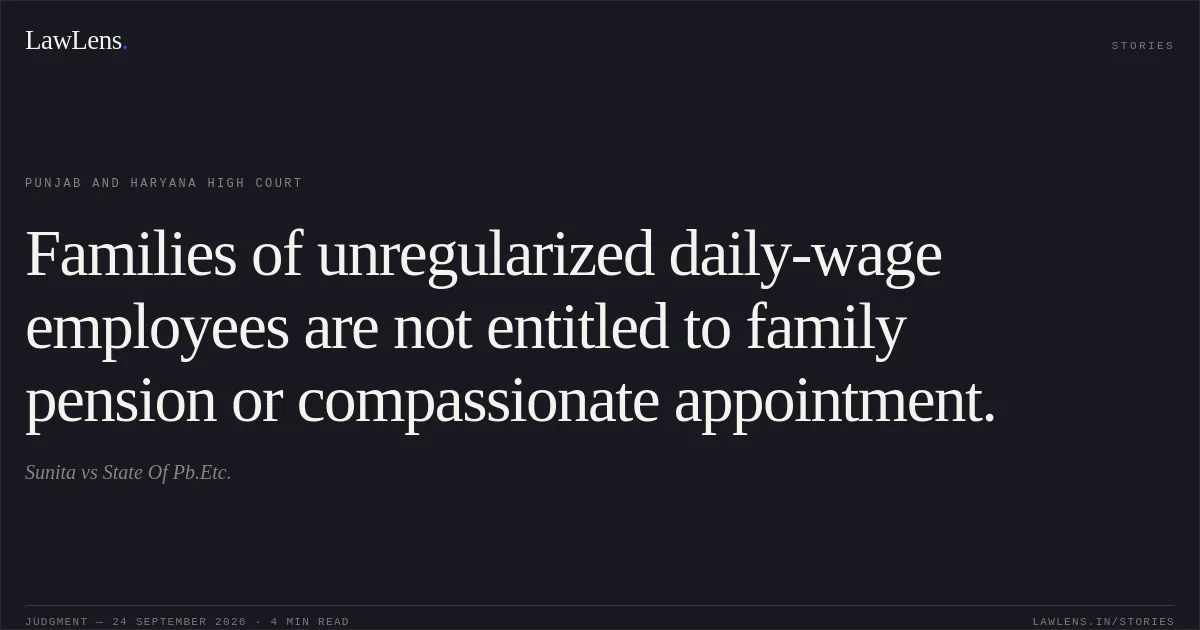
It held that the petitioners were not entitled to family pension, consequential pensionary benefits, or compassionate appointment because their deceased husbands had not been regularised and did not qualify for regularisation under the applicable policies.
Source reference: paras. 10–11; p. 15All four writ petitions—CWP-19021-2002, CWP-4572-2004, CWP-4602-2004 and CWP-5425-2004—were dismissed on merits as well as on the ground of delay and laches, in terms of Sudesh Kumari v. State of Punjab.
Source reference: para. 11; p. 15Pending applications, if any, were also disposed of.
Source reference: para. 13; p. 16Original Court PDF
SunitavsState Of Pb.Etc.
Click to open original judgment
Original judgment, available to read, download and summarize on LawLens.in